
Indiana’s New FAA Drone Test Site Opens, and a 33-Foot Autonomous Cargo Plane Flew First

November 4, 2026
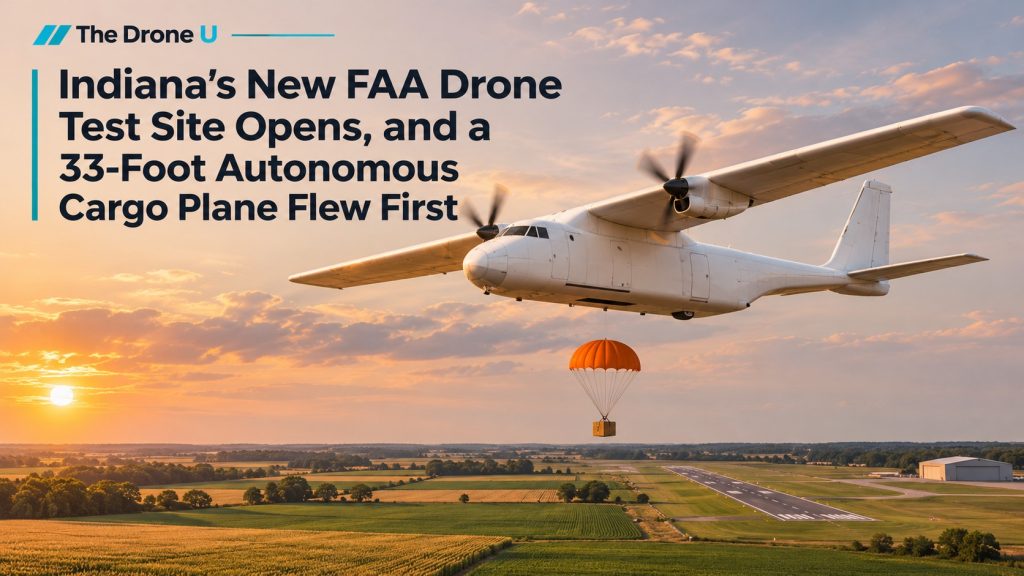
Indiana is officially open for drone testing. The Midwest UAS Test Site of Indiana, one of the nine FAA-designated uncrewed aircraft test sites in the country, held its ribbon cutting at Terre Haute Regional Airport on Thursday, October 29, and the first aircraft to fly beyond visual line of sight (BVLOS) in its new drone corridor was a 33-foot-wingspan autonomous cargo plane owned by Purdue University.
Windracers, the British company that builds that aircraft, announced the milestone on November 2. Its ULTRA flew more than 50 miles of the corridor, which the company describes as stretching over 200 miles, and it put on an autonomous parachute resupply demonstration for the crowd.
In January, the U.S. Department of Transportation and the FAA picked Indiana and a site run by the Choctaw Nation of Oklahoma as new UAS test sites, expanding the national program from seven to nine. The Indiana site is run by the Indiana Economic Development Corporation (IEDC) and the Bloomington-based Applied Research Institute (ARI). It joins long-running test sites in Alaska, New Mexico, Nevada, New York, North Dakota, Texas and Virginia.
According to the IEDC, the site works as a network of testing locations, airspace and technical partners rather than a single fenced-in range. With the launch, it is now accepting members and supporting flight-test operations, and it is open to everyone from startups and component suppliers to large aerospace and defense companies. Partners named by the state include Purdue University, Pierce Aerospace, Windracers, the Indiana National Guard and Naval Surface Warfare Center Crane. Terre Haute is one operational hub, and the state says more hubs will be announced in the coming months.
Gov. Mike Braun and U.S. Sen. Todd Young gave the keynote remarks. The state’s framing is heavily about defense and counter-drone work, but the FAA’s focus areas for the program also include agriculture, shipping, transportation and public safety. Inside INdiana Business reported that plans include a proposed 225-mile testing corridor linking West Lafayette and Terre Haute for longer-range flights such as package delivery.
The ULTRA is not a quadcopter. It is an aluminum-framed autonomous airplane with a three-bay drop door for releasing cargo in flight. Windracers lists a range of about 2,000 kilometers (1,242 miles), a payload of up to 200 kilograms (441 pounds) and up to 15 hours of endurance.
Purdue, which owns its own airport, plans to make its ULTRA available for test and evaluation work that matters to Indiana. The first use case named is dropping emergency supplies by parachute to communities cut off by seasonal flooding. “By providing a dedicated space where industry and academia can conduct large-scale R&D in a real-world environment, Indiana is accelerating the future of Advanced Air Mobility,” said Damon Lercel, an associate professor in Purdue’s School of Aviation and Transportation Technology.
This was the ULTRA’s second BVLOS flight in the U.S. In August, the same aircraft type flew 670 miles in Alaska with the University of Alaska Fairbanks’ Alaska Center for Unmanned Aircraft Systems Integration, testing whether anti-doping blood samples could survive long-distance transport.
The FAA is working toward a permanent rule for routine BVLOS operations, and the data that supports that kind of rule has to come from somewhere. Test sites let companies fly in real, shared airspace with an approved framework for research, experimentation and certification flights, instead of working one waiver at a time. A new site in the Midwest means manufacturers there no longer have to haul aircraft to Grand Forks, Las Cruces or Fairbanks to collect that data.
For most of us, a 441-pound cargo plane is not the next purchase. But the work that happens at test sites shapes the rules everyone flies under. Every BVLOS hour logged in Indiana feeds into the safety case for longer, more automated operations, which is where much of the paid drone work in agriculture, inspection, delivery and public safety is headed.
If you are in the Midwest, this is also a hiring signal. Test sites, universities and the companies flying there need certificated remote pilots, visual observers and people who understand airspace. That all starts with an FAA Part 107 certificate. Drone U’s Part 107 course prepares you for the knowledge test, and students have been known to finish the online course in three days and pass.
Sources: DroneLife; Windracers; Indiana Economic Development Corporation; The Bloomingtonian; Inside INdiana Business
 0