
Joby Expands U.S. Air Force Autonomy Contracts to Nearly $37 Million After Coast-to-Coast Tour

November 5, 2026
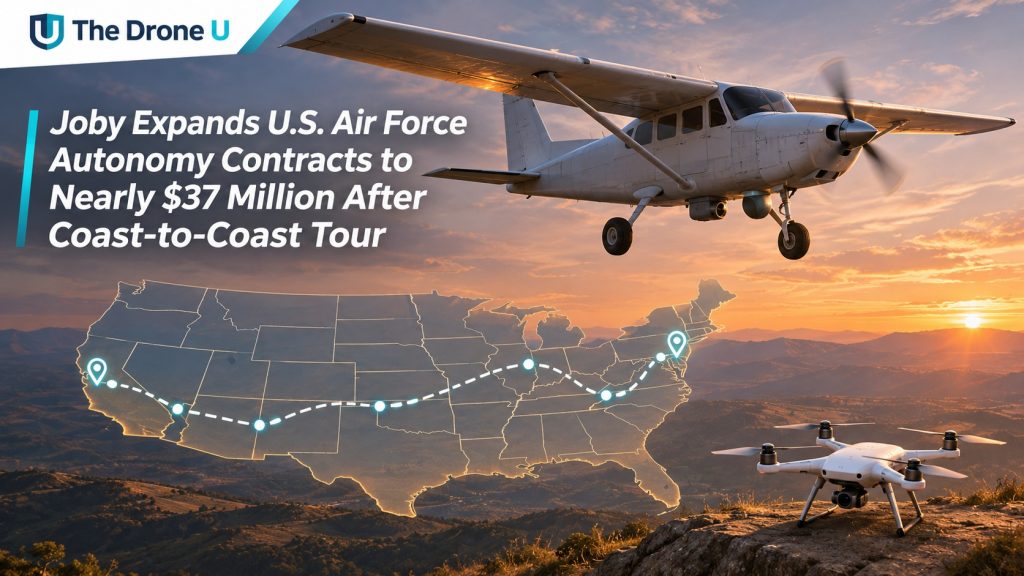
Joby Aviation says the U.S. Air Force has added funding that brings the service’s total commitment to Joby’s autonomous flight work to nearly $37 million and raises the ceiling on Joby’s operational testing contract to $50 million. The awards come through AFWERX, the Air Force innovation arm, and follow Joby’s record autonomous coast-to-coast tour in its J208 aircraft.
The company posted the news on November 4. HoverNews and other aviation outlets amplified the contract expansion the same day; the figures below are from Joby’s investor release.
According to Joby, the expanded agreements cover software integration and operational testing across two primary AFWERX contracts. The money is meant to keep developing Joby’s autonomy software and to expand Pacific operational testing as the Air Force pushes toward sustained autonomous logistics. AFWERX Contested Logistics Tactical Airlift Lead Kate Brown said the goal is sustaining cargo operations in contested environments while reducing risk to aircrews and saving crewed aircraft for missions that need them.
“This contract expansion is a powerful validation of the adaptability of Joby’s autonomy stack,” said JoeBen Bevirt, Joby’s founder and CEO. “We designed this system to be platform-agnostic, letting us quickly bring advanced autonomy to a wide range of high-utility aircraft.”
Joby says the expansion builds on its 2026 Electric Skies campaign, including what it calls the first autonomous flight across the United States. A Cessna Caravan fitted with Joby’s autonomy stack flew from Concord, California, to North Carolina’s Outer Banks with zero control inputs from the onboard safety pilot, the company said. The multi-leg tour covered 6,665 miles with landings in 11 states and integrated operations across 24 states, including fully autonomous taxi, takeoff, route navigation and landing under remote supervision from as far as 2,537 miles away.
Joby traces the stack to the autonomy technology it acquired with Xwing in 2024 and says the system has completed more than 400 fully autonomous flights. Earlier Pacific work included REFORPAC exercises in which an aircraft in Hawaii was operated remotely from Guam, nearly 4,000 miles away, and an Agile Flag demonstration that Joby says delivered critical parts 24 hours faster than conventional logistics. The new funding is aimed at follow-on Pacific exercises. Joby also noted its planned Resonant Sciences acquisition, expected to close early in 2027, as a way to deepen defense capabilities.
Best known for its piloted electric air taxi, Joby is pitching the same autonomy software for defense logistics, cargo and emergency response. The J208 tour also fed White House-backed eVTOL Integration Pilot Program work in Utah and North Carolina, where the company says autonomous routes for medical and logistics cargo will generate data for the FAA’s evolving autonomy frameworks.
Large autonomy contracts do not replace Part 107 work tomorrow, but they show where money and hiring are going: remote supervision, cargo logistics and dual-use software that has to share airspace with everyone else. The pilots who thrive in that world still need rock-solid regulatory fundamentals before they ever touch an experimental autonomy stack.
If you want to be ready when those programs look for certificated remote pilots and visual observers, start with the FAA knowledge test. Drone U’s Part 107 test prep course is built for that exam, and students have been known to take the online course in three days and pass.
Sources: Joby Aviation; HoverNews
 0