

Leaked DJI Mini 6 Pro Photos Surface. Here’s Our Spec Guesstimate vs the Mini 5 Pro

November 27, 2026
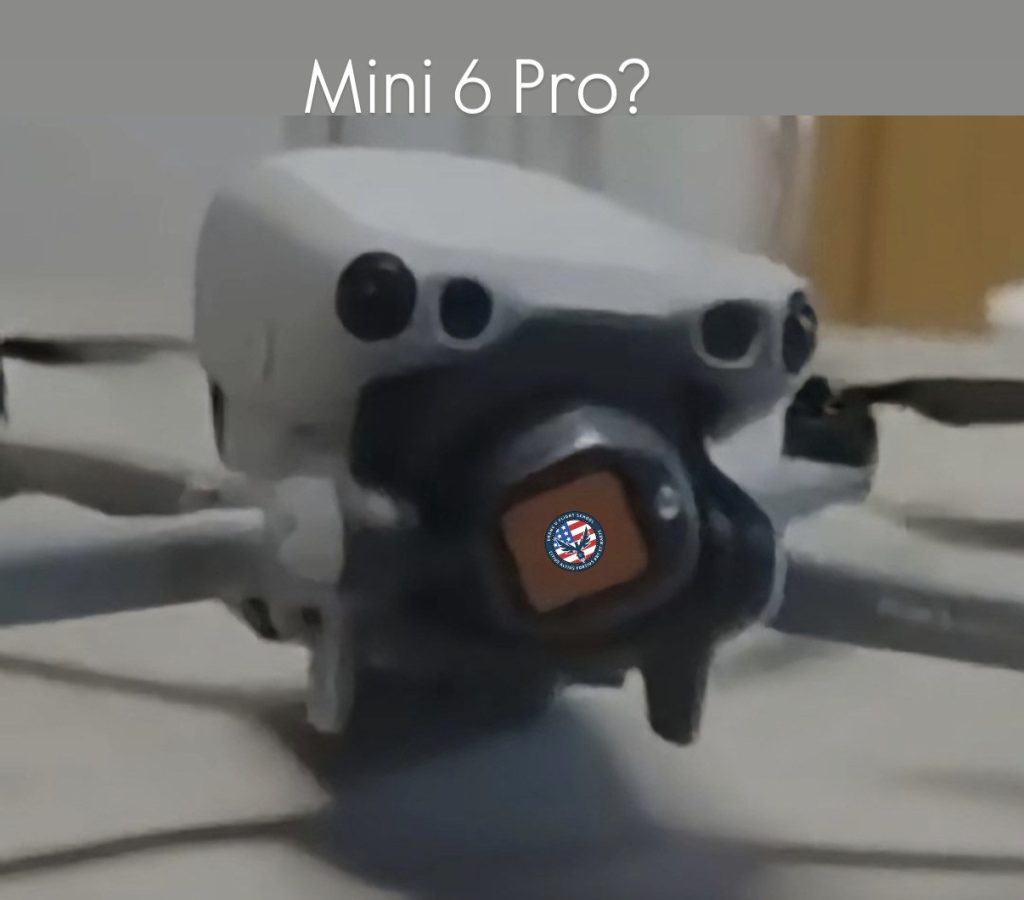
Photos circulating this week appear to show a DJI Mini 6 Pro, the unannounced follow-up to last year’s Mini 5 Pro. DJI has not confirmed the aircraft, published a spec sheet or set a release date. Treat everything below as informed speculation, not a product announcement.
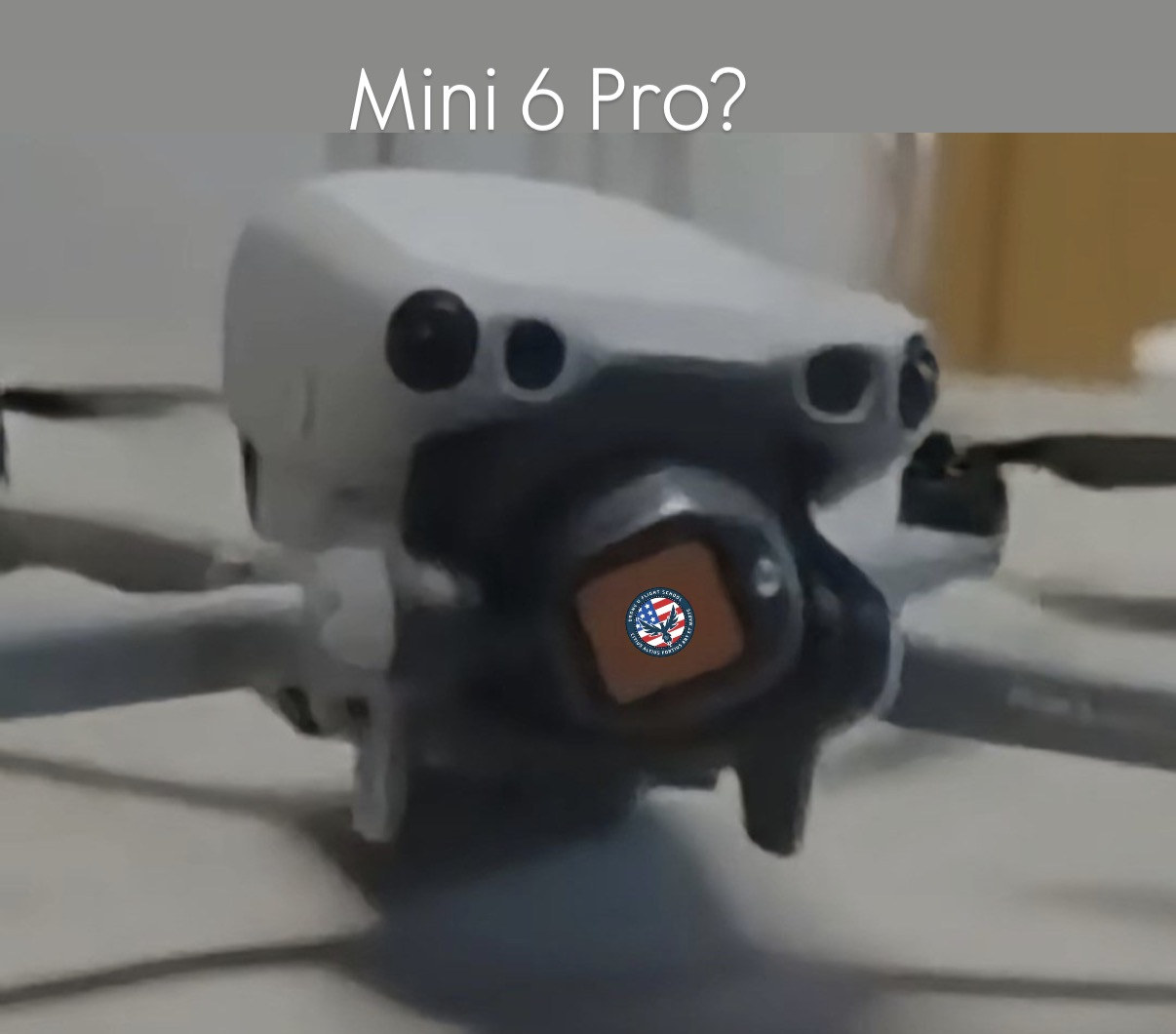
A close-up circulating this week of a leaked DJI Mini 6 Pro camera and gimbal, with a copper-colored cover over the lens. DJI has not confirmed the aircraft.
On Nov. 25, the account Xdrones Studio (@D2Help) posted a photo of packaging labeled DJI Mini 6 Pro, marked “For Service Only” and “Not For Sale,” which points to a service or sample unit rather than a retail box. The next day, the same account shared hands-on photos of a gray, Mini-style aircraft with a prominent camera module and a copper-colored square cover on the lens. Notebookcheck picked up the posts on Nov. 27 and said it could not independently verify the images.
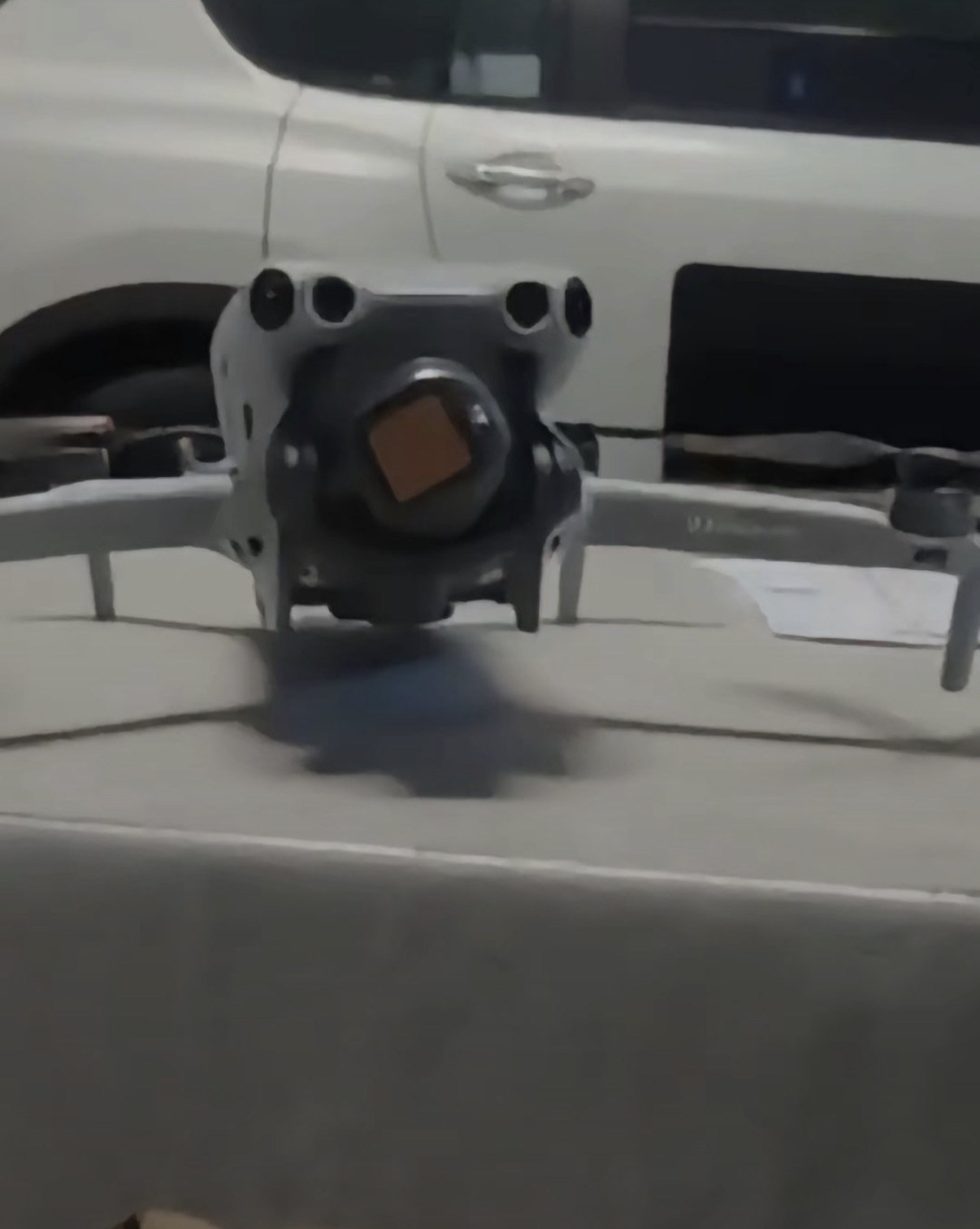
A leaked DJI Mini 6 Pro front view on a ledge, showing a Mini-style body, a large camera module and a copper-colored square cover on the lens, with a white car in the background.
The photos look a lot like a Mini 5 Pro at first glance: a compact foldable body, forward vision sensors clustered around a 3-axis gimbal, and that familiar Mini silhouette. The camera housing looks more prominent than the Mini 5 Pro’s, which is consistent with keeping a large 1-inch-class sensor in a still-tiny airframe. We cannot confirm these photos are authentic, and a larger-looking lens in a snapshot is not a spec sheet. No official FCC or CMIIT filing for a Mini 6 Pro has been cited in the coverage we reviewed, and DJI has not said a word.
Because no official Mini 6 Pro specifications exist, we went back to DJI’s own numbers for the last three Mini Pro generations and looked at what actually changed, gen over gen, on the official spec pages for the Mini 3 Pro, Mini 4 Pro and Mini 5 Pro.
The pattern is pretty consistent. The Mini 4 Pro (2023) kept the Mini 3 Pro’s 1/1.3-inch, 48 MP sensor and sub-249 g weight, then spent the generation on everything around the camera: omnidirectional obstacle sensing, O4 transmission out to 20 km (FCC), 10-bit D-Log M and HLG, 4K/60 HDR and 4K/100 slow motion. The Mini 5 Pro (September 2025) was the leap generation. DJI put a 1-inch, 50 MP sensor into a mini, bumped the airframe to about 249.9 g, added 4K/120 slow motion, 4K/60 HDR with up to 14 stops of dynamic range, O4+ transmission, 42 GB of internal storage, 225° gimbal rotation, and Nightscape omnidirectional sensing with a forward LiDAR unit.
If that cadence holds, a Mini 6 Pro is more likely to look like the Mini 4 Pro step than another Mini 5 Pro-style leap: keep the 1-inch sensor class, then push the recording pipeline, endurance and refinements. That is the basis for the estimates below, including 6K video as the most plausible new headline feature. Every Mini 6 Pro figure is a guesstimate.
Official DJI figures are in the first three columns. The Mini 6 Pro column is our estimate only.
| Spec | Mini 3 Pro (official) | Mini 4 Pro (official) | Mini 5 Pro (official) | Mini 6 Pro (estimated) |
|---|---|---|---|---|
| Image sensor | 1/1.3-inch CMOS, 48 MP | 1/1.3-inch CMOS, 48 MP | 1-inch CMOS, 50 MP | 1-inch CMOS, about 50 MP (refined; a stacked sensor is possible, not confirmed) |
| Lens | 24 mm equivalent, f/1.7, focus 1 m to infinity, 82.1° FOV | 24 mm equivalent, f/1.7, focus 1 m to infinity, 82.1° FOV | 24 mm equivalent, f/1.8, focus 0.5 m to infinity, 84° FOV; 48 mm med-tele mode | 24 mm-class prime, focus at least as close as 0.5 m; med-tele mode likely kept |
| Max photo size | 8,064 × 6,048 (48 MP) | 8,064 × 6,048 (48 MP) | 8,192 × 6,144 (50 MP) | About 50 MP, maybe a modest bump |
| Max video | 4K/60 | 4K/60 HDR; 4K/100 slow motion | 4K/60 HDR (up to 14 stops); 4K/120 slow motion (H.265) | 6K video (6K/30 the safer bet; 6K/60 is a stretch) |
| 4K high frame rate | 1080p/120 slow motion only | 4K/100 slow motion | 4K/120 slow motion | 4K/120 kept; 4K/120 HDR is the open question |
| 4K/60 HDR | 4K/30 HDR only | Yes, 4K/60 HDR | Yes, 4K/60 HDR, up to 14 stops | 4K/60 HDR? Likely yes; more dynamic range is unconfirmed |
| Color / bit depth | Normal and D-Cinelike; up to 150 Mbps | 10-bit D-Log M and HLG; up to 150 Mbps | 10-bit 4:2:0 H.265 (Normal 4K, HLG, D-Log M); up to 130 Mbps | 10-bit D-Log M and HLG kept; bitrate may rise if 6K lands |
| Takeoff weight | Under 249 g with the standard battery | Under 249 g with the standard battery | 249.9 g ± 4 g | About 249–255 g, still hugging the 250 g line |
| Max flight time | 34 min standard / 47 min Plus | 34 min standard / 45 min Plus | 36 min standard / 52 min Plus | About 38 min standard / about 54 min Plus |
| Max speed (S mode) | 16 m/s (about 36 mph) | 16 m/s (about 36 mph) | 18 m/s standard / 19 m/s Plus (about 40–43 mph) | About 18–20 m/s (40–45 mph) |
| Max wind resistance | 10.7 m/s (about 24 mph) | 10.7 m/s (about 24 mph) | 12 m/s (about 27 mph) | About 12–14 m/s (27–31 mph) |
| Transmission | O3, 12 km FCC, 1080p/30 live view | O4, 20 km FCC, 1080p/60 live view | O4+, 20 km FCC, 1080p/60 live view | O4+ or a modest refresh; still around 20 km FCC, 1080p/60 live view |
| Obstacle sensing | Forward, backward and downward | Omnidirectional binocular vision plus a downward 3D infrared sensor (lux > 15) | Nightscape omnidirectional sensing, forward LiDAR and a downward infrared sensor (lux > 1) | Improved nightscape omni plus LiDAR; evolutionary, not a new sensing class |
| Internal storage | None (microSD only) | 2 GB | 42 GB | About 42–64 GB, plus microSD |
| Gimbal | 3-axis; true vertical (90° roll) | 3-axis; true vertical (90° roll) | 3-axis; 225° flexible roll; ±0.005° angular vibration | 225° rotation likely kept |
Mini 3 Pro, Mini 4 Pro and Mini 5 Pro figures are from DJI’s official specifications. Mini 6 Pro figures are estimates only and are not a DJI announcement. Flight times are DJI’s lab maximums, not typical flight time.
Start with what is already official. The Mini 5 Pro is the first mini DJI rated with a 1-inch CMOS sensor and 50 MP stills. Putting a larger-than-1-inch sensor into a roughly 250 g aircraft would be a brutal packaging problem, so the most realistic Mini 6 Pro guesstimate is that the 1-inch class stays. The photos’ bulkier camera module fits that idea. Megapixel count barely moved from the Mini 3 Pro to the Mini 5 Pro (48 MP, then 48 MP, then 50 MP), so we would not bet on a huge jump. About 50 MP, maybe a modest increase, is the conservative read. A stacked 1-inch sensor is a rumor you will see elsewhere; we have no evidence for it.
Video is where a Mini 6 Pro can actually look better than a Mini 5 Pro. None of the last three Mini Pros records above 4K. After DJI spent the Mini 5 Pro generation getting a 1-inch sensor and 4K/120 slow motion into a mini, the clean next headline is resolution: 6K video. We would peg 6K/30 as the safer estimate. 6K/60 would be a bigger processing and heat ask in this size class, so treat that as a stretch, not a baseline.
4K/120 is already on the Mini 5 Pro as a slow-motion mode, encoded in H.265 only. A Mini 6 Pro almost certainly keeps it. The more interesting question is whether 4K/120 becomes more usable, for example with HDR, or as a standard recording mode instead of a slow-motion wrap. We are not treating 4K/120 as a new Mini 6 Pro feature. It is a carryover that might get better.
As for 4K/60 HDR, that is already standard on the Mini 4 Pro and Mini 5 Pro (the Mini 5 Pro is rated up to 14 stops). It should carry over. The open question, and the reason we leave a question mark on it, is whether a 6K pipeline also unlocks a stronger 4K/60 HDR mode, or even 4K/120 HDR. Until DJI publishes a spec sheet, 4K/60 HDR stays a “yes, probably, but how much better?” item, not a confirmed upgrade.
Standard-battery max flight time sat at 34 minutes for two generations, then moved to 36 minutes on the Mini 5 Pro. The Plus battery went 47 to 45 to 52 minutes. A small step to about 38 minutes standard and about 54 minutes with a Plus pack fits that curve. Do not expect a 60-minute standard battery in this weight class, and remember DJI’s published maximums are wind-tunnel figures, not what you will see on a real job.
Weight is the tightrope. DJI stayed under 249 g through the Mini 4 Pro, then accepted 249.9 g ± 4 g on the Mini 5 Pro to fit the 1-inch camera. A 6K pipeline and a slightly larger gimbal camera could add a few grams. Our guesstimate is still right around 249–255 g, marketed as a mini, with the usual warning that a Plus battery would push it heavier. If you fly in the United States, registration rules turn on the actual aircraft you have in your hands, not the marketing name.
Speed and wind followed the same “hold, then bump” pattern: 16 m/s and 10.7 m/s through the Mini 4 Pro, then 18–19 m/s and 12 m/s on the Mini 5 Pro. We would expect something in the 18–20 m/s and 12–14 m/s range, not a sport-drone rewrite. Transmission has already reached the 20 km FCC lab figure on O4 and O4+. A Mini 6 Pro is more likely to keep O4+ or a modest refresh at about the same advertised range, with 1080p/60 live view, than to jump to a 4K downlink in this category. Obstacle sensing already went from three-way, to omnidirectional, to Nightscape omni with forward LiDAR. The next step is refinement, not a new class of sensors.
Even if DJI does launch a Mini 6 Pro, U.S. pilots should not count on walking into a store and buying one. On Dec. 22, 2025, the FCC added foreign-produced uncrewed aircraft systems and certain critical components to its Covered List, implementing a national-security determination tied to the FY25 National Defense Authorization Act. The Commission’s own FAQ is blunt: new models of covered equipment cannot receive FCC equipment authorization, and equipment that lacks that authorization is prohibited from being imported, marketed or sold in the United States. Previously authorized models can still be sold and used. A brand-new Mini 6 Pro would be a new model, so it is very unlikely to be sold by U.S. retailers.
Units may still show up on eBay and other gray-market listings through imports from countries where DJI can sell the aircraft. Whether buying, importing or operating one of those drones is legal in the United States is unclear, and you should not assume it is. An aircraft without FCC authorization is not just a paperwork problem. Most radio transmitters need authorization before they can be marketed or operated here, and a gray-market drone may also lack a working U.S. Remote ID implementation. If you fly in U.S. airspace, Remote ID is still required on the aircraft you actually take off, through built-in broadcast or a standard add-on module. If you fly for work, you still need a Part 107 certificate. Drone U’s Part 107 course is built so you can prep in 3 days and pass the FAA knowledge test.
None of this is a reason to rush out for an unannounced, unconfirmed aircraft. The Mini 5 Pro remains the current mini to learn and fly, and it is the model U.S. retailers were able to sell because it launched, and was authorized, before the December 2025 Covered List update.
Get the most out of the Mini 5 Pro with The Drone U’s Mini 5 Pro Don’t Crash course, which covers setup, camera settings, ND filters, 4K/120 slow motion, rolling hyperlapses and the preflight habits that keep the aircraft in one piece.
Sources: Xdrones Studio (@D2Help), Nov. 25, 2026; Xdrones Studio (@D2Help), Nov. 26, 2026; Notebookcheck (Alex Alderson, Nov. 27, 2026); DJI Mini 3 Pro official specs; DJI Mini 4 Pro official specs; DJI Mini 5 Pro official specs; DJI Mini 5 Pro announcement (PR Newswire, Sept. 17, 2025); FCC Covered List FAQs: UAS and UAS Critical Components; FCC Covered List.
 0