
Learn to Fly a Drone if You Want a Flying Car
July 11, 2025
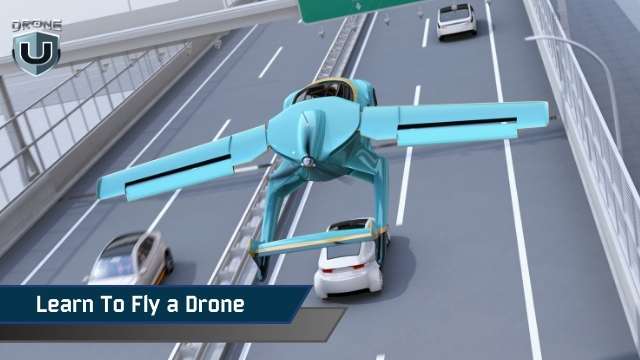
Flying cars are no longer science fiction. If you know how to fly a drone, you’re closer to flying one.
Companies like Joby Aviation, Archer, Beta Technologies, and international players like Jetson and EHang are actively working to make personal flying vehicles a reality.
What’s surprising is that the skills required to fly these vehicles have much in common with flying a drone.
Learning to fly a drone can be one of the smartest steps you can take today, as it helps prepare you to operate a flying car in the future. The controls, coordination, and spatial awareness you build flying a drone are essentially the same skills you’ll need to ride an electric Vertical Take-Off and Landing aircraft (eVTOLs).
In this article, we’ll explore how drone flight prepares you to pilot a flying car. You’ll learn how motion controllers bridge the gap between drones and flying cars, and why drone training could be your launchpad into the skies.
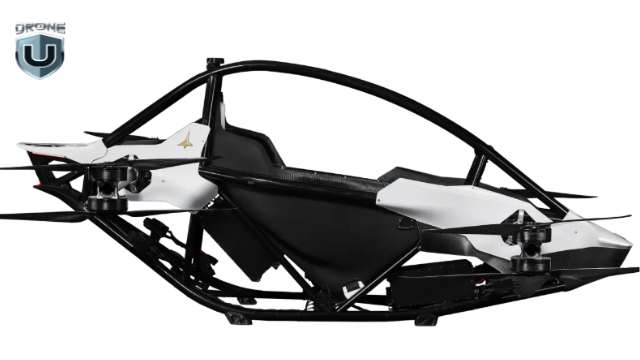
Jetson One- a Personal eVTOL
The Jetson One is one such example of a personal eVTOL that flies like a drone. It operates with eight electric motors and can reach speeds of 63 mph with a flight time of 20 minutes.
It uses a simple joystick system with drone-style stabilization. Pilots typically require only a few hours of basic flight training.
But here’s the reality: even with built-in automation, you still need fundamental piloting skills. You need to understand:
These aviation skills develop the muscle memory and mindset required to fly something larger, more expensive, and potentially passenger-carrying flying cars.
However, the stakes are entirely different. A crashed drone might cost $500, but a failed eVTOL could result in injury or death. So, understanding the basic concepts of drone piloting is non-negotiable.
What these aircraft have in common is that they’re designed for people who already understand drone flight. But that doesn’t mean anyone can hop on and start flying.
Some lightweight, single-seat models, like the Jetson One, fall under the FAA’s ultralight rules. They don’t require a pilot’s license as long as they meet the speed and fuel limits.
However, most passenger-carrying flying cars are considered powered-lift aircraft, which is a new category that the FAA is developing. These aircraft don’t fit into the current helicopter or airplane category.
The new certification framework is expected to be introduced later this year. This training is built on rotorcraft experience and adds eVTOL-specific systems, urban flight planning, and traffic integration.
Learn Drone Controls to Learn eVTOL
Understanding drone flight controls gives you a sneak peek into how you can fly a personal aircraft. When you learn to fly a drone, you’re training on the same core principles. The way drones move through the air is surprisingly similar to how flying cars are designed to move.
Let’s explore what drone flights teach you.
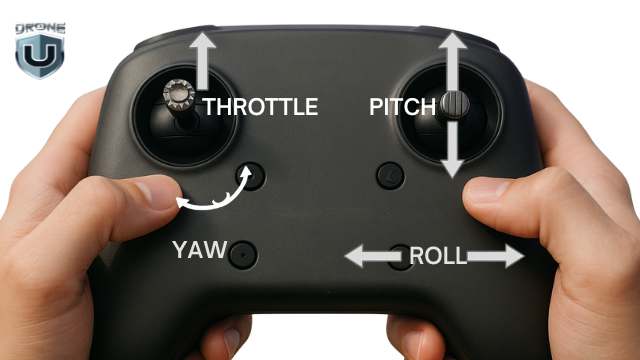
Most drones, especially quadcopters, are controlled with a two-stick transmitter, which maps directly to the four axes of motion used by eVTOLs and helicopters.
Pitch controls forward and backward movement. When you push the right stick forward on your drone controller, the aircraft tilts forward and moves ahead. In a flying car, this accelerates you forward through three-dimensional space.
Roll manages side-to-side movement. Banking left or right with your drone using the right stick translates directly to shifting sideways maneuvers in an eVTOL. This is perhaps the most intuitive control for new pilots to master.
Yaw rotates the aircraft around its vertical axis. It is controlled by the horizontal movement of the left stick. In a flying car, this lets you change your heading without banking. This helps in navigating the eVTOLs in tight urban environments.
Throttle controls altitude through the vertical movement of the left stick. This is where drone pilots have a huge advantage over traditional pilots. Drone pilots are used to controlling altitude directly, without needing the complex parts planes use, like flaps or engines.
The beauty of these controls is their universality. Whether you’re flying a $500 DJI Mini or a $250,000 Jetson One, the fundamental inputs remain the same.
Flying a drone is not like playing a video game because your environment is real, dynamic, and often unpredictable. As a drone pilot, you develop real-world instincts, such as judging height and distance, avoiding obstacles, adjusting flight patterns, and carefully managing battery life.
Your muscle memory, spatial awareness, and intuitive understanding of three-dimensional movement transfer directly to more advanced aerial systems, including flying cars. These best practices train you to think like a pilot, not a casual user.
You also become familiar with advanced drone features, such as obstacle avoidance, GPS hold, and return-to-home functions, which are also standard in eVTOLs. The more you understand these core systems, the more confident and capable you’ll be when operating a flying car.
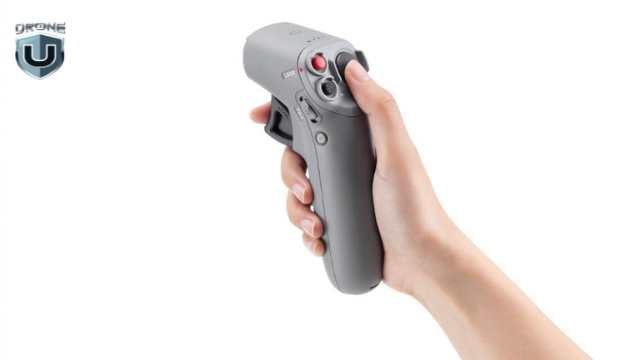
DJI Motion Controller
DJI’s Motion Controller represents the evolutionary leap from traditional dual-stick controllers to intuitive flight interfaces. This device lets you control a drone through natural hand movements. It shows how complex flight operations can be simplified into intuitive gestures.
The Jetson One uses a simplified joystick that operates on the same principles as the Motion Controller. The goal is to make flying as intuitive as driving by using the Motion controller.
Training with both traditional controllers and motion controllers gives you the complete skill set. Even gesture-based flying becomes easier when you’ve already learned to fly a drone with traditional controls. Traditional controllers teach precision and technical proficiency, while motion controllers help develop the intuitive spatial awareness that makes flying feel natural rather than mechanical.
Learn to fly a Drone and get FAA Pilot Certificate
To turn your drone skills into future aviation roles, you need certification. This is where drone licensing comes in.
In most countries, drones are treated as real aircraft, and to fly one, pilots must follow the aviation rules. A drone license is a certificate that says you’re trained and trusted to fly drones safely and responsibly under government rules.
For example, in the U.S., you need the FAA part 107 Remote Pilot certificate to fly a drone for commercial purposes. To qualify, you must be at least 16 years old and pass a 60-question knowledge exam at an FAA-approved center.
Once you pass, you’ll receive a Remote Pilot Certificate, which must be kept current through free online recurrent training every 24 months.
Once you’re certified, you can keep growing your skills in specialized areas like thermal imaging & inspections, aerial mapping & photogrammetry, drone cinematography, and so on. Each of these areas has its own certifications, software, and best practices.
So, if you’re serious about aviation, start by getting certified. Learn to fly a drone today with real training and safety skills.
While each country has its specifics, most drone rules worldwide share a few basics:
| Rule | Why It Matters |
| Stay below 400 feet (120 meters) | To avoid conflict with manned aircraft |
| Keep a visual line of sight | So you always know where your drone is and can react quickly |
| Avoid flying over people | For safety in case of malfunction or crash |
| Register your drone | Helps authorities track usage and ensure compliance |
| No flying near airports or military zones | These are high-risk, high-security zones |
Always check your local aviation authority (FAA, DGCA, EASA, CASA, etc.) for region-specific updates.
Regulators are updating drone and aviation rules to include eVTOLs as the flying car industry grows.
For example:
The FAA classifies eVTOLs as powered-lift aircraft and will be treated as a cross between helicopters and planes. Pilot licensing for flying cars now requires advanced certification, built specifically for drones or rotorcraft.
Companies like Joby Aviation, Archer, and Volocopter are working closely with regulators to define safe air corridors, digital traffic systems (UTMs), and vertiport access.
In short, drone pilots who understand the basics and rules will be well-equipped for the more complex airspace of tomorrow.
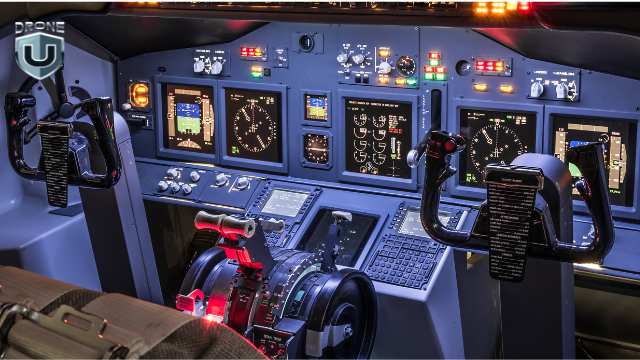
Learn to fly a Drone with Flight Simulator Software
Imagine a comprehensive training program that bridges the gap between today’s drones and tomorrow’s eVTOLs. This is the logical next step for flight training institutions.
Students begin with flight simulator software that replicates both drone and eVTOL physics. Microsoft Flight Simulator 2024 now features eVTOL aircraft, giving students a fun and realistic way to explore vehicles like the Joby S4 and Lilium Jet.
Students start with hands-on training using professional-grade drones, learning basic flight operations before advancing to complex maneuvers. They master line-of-sight flying, FPV operations, and advanced flight modes. The goal is to develop muscle memory and spatial awareness through real flying rather than just technical knowledge.
Training with DJI Motion Controllers or similar devices to develop intuitive flight control. Students learn to fly through gesture and natural movement. This module focuses on preparing students for the simplified control systems of consumer eVTOLs.
Students engage in real-world scenarios where drones are used to simulate flying car operations. This includes urban navigation, emergency procedures, weather considerations, and integration with air traffic systems. This approach bridges the gap between hobby flying and practical transportation use.
Students gain a clear understanding of the evolving regulations surrounding personal aviation and the integration of eVTOLs into existing airspace. Training also covers safety protocols and emergency procedures specific to electric aircraft, as well as the challenges of urban flight operations.
The course prepares students to go beyond drone piloting, but as strong candidates for early eVTOL training programs. As eVTOLs become commercially available, graduates would need minimal additional training to make the transition to personal air mobility.
The Advanced Air Mobility market is projected to reach $1 trillion by 2040. This means thousands of new jobs for skilled pilots, instructors, technicians, and airspace managers. All the roles that didn’t exist a decade ago.
eVTOL manufacturers are designing their aircraft and training programs specifically for people with drone experience.
Major companies like Joby Aviation, Archer, and even Uber, through their former Elevate division, have already developed eVTOL training programs that prioritize drone skills. These programs teach experienced drone pilots the extra skills they need to fly passengers and handle commercial flights.
While becoming a commercial airplane pilot can take years and cost over $100,000, many drone pilots could transition into eVTOL flight with minimal extra training.
Starting now means you won’t need to start from the basics all over again. You’ll already have the flight experience and mindset that tomorrow’s aviation industry requires.
Drone flight is not just a hobby; it’s the foundation for real aviation skills. The same companies pioneering consumer drones are creating the flying cars of tomorrow. They’re designing these aircraft specifically for people who already understand drone operations.
So, the question isn’t whether flying cars will become a reality, because they already are. The question is whether you’ll be ready when they arrive. By starting with drones today, you’re positioning yourself at the forefront of a transportation revolution that will define the next century.
The future of flight starts with the technology in your hands today. When you learn to fly a drone, you’re not only gaining a new skill, you’re preparing for a new era of personal air travel. Every lesson learned with a drone brings you one step closer to piloting the aircraft of the future.
Ready to start your journey into the future of flight?
Explore Drone courses or an all-access pass to start building the skills that future aviation requires.
 4
4