

Neros Lands a $450 Million Pentagon Loan Commitment to Build Drones and Their Parts in America

November 3, 2026
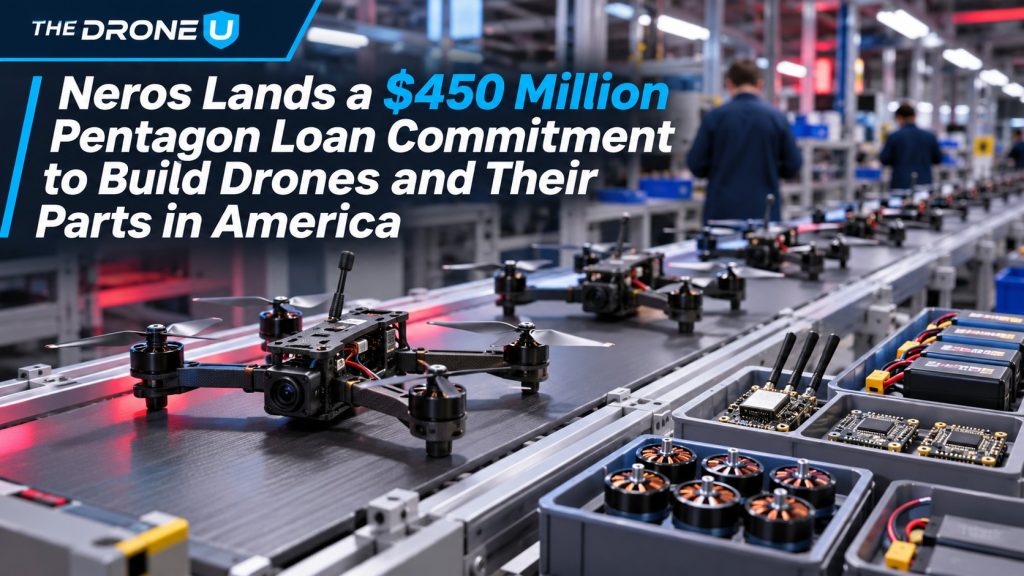
Neros, the Southern California company that has become one of the largest builders of FPV drones in the United States, says the Pentagon is ready to lend it up to $450 million. The company announced the deal on X and on its website Monday, November 2, and the Department of War’s Office of Strategic Capital (OSC) confirmed it the same day.
Neros is putting in $165 million of its own equity, which brings the total project to $615 million. The goal is to build more complete drones in the U.S. and, just as important, more of the parts inside them.
According to the OSC announcement, the financing will support Neros’ plans for vertically integrated manufacturing. That means producing dual-use small drone platforms, ground control systems and key components in-house. The list includes motors, radios, flight electronics, sensors and batteries.
The work centers on Neros’ factory in Torrance, California. OSC says the plant will onshore propulsion motors, flight stacks, radios and thermal sensors. It will also sell NDAA-compliant components to other U.S. and allied drone makers, not just supply Neros’ own production lines.
OSC Director David A. Lorch said Neros has already shown it can design, build and deliver capable small drones, and that the loan will speed up its production of drones and the components they need.
Neros co-founder and CEO Soren Monroe-Anderson set an even bigger target. In the company’s release, he said the capital puts Neros on the path to building one million drones per year by 2028.
This is a conditional commitment, not a check that has cleared. OSC says Neros still has to meet a list of financial, legal, technical, investment and due diligence requirements before the loan reaches financial close. Neither side has published an interest rate, term or disbursement schedule.
Neros’ X post reflects that nuance. An earlier version of the post described the deal simply as a “$450M loan.” The company later edited it to say “conditional loan commitment.”
There is also an equity angle. The version of the announcement on Neros’ own website says the deal gives the American taxpayer an ownership stake in the company. Defense Daily reported that the government will take an equity stake that Neros described as “small.” The OSC release itself describes only a conditional loan alongside private capital, and nobody has disclosed what form the stake takes or how large it is.
This is OSC’s second large drone-industry commitment this year. On July 31, the office announced a conditional commitment of up to $820 million to Performance Drone Works in Huntsville, Alabama, to mass-produce drone components. At the time, Lorch said several domestic component makers would receive OSC loan commitments. Both deals are tied to Executive Order 14307, “Unleashing American Drone Dominance.”
Neros has been growing fast. In August, it announced a $250 million Series C at a $2.5 billion valuation. On September 30, it announced an order for 14,000 drones and explosive payloads, valued at more than $100 million, through the Pentagon’s Drone Dominance Gauntlet II. That order centers on its Archer FPV family, including the autonomy-enabled 10-inch Archer AI and a smaller 5-inch version built for close-quarters work.
The headline is military, but the motors, radios, flight controllers and batteries in this plan are the same kinds of parts that commercial and hobby pilots buy. Right now, most of that supply chain runs through China, at a time when U.S. rules on Chinese drone hardware keep tightening. If Torrance actually ends up selling NDAA-compliant components to other manufacturers, that could eventually mean more domestic options for enterprise fleets, public safety programs and FPV builders. It is a promise for now, not a product line, so watch whether the loan reaches financial close.
It is also a reminder of how valuable FPV skill has become. On the civilian side, smooth stick control and calm decisions in goggles pay for real estate and commercial fly-through tours, event coverage and social media content. Drone U’s fly-through drone tours class shows how to turn that skill into paid work.
Before you take any paying job, you need an FAA Part 107 certificate. Drone U’s Part 107 course prepares you for the knowledge test, and students have been known to complete the online course in three days and pass. Remember that civilian FPV flying still has to meet the FAA’s visual line of sight rules, which usually means a visual observer standing beside you.
Sources: Neros on X; Neros; Neros (PR Newswire); U.S. Department of War; Defense Daily; U.S. Department of War (PDW release); Neros Gauntlet II release (PR Newswire)
 0
