
Nomadic Raises $6 Million for Drones That Land on Live Power Lines and Charge From Them

November 20, 2026
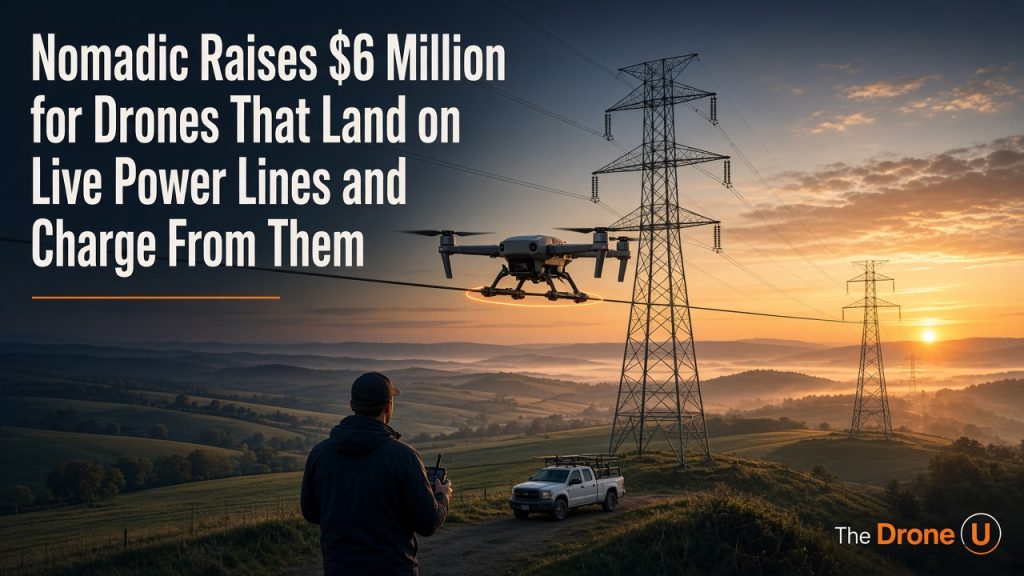
Most utility drones fly a line, grab imagery and head home to swap batteries. Munich startup Nomadic is betting on a different model: drones that land on a live high-voltage conductor, stay there and charge themselves from the line. The company has closed a $6 million seed round to put more of them on power grids in Europe and the United States.
Berlin-based venture firm Foundamental led the round, announced Nov. 17. Verve Ventures and Cyan Ventures joined as new investors, alongside existing backers Outlander VC and Asia2G Capital and angel investors from the sdw alumni network. DroneLife covered the raise on Nov. 19.
Nomadic’s drones, called NOMADs, weigh about 4 kilograms (8.8 pounds). A utility’s own drone pilot carries the unit to the site and flies it onto an energized conductor, with no planned outage required. Once it’s attached, the drone harvests power inductively from the magnetic field around the wire, so it doesn’t need to come down for a battery change.
Key figures from the company:
The system is running on German transmission and distribution grids and has been deployed in Norway and the United States. Nomadic says it began putting prototypes on German distribution lines about a year ago, and it built its own test grid with real conductors and high currents so every hardware version is tested before it reaches a customer.
Demand from data centers, renewable projects and industry is outpacing how fast new transmission lines can be permitted and built. That pushes utilities to squeeze more capacity out of the lines they already have. The catch is that a line’s safe limit is often set by its weakest span, and conditions such as aging hardware, connections and local weather vary from one section to the next.
Nomadic’s software, Nomadic OS, combines the drone measurements with weather models, grid models and historical line data to show operators what’s happening between substations. CEO and co-founder Andreas Moldskred said in remarks quoted by DroneLife that operators usually have a good view at each substation, but the kilometers of line in between have been much harder to see because installing anything on a live line is so difficult.
CTO and co-founder Lauritz Weil described landing on a 420 kV line in wind and subfreezing cold, then running on power from the field around it, as a hard robotics problem.
Nomadic plans to spend the money on expanding its fleet with more utility customers in Europe and the U.S. and growing its Munich team. It also expects to bring remote relocation into production with customers in 2027. That feature would let a drone move itself from one section of line to another, directed from an operator’s office instead of by a pilot on site. The company was founded in 2024 at the University of California, Berkeley, by Moldskred and Weil and is now headquartered in Munich.
Utility work is already one of the steadiest sources of commercial drone jobs, and this model still puts a pilot in the loop for installation. In the U.S., a crew flying a drone onto an energized line is flying a commercial operation, which means a Part 107 remote pilot certificate, a registered aircraft and a careful look at airspace before every flight. Power-line corridors often run near airports and through controlled airspace, so LAANC authorizations and NOTAM checks are part of the job.
The remote-relocation feature points to where utility drone work is heading: longer, more autonomous operations that will eventually depend on beyond-visual-line-of-sight approvals and the FAA’s proposed Part 108. Pilots who already understand inspection workflows and the regulations are best placed to run those programs. If you’re aiming for utility or infrastructure work, Drone U’s Part 107 course is the place to start. For another look at where autonomous inspection is going, see our story on Percepto’s Axion inspection AI.
Sources: DroneLife (Miriam McNabb, Nov. 19, 2026); Foundamental announcement (Nov. 17, 2026); Tech.eu.
 0