
FAA Suspension Over Drone Deer Lifts: Where Part 137 and the 55-Pound Line Stop

October 19, 2026
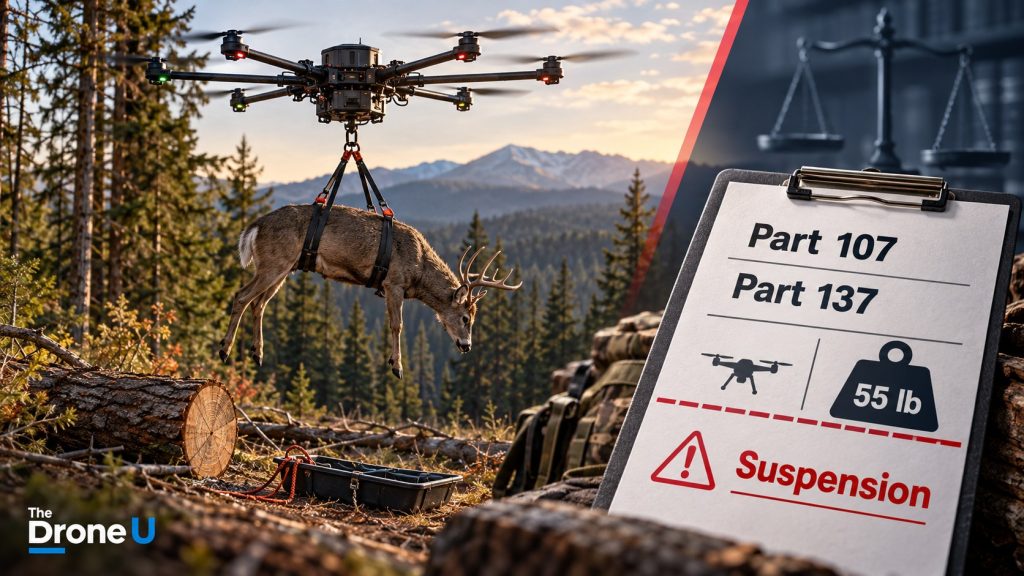
A heavy-lift drone hauling a deer carcass out of the woods makes for great YouTube. It also, it turns out, makes for an FAA enforcement case. Mike Yoder, co-owner of Ohio agricultural drone company nuWay Ag, says he has agreed to a 180-day suspension of his remote pilot certificate after the FAA investigated three of his own videos: a drone lifting a deer carcass, one lifting logs on a tree job, and one towing a person on a sled.
Yoder announced the settlement in an October 13 video and expects his certificate back around April 2027. One important caveat up front: nearly everything public about this case comes from Yoder’s own account, as reported by DroneXL. The FAA’s enforcement documents aren’t public, and the agency’s side hasn’t been reported.
Drones over 55 pounds can’t fly under Part 107. Ag operators flying big spray rigs typically work under an FAA exemption plus a Part 137 agricultural aircraft operator certificate. That’s where the trouble starts.
Under 14 CFR 137.3, an agricultural aircraft operation means flying for one of three purposes:
Every branch is about dispensing. A deer carcass, a log or a sled isn’t being dispensed, no matter how agricultural the setting feels. Think of it like a commercial driver’s endorsement: a tanker endorsement doesn’t cover hauling passengers just because it’s the same truck.
By his account, as reported by DroneXL:
Treat those details as one side of the story until the FAA’s record says otherwise.
This part is worth understanding even if you never touch a 55-pound drone. Under 14 CFR 107.12, nobody can act as remote pilot in command (RPIC) without a valid remote pilot certificate. A person without one may still manipulate the controls of a small drone, but only under the direct supervision of a certificated RPIC who can immediately take over. So a suspended pilot can still be on the sticks with a qualified RPIC standing by—but can’t be the one in charge, and can’t supervise anyone else.
Knowing exactly where Part 107 starts and stops is the foundation for every commercial job. Our Part 107 course covers certificate requirements, RPIC responsibilities and the limits that keep you out of situations like this one.
There’s a real policy gap here. Heavy-lift drones can clearly do useful farm and rescue work that doesn’t fit Part 137 or Part 107, and by Yoder’s account the FAA had no clear answer for how to authorize it. That’s a fair criticism. But the FAA read its own definition correctly—and posting the flights publicly after being told they didn’t fit made enforcement close to inevitable. Until the rules catch up, assume the gap is a no-fly zone.
Sources: DroneXL; UASFeed; 14 CFR 137.3 (eCFR); 14 CFR 107.12 (eCFR)
 0