QUICK ANSWER
Why Do Most Pilots Fail the Part 107 Test?
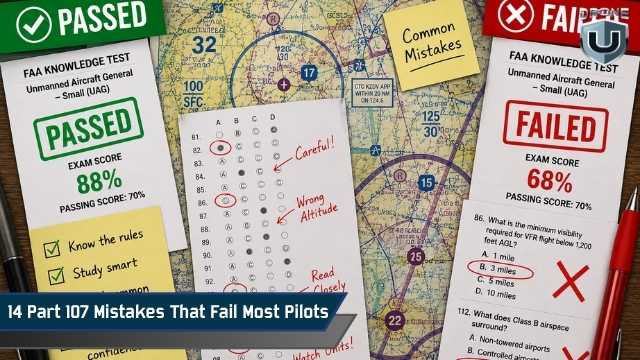
Most Part 107 test mistakes happen for two reasons. Many applicants memorize answers instead of learning the underlying rules. Others lose points on sectional charts and weather questions because these topics require true understanding.
In 2025, only 82.96% of test takers passed, with an average score of 79.31% — roughly 1 in 6 walk out without a certificate (FAA CY2025 AKT Volume Report).
Want to practice first? Try our Part 107 Practice Test before exam day. |
You studied. You felt ready. Then you walked out of the testing center without a passing score.
In 2025, 1 in 6 pilots failed the Part 107 exam. Most did not fail because the test was too difficult. They failed because they made avoidable mistakes before and during the exam.
This guide covers 14 common mistakes that catch applicants off guard on test day and shows you how to avoid them before you sit for the exam.
What Is the Part 107 Test?
The FAA Part 107 Remote Pilot Certificate is the license required to fly drones commercially in the US. To earn it, you must pass the Unmanned Aircraft General – Small (UAG) Knowledge Test.
- 60 questions, multiple choice
- 2-hour time limit
- Passing score: 70% (42 out of 60 correct)
- Cost: $175, paid to the testing center
- ~700 testing locations nationwide (FAA)
This is not a memorization test. The FAA tests whether you can apply rules in new situations. Every exam pulls randomly from a large question bank. Some questions will look nothing like your study materials (FAA Remote Pilot Study Guide).
How Hard Is the Part 107 Test?
Pass rates have been falling every year.
| Year |
Test Takers |
Pass Rate |
Average Score |
| 2020 |
~40,000 |
~91% |
~82% |
| 2024 |
67,576 |
84.20% |
79.95% |
| 2025 |
73,914 |
82.96% |
79.31% |
Source: FAA CY2025 AKT Volume Report | FAA CY2024 AKT Volume Report
The overall FAA Knowledge Test pass rate in 2025 was 89.56%. Drone pilots score lower than every other group.
The 14 Most Common Part 107 Test Mistakes
| # |
Mistake |
Category |
| 1 |
Not reading the full question and all answer choices |
Test-taking |
| 2 |
Moving too fast through the exam |
Test-taking |
| 3 |
Not flagging hard questions to return to later |
Test-taking |
| 4 |
Picking the first defensible answer instead of the best one |
Test-taking |
| 5 |
Ignoring the test supplement booklet and its legend |
Test-taking |
| 6 |
Confusing AGL and MSL altitude references |
Knowledge |
| 7 |
Misreading sectional charts |
Knowledge |
| 8 |
Struggling to decode METARs and TAFs |
Knowledge |
| 9 |
Getting density altitude wrong |
Knowledge |
| 10 |
Mixing up thunderstorm lifecycle stages |
Knowledge |
| 11 |
Misreading airport traffic patterns and runway headings |
Knowledge |
| 12 |
Confusing Military Training Routes and Special Use Airspace |
Knowledge |
| 13 |
Underestimating VLOS and operational limitation questions |
Knowledge |
| 14 |
Getting confused by CRM and emergency procedure questions |
Knowledge |
First, let’s start with test-making mistakes.
Part 107 Test-Day Mistakes That Cost Easy Points
These mistakes have nothing to do with knowledge. These are errors in how you take the test, and they cost points on questions you already know.
Mistake #1: Not Reading the Full Question
The FAA puts traps in the answer choices. Consider this example:
The ceiling of Class D airspace at Napa County Airport is:
A) 2,500 ft. AGL
B) 2,500 ft. MSL
C) 2,499 ft. MSL
Both A and B say 2,500 feet. The difference is AGL vs. MSL. Class D ceilings are in feet MSL, so B is correct. Rushing past answer choices costs points on questions you already know.
Fix: Read every answer choice before selecting one.
Mistake #2: Moving Too Fast
You have two full hours for 60 questions. Most students finish in under 90 minutes. That extra time is wasted insurance. Rushing makes you miss qualifier words like NOT, EXCEPT, minimum, and maximum, which completely change what a question is asking.
Fix: Slow down. Read each question twice.
Mistake #3: Not Flagging Hard Questions
Flag anything you are unsure about and move on. A question on page 4 might contain information that answers something on page 1. Go back to flagged questions at the end with fresh eyes. Never leave a question blank.
Mistake #4: Picking the First Defensible Answer
Some questions have multiple correct answers. The exam tests whether you find the best answer within Part 107 rules, not the most logical one in real life. Also, avoid mixing up recreational flying rules with Part 107 rules. You are taking the Part 107 test. Answer from that ruleset only.
Mistake #5: Ignoring the Test Supplement Booklet
The proctor gives you a physical booklet with a legend in the opening pages. It shows what every sectional chart symbol means. If you blank on a symbol mid-exam, the answer may be right there. Most students never open it.
Fix: Download the FAA Airman Knowledge Testing Supplement (PDF) before your exam. Study the legend. Use it during the test.
Test-taking habits matter, but content knowledge is where you win or lose the most points. These are the topics the FAA targets most aggressively.
Part 107 Knowledge Gaps That Cost the Most Points
The three highest-failure areas are weather concepts, METAR/TAF decoding, and sectional chart reading, consistent with the FAA’s own Frequently Missed Knowledge Test ACS Codes.
Mistake #6: Confusing AGL and MSL
AGL and MSL are used differently depending on airspace class. Many students assume that one applies everywhere; it does not. Getting this wrong turns easy points into missed ones.
Part 107 altitude limit: 400 ft. AGL (14 CFR § 107.51). Class D ceilings are in MSL. Class E transitions start at 700 ft. AGL. Victor Airways floor: 1,200 ft. AGL.
Structure exception formula: Tower height (AGL) + 400 ft. = your max allowed altitude.
- Tower at 453 ft. AGL –> max = 853 ft. AGL
- Tower at 1,036 ft. AGL –> max = 1,436 ft. AGL
Mistake #7: Misreading Sectional Charts
Sectional charts are dense. There are overlapping symbols, colors, and data blocks, all of which mean something specific. Students who haven’t practiced reading them under time pressure almost always lose points here.
Key symbols:
- Solid blue = Class B | Solid magenta = Class C | Dashed blue = Class D
- Dashed magenta = Class E at 700 ft. AGL | No shading = Class G
Class B fractions: A fraction like 110/40 means a ceiling of 11,000 ft. MSL, floor 4,000 ft. MSL. Each concentric section has different values.
MEF (Maximum Elevation Figure): Large-small number pairs per quadrangle. 11 7 = 11,700 ft. MSL. This is the minimum altitude to clear all obstacles.
Latitude/longitude: Convert decimal degrees to minutes by multiplying by 60. Example: 46.93°N = 46° 56’N. Work these on scratch paper.
Mistake #8: Struggling to Decode METARs and TAFs
METARs look like a random string of letters and numbers at first glance. But they follow a fixed structure. Students who have not drilled this format lose time and points trying to decode it under pressure.
Sample METAR: METAR KORD 151552Z 28015KT 10SM CLR 22/08 A2998
| Field |
Meaning |
| 28015KT |
Wind FROM 280° at 15 knots |
| 10SM |
Visibility 10 statute miles |
| CLR |
Clear below 12,000 ft |
| 22/08 |
Temp 22°C / Dew point 8°C |
Common traps: Wind direction = where it comes FROM, not where it goes. Only BKN and OVC are ceilings; FEW and SCT are not. Cloud heights are in hundreds of feet AGL (BKN030 = 3,000 ft. AGL). A narrow temp/dew point spread signals fog risk.
TAF change groups: FM = abrupt change. BECMG = gradual change. TEMPO = temporary, under one hour.
Mistake #9: Getting Density Altitude Wrong
Density altitude sounds simple. But most students do not fully understand what it means for aircraft performance, and the exam tests exactly that.
It occurs when the temperature, humidity, or field elevation is high. The exam asks: “Which conditions produce the highest density altitude?” Always: high temp + high humidity + high elevation.
Temperature inversions are tested separately. When temperature increases with altitude instead of decreasing, it traps pollutants near the surface, reduces visibility, and creates wind shear.
Mistake #10: Mixing Up Thunderstorm Lifecycle Stages
The FAA tests thunderstorm stages with a question that reliably catches students off guard. The three stages sound familiar, but the exam asks about a specific characteristic that most people assign to the wrong stage.
| Stage |
Key Characteristics |
| Cumulus |
Updrafts only |
| Mature |
Updrafts AND downdrafts simultaneously |
| Dissipating |
Downdrafts dominate |
The trap: “Which stage is mostly characterized by downdrafts?” The answer is dissipating, not mature.
Mistake #11: Misreading Traffic Patterns and Runway Headings
Traffic pattern questions require spatial reasoning. Students who try to picture these in their heads make mistakes. The fix is simple- use scratch paper every time.
Left downwind = flying parallel to the runway in the opposite direction, runway to the pilot’s left.
Math: Left downwind for Runway 16: 160° + 180° = 340°. Left downwind for Runway 13: 130° + 180° = 310° (aircraft is east of the runway).
Fix: Sketch it on scratch paper. Draw the runway. Mark the heading. Add a compass. Takes 30 seconds.
Mistake #12: Confusing Military Training Routes and Special Use Airspace
Students often know these terms exist but cannot tell them apart on a chart. The key is knowing exactly what the digit count on an MTR tells you, and what each type of Special Use Airspace actually restricts. (e.g., IR644) fly above 1,500 ft. AGL. 4-digit VR routes fly at or below 1,500 ft. AGL, highest risk to drones.
Special Use Airspace: MOAs require a NOTAM check. Restricted Areas require authorization (14 CFR Part 73). Warning: Areas are offshore and unregulated. Alert Areas have high training volume.
Mistake #13: Underestimating VLOS and Operational Limitation Questions
VLOS rules sound straightforward until the exam tests the fine print. A few specific details trip up even pilots who feel confident about this topic.
Key rules from 14 CFR § 107.31:
- No binoculars. Corrective lenses are allowed.
- A Visual Observer helps but does not assume PIC authority.
- Night operations are now allowed under standard Part 107. Your drone needs anti-collision lighting visible for 3 statute miles (14 CFR § 107.29). Study materials predating 2021 may have this wrong.
Mistake #14: Getting Confused by CRM and Emergency Procedures
CRM (Crew Resource Management) questions are actually some of the most straightforward on the exam, once you understand one core principle. The Remote PIC is always in charge, no matter the situation.
Under 14 CFR § 107.19, they may break a Part 107 rule during an emergency and must report it to the FAA upon request.
Accident reporting thresholds (14 CFR § 107.9): Report within 10 calendar days if there is serious injury, loss of consciousness, or property damage exceeding $500. Know both numbers as the FAA tests each one separately.
Beyond the high-error areas above, three topics rarely get enough study time but appear on the exam regularly. Let’s understand these topics in the next section.
Part 107 Topics Most Pilots Do Not Study Enough
These topics do not get enough attention in most self-study plans. But they show up on the exam.
Remote ID
Many students skip Remote ID because it feels like a gear question. It is not. The FAA tests whether you know the rule and how to comply.
Remote ID is mandatory since September 16, 2023 (14 CFR Part 89). During flight, drones must broadcast their ID and location. There are three ways to comply:
- Standard Remote ID drone — built-in broadcast module
- Broadcast module add-on — attached to an older drone
- FRIA (FAA-Recognized Identification Area) — fly within a designated zone without a module
Remote ID broadcasts over radio frequency. No internet connection is required. Know all three compliance methods.
NOTAMs and TFRs
These feel like admin topics. Students overlook them. But the FAA tests whether you know what they are and when to check them.
A NOTAM (Notice to Airmen) carries urgent information about hazards or changes not yet on official charts. Checking NOTAMs before every flight is a legal requirement under 14 CFR § 107.49.
A TFR (Temporary Flight Restriction) is a specific type of NOTAM. It closes a defined area of airspace for a set period. Common reasons include wildfires, presidential travel, and major public events. Flying inside a TFR without authorization is a federal violation.
Always check the FAA TFR map or the B4UFLY app before every flight.
Radio Frequencies on Sectional Charts
Students often know what CTAF and ATIS are. What they cannot do is find the right frequency on a sectional chart quickly. The exam tests exactly that.
CTAF (Common Traffic Advisory Frequency): Look for the CTAF symbol in the airport data block. The frequency immediately to the left of that symbol is the CTAF frequency used for pilot communications at non-towered airports.
ATIS (Automatic Terminal Information Service): Look for the label “ATIS” followed by a frequency in the airport data block.
Practice locating both using the legend in the FAA Testing Supplement before your exam.
Most pilots who fail put in real effort. The issue is usually the approach, not the effort. Here is what actually works.
How To Study Smarter
Knowing the mistakes is only half the battle. The other half is making sure your study approach actually prepares you to avoid them.
1. Understand the rules, not just the answers. The FAA tests at the application level (FAA Remote Pilot Study Guide). If you only recognize answers from practice banks, a rephrased question will fool you.
2. Study the source material. All exam content comes from two FAA documents:
- FAA-H-8083-25: Pilot’s Handbook of Aeronautical Knowledge
- Remote Pilot – Small UAS Study Guide
3. Prioritize the three hardest areas. Weather, sectional charts, and airport operations — in that order.
4. Take full-length timed tests. Sit down for 60 questions with a 2-hour clock. Plan for at least 15–20 hours of total study time if you have no aviation background.
5. Practice with the real FAA Testing Supplement. Download it here: FAA Airman Knowledge Testing Supplement (PDF). The real exam uses these exact figures.
Even with solid preparation, some pilots do not pass on the first try. Here is what to do.
If You Fail
A failed attempt is not the end. In 2025, roughly 12,500 people needed a retake.
You must wait 14 calendar days before retesting (14 CFR § 107.71). The retake fee is $175. There is no limit on the number of attempts.
The FAA sends you a score report that shows which knowledge categories you missed. Focus your review there. If you self-studied the first time, consider a structured course for the retake.
Conclusion
Avoiding Part 107 test mistakes starts with knowing what they are. Most people who fail are not underprepared. They underestimate the test or study in a way that does not match how the FAA actually tests.
Now you know what the traps are. You know where most pilots drop points. And you know how to study in a way that builds real understanding, not just pattern recognition.
The next step is practice. Work through real questions, time yourself, and get comfortable with sectional charts before you sit down at the testing center.
Drone U’s Part 107 Practice Test is a good place to start.
 1
1