

Pentagon Opens a $500 Million Extended Range Strike Drone Challenge Under Drone Dominance

November 26, 2026
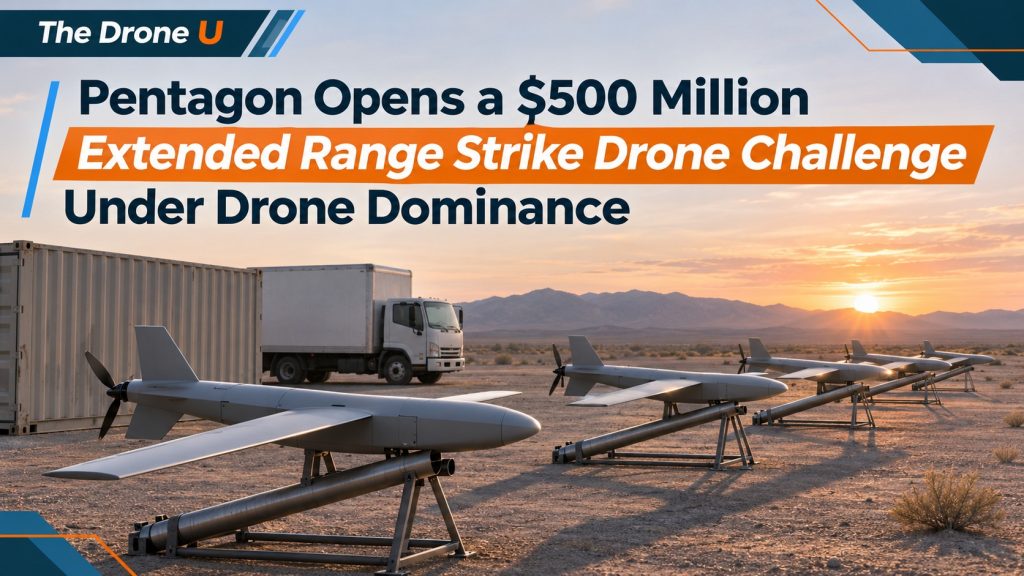
The Pentagon’s Drone Dominance program is adding a long-range event. The Defense Innovation Unit (DIU) has opened a prize challenge called Extended Range Strike (ERS) Gauntlet II, with up to $500 million set aside for prizes and follow-on work. It is looking for cheap, mass-producible attack drones that can fly hundreds of miles and keep working when GPS and radio links are jammed. Defense Daily reported that the solicitation adds a third category to the Drone Dominance Gauntlet II competition. DroneLife noted that it builds directly on an earlier prize challenge that wrapped up this month.
The solicitation describes the problem plainly. Precision weapons cost too much and take too long to build to be used at scale, and adversaries are getting better at disrupting communications and GPS. DIU wants mature, surface-launched drones at technology readiness level 7 or higher, in two tiers:
“Cost-per-effect” is the main yardstick. DIU defines it as the fully burdened unit cost divided by the mission success rate. That means the price of launchers, ground stations, software licenses and support all count, along with how often the drone actually gets the job done. The solicitation says a low sticker price that comes with heavy training, staffing or sustainment costs may not be the best value.
DIU also wants autonomous navigation that works without GPS, onboard automatic target recognition and terminal guidance that doesn’t need constant operator control. Systems should launch from simple setups, ideally standard shipping containers or a box truck.
Every company that attempts all of the test cards gets a $500,000 cash prize. The top performers can win prototype Other Transaction Agreements, which can lead to production awards tied to delivery speed and volume. Companies that won prototype deals in Gauntlet I, formerly the Ground-Based Affordable Mass (G-BAM) challenge, are invited automatically. A Gauntlet III solicitation is expected in April 2027, with that round starting in mid-August. The challenge is open to U.S. and international companies, but winners must meet a supply-chain framework DIU plans to release in December.
This is a weapons program, not a commercial drone rule, and it doesn’t change anything about how you fly under Part 107. It still matters to the civilian drone world in a few ways.
First, it’s the latest sign that Washington is putting serious money into U.S. drone manufacturing capacity. DIU is scoring companies on how fast they can scale, not just on flight performance. That kind of demand tends to build supplier networks, such as motors, airframes and navigation chips, that commercial makers can later use.
Second, the technical priorities, including navigation without GPS, onboard autonomy and resistance to jamming, are the same problems that commercial beyond-visual-line-of-sight operations have to solve. Third, defense manufacturers keep hiring people who know how to fly, test and maintain drones, and a Part 107 certificate is often the entry ticket. We’ve followed earlier rounds of this program, including Red Cat’s recent warning that defense drone orders are slow to arrive.
If you want to work in that pipeline, start with the basics. Drone U’s online Part 107 course gets you ready for the FAA knowledge test.
Sources: DIU solicitation, Drone Dominance: Extended Range Strike – Gauntlet II; Defense Daily (Cal Biesecker, Nov. 25, 2026); DroneLife (Miriam McNabb, Nov. 25, 2026).
 0