
Hackers Hit a Drone Maker’s Update Server and Germany Grounded Its Quantum Systems Drones

November 16, 2026
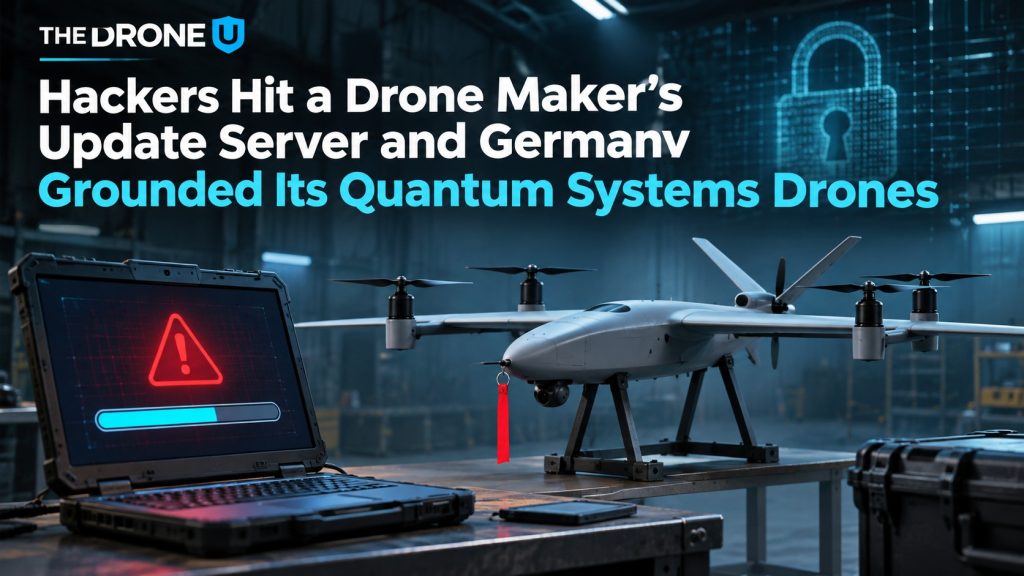
A cyberattack on a drone maker’s software update system was enough to ground part of a NATO army’s drone fleet. Germany’s Bundeswehr temporarily grounded drones built by Quantum Systems, one of Europe’s best-known drone manufacturers, after the company found hostile actors inside its systems in late October. The company says the threat has been contained and the fleet is flying again. Even so, the incident is a clear example of a risk every drone operator faces: the software updates you install.
In a statement dated November 12, Quantum Systems, based in Gilching near Munich, said it detected a cybersecurity incident at the end of October. An internal investigation found “an active cyberattack by hostile actors.” The company said its IT and security teams contained the attack while working with authorities. It also said that, because of the steps it took and the nature of the incident, there is no risk to end users or operators flying its unmanned systems. The company reported the incident to regulators and is investigating it with state authorities and outside cyber experts. It did not say who was behind the attack. It noted that European defense companies supporting Ukraine have been targeted for years.
The details came from other outlets. BleepingComputer, citing Der Spiegel and the Financial Times, reported that the attackers got in through a malicious update file for QBase, the company’s ground control and mission planning software, which was distributed from a compromised update server. Der Spiegel named the Vector reconnaissance drone, which the German military flies as “Falke,” as one of the aircraft whose missions are planned in QBase. It’s unclear how many customers installed the rogue update.
Germany’s newspaper FAZ reported that the federal cybersecurity agency, the BSI, confirmed the incident. According to the FAZ, the Bundeswehr grounded all of its Quantum Systems drones for at least several days, and the Financial Times reported the grounding kept the company out of a recent military exercise. On November 13, a Quantum Systems spokesperson told Reuters that “the fleet is operating normally around the globe,” including with the Bundeswehr, and that the German military was the only customer to ground its aircraft as a precaution. The FAZ said Ukraine’s military, another customer, never stopped flying.
Western defense customers have pushed hard to replace Chinese drones, in part over data security concerns. This incident shows that a trusted supplier doesn’t remove the risk. Your aircraft’s security depends on the whole software supply chain: the flight controller firmware, the ground station app, the mission planner and the servers that deliver updates. A BSI spokesperson told the FAZ that hijacking update servers is a common technique, and the paper pointed to the 2017 NotPetya attack, which spread through a compromised software update.
Most commercial pilots aren’t targets for a nation-state hacking team, but the lessons apply to any fleet:
Good habits like these are part of flying professionally, along with knowing the regulations. If you’re getting started, Drone U’s Part 107 test prep course covers the rules, airspace and operating procedures you need, and students have been known to take the online course in 3 days and pass the test.
Sources: Quantum Systems, Statement on Cyber Incident; Reuters via CNA; BleepingComputer; Frankfurter Allgemeine Zeitung.
 0