

FAA Remote ID Rules for Drones (2026): Who Must Comply

October 26, 2026
Quick Answer: Remote ID for DronesRemote ID is an FAA rule. It requires any drone that needs FAA registration to broadcast its ID and location during flight.You must register any drone over 250 grams (0.55 lb), and any drone you fly under Part 107. Registration costs $5 and lasts three years. To meet Remote ID, fly a standard Remote ID drone, add a broadcast module, or fly inside an FAA-recognized identification area (FRIA). Pilots had to comply by September 16, 2023. The FAA has fully enforced the rule since March 16, 2024. The FAA can fine violators and suspend or revoke their certificates. |
The FAA has fully enforced Remote ID since March 16, 2024. Flying a registered drone without it can bring FAA fines and suspension or revocation of your certificate.
Most drones flown in the United States must now broadcast Remote ID. This guide explains what the rule requires and how to comply.
Drones now fly for photography, delivery, farming and defense. Authorities need a way to identify them in the air. Remote ID does that.
This guide explains what Remote ID is, why it matters, how it differs from Session ID, and how to make your drone compliant.
Watch: how to legally fly without Remote ID at FRIA sites.
Remote ID works like a digital license plate for drones.
It is a system that provides identification and location information of drones in flight, broadcasting essential details like the drone’s ID, location, altitude, and operator information.
Drones with Remote ID capability transmit identification and location data via a broadcast signal, allowing reception by other parties.
The next section explains why Remote ID is important and how it contributes to a safer and more enjoyable drone flying experience for everyone.
Remote ID establishes an essential safety and security framework required for advanced drone operations. It also assists the FAA, law enforcement, and other federal agencies in pinpointing the control station when a drone is observed flying in a hazardous manner or in restricted airspace.
The necessity for a Drone Remote ID arises from several key factors:
Here is the background of how Remote ID came into existence.
The FAA published the Remote ID final rule in January 2021 after reviewing more than 53,000 public comments. Operators had to comply by September 16, 2023. The FAA ended its enforcement grace period on March 16, 2024.
There has been some confusion surrounding Remote ID and Session ID in the Drone community. So, we’d like to clarify that in the section below and help you understand the nuances of each.
Let’s begin by clarifying what Session ID is.
While the Remote ID is a broad concept for drone identification, Session ID is a specific type of Remote ID.
In the future, standard Remote ID drones may broadcast a Session ID instead of a serial number.
The FAA is in the process of formulating a plan for assigning Session IDs to drone pilots, taking into account current policies during the development of the Session ID policy.
The primary difference lies in the information shared and privacy considerations:
|
Remote ID |
Session ID |
| It includes persistent identification of the drone and its operator. This means that the drone’s ID is always linked to its registered owner. | Session ID offers more privacy by linking a unique identifier to each session, without revealing the long-term identity of the operator to the public. |
A Session ID still lets authorities track a drone during one flight. It does not show the public who owns the drone.
However, this capability won’t be accessible to the public. The FAA plans to gather public input on the Session ID policy before making it final.
The first step to becoming Remote ID ready is finding out if your drone is compliant or not.
Source: FAA
Here are the practical steps to ensure your drone is compliant and ready for legal flight:
The first step is to determine if your drone is already Remote ID compliant. Many newer drone models, especially those weighing over 250 grams, come equipped with this technology.
Your drone’s user manual should explicitly mention if it has a built-in Remote ID or Broadcast ID.
Some manufacturers offer firmware updates that enable Remote ID on older drone models. Visit the manufacturer’s website and see if an update is available for your specific drone.
If your drone has no built-in Remote ID, add a broadcast module or fly inside a FRIA. These devices attach to your drone and transmit the required identification and location data. Research compatible broadcast modules for your specific drone model and follow the installation instructions carefully.
You register on the FAA DroneZone website. It takes about five minutes. Follow these five parts.
Recreational flyers must also pass TRUST before flying. Read our TRUST drone test guide.
The world of drone regulations is constantly evolving. Stay informed by checking your local aviation authority’s website for any updates or changes to Remote ID regulations.
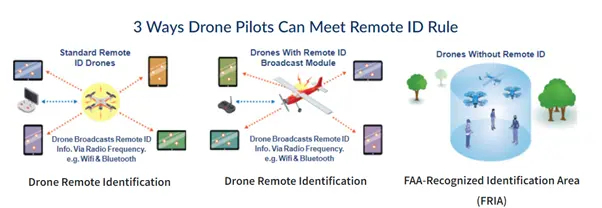
Drone pilots have three ways to meet the identification requirements of the Remote ID rule:
Use a drone with built-in Remote ID broadcast capabilities that comply with the requirements of the Remote ID rule. It broadcasts identification and location information of the drone and control station. These Standard Remote ID drones come pre-equipped with the necessary features.
The broadcast module can be added to a drone to retrofit it with Remote ID capabilities. A broadcast module is a device that broadcasts identification and location information about the drone and its take-off location in accordance with the Remote ID rule’s requirements. Pilots using a drone with a Remote ID broadcast module must maintain visual contact with their drone throughout the flight.
In areas sponsored by community-based organizations (CBOs) or educational institutions that are recognized by the FAA, drone pilots can operate without Remote ID equipment. Drones without Remote ID equipment may fly only inside a FAA-recognized identification areas (FRIAs). Pilots must keep the drone in sight and within the FRIA. Unregistered recreational drones under 250 grams do not need Remote ID.
Remote ID is now a permanent requirement for most U.S. drone operations. As air traffic gets busier, identifying drones in flight is a safety necessity.
Privacy concerns remain under discussion, particularly around who can access broadcast data. The FAA continues to develop its Session ID policy in response.
Remote ID and registration are federal rules, so they apply in every state. Some states and cities add their own limits on where and when you can fly. Check drone laws by state before your next flight.
Feel free to share your thoughts in the comments.
 1

Add Your Comment