
The Flying Ambulance Arrives: Ukraine’s SkyFall StarGate Medevac Drone Heads to the Front

October 23, 2026
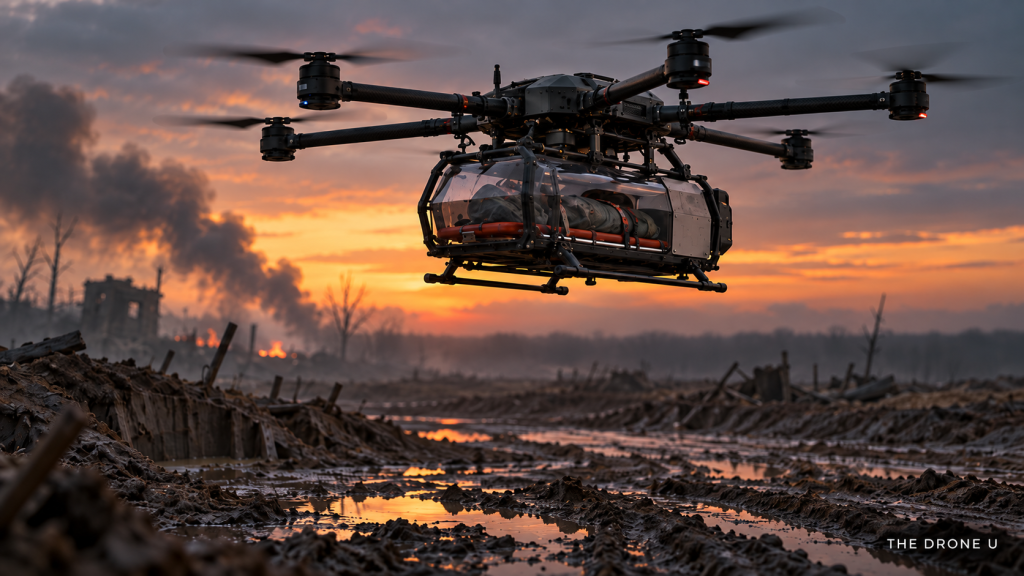
Getting a wounded soldier off the front line has become one of the most dangerous jobs in Ukraine. Ukrainian defense company SkyFall thinks part of the answer is a flying ambulance. The company has introduced StarGate, a six-rotor heavy-lift drone built around a stretcher. This week it was handed to a combat brigade for front-line evaluation. The drone has arrived at the front, but it hasn’t proven itself in combat yet. Here’s what we know.
The Associated Press got an exclusive look at a field demonstration somewhere in Ukraine. AP was not allowed to reveal the location. In the demo, StarGate lifted off with a weighted stretcher strapped to its frame, simulating a soldier in body armor. SkyFall says it developed the aircraft over the past year.
The company’s figures, as reported by AP:
All of these numbers come from SkyFall. None have been independently verified.
A human pilot flies StarGate. It has two communication links, Starlink and SkyFall’s own L-Link system, plus AI-assisted functions meant to keep it under control when GPS is jammed or spoofed. SkyFall says that if all communication is lost, the drone can plan its own route back to a safe area. It carries thermal cameras for night missions and is designed to fly in rain and snow.
During AP’s demonstration, first-person-view (FPV) drones were flown at StarGate to simulate attacks, while electronic jamming was switched on. A net was fired to catch one of the incoming drones. SkyFall also says StarGate has kept flying after losing one of its arms, though it hasn’t released data on how well it survives damage in combat.
In some sectors, the “kill zone” under constant drone and artillery threat reaches 10 to 15 km or more. A 15 km one-way range could put StarGate within reach of soldiers stuck deep inside that zone.
The idea came from the troops. According to AP, a commander of Ukraine’s 475th Separate Assault Regiment, known as Code 9.2, asked SkyFall’s founder last year for a safer way to evacuate wounded soldiers. Ground robots already handle many evacuations, but mud, craters, rivers, mines and drones slow them down or stop them. Another Code 9.2 commander told AP that robots usually take two to three hours to reach a position, and that covering 10 km in minutes would change things dramatically. He was also careful to say his unit needs at least a month with the drone before it can judge how well it works. SkyFall confirmed the unit is testing StarGate but did not share results.
SkyFall is already known for its Vampire heavy-lift drone, which Russian troops call “Baba Yaga,” along with Shrike FPV drones and the P1-SUN interceptor.
StarGate is part of a wider move toward drones that carry heavy loads instead of cameras. Militaries are already using drones to deliver supplies at the last mile. In civilian life, medical drone delivery of blood, lab samples and AEDs has grown fast. Carrying a person is a much bigger step than carrying a package, though, because of the redundancy, certification and safety margins required.
In the U.S., a drone carrying a patient would be far beyond what Part 107 allows. Part 107 caps aircraft at under 55 lb and prohibits carrying people. Larger operations need other rules: Part 135 for air carrier operations, and the FAA’s proposed Part 108 framework for beyond-visual-line-of-sight flying. StarGate shows what a wartime urgency can produce quickly. Civilian aviation will move more slowly, and for good reason.
The skills behind a mission like StarGate’s are the same ones commercial pilots use every day: knowing your aircraft’s weight and balance and payload limits, planning for lost-link events, understanding GPS and signal interference, and flying safely at night with thermal cameras. Heavy-lift and delivery work is one of the fastest-growing areas of the industry, and it starts with a solid foundation. If you’re getting into commercial flying, our Part 107 course covers performance, airspace and operating rules you’ll need before moving on to bigger aircraft.
StarGate is in the field but still has to prove itself. We’ll follow how Ukraine’s front-line evaluation goes.
Sources: Associated Press (Samya Kullab); The Independent (AP report); tip via @Drone_Wars_ on X.
 0