

White House Says Local Police Will Be the Front Line on Drone Threats as FBI Triples Counter-Drone Training

November 16, 2026
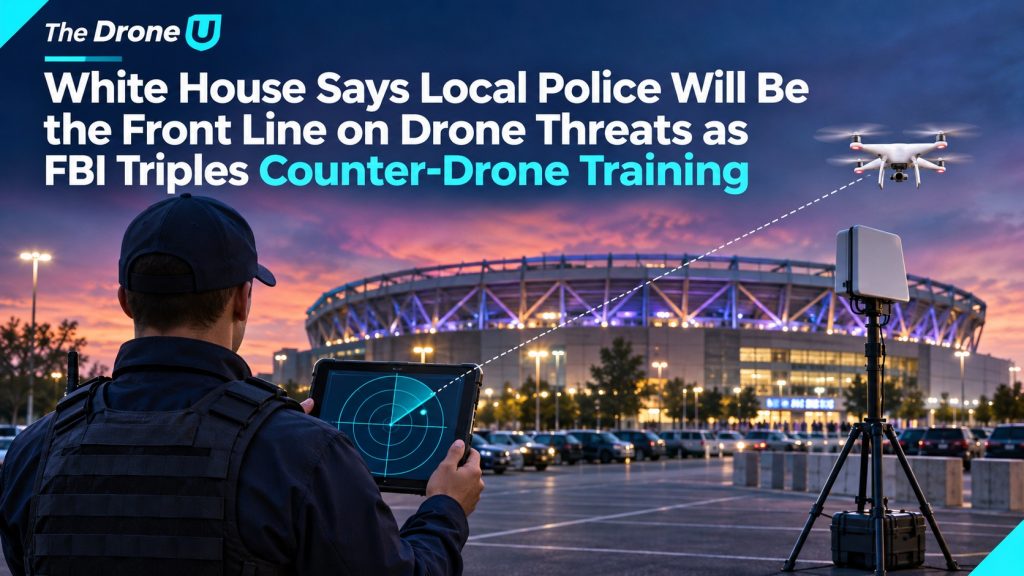
Drone security now gets attention at the very top of the federal government, and local police are being asked to take on more of it. That was the message from a Washington-area forum last week, where a White House counterterrorism official and FBI leaders explained how counter-drone authority is moving from federal agencies to state and local law enforcement, and why legitimate drone operators should pay attention.
As DroneLife reported, Dr. Sebastian Gorka, Deputy Assistant to the President and Senior Director for Counterterrorism at the National Security Council, spoke at the November 9 Drone Security and SLTT Grant Forum at MGM National Harbor in Maryland. DRONERESPONDERS and the Commercial Drone Alliance organized the event, which brought together federal officials, public safety leaders and industry.
Gorka said drones came up at the very first National Security Council meeting of the president’s second term, including concerns about unidentified drone activity near Bedminster, New Jersey. He described airspace as part of national sovereignty: the government needs to know what is flying overhead the same way it needs to know who is crossing the border.
His main point was about who will respond first. According to DroneLife, Gorka said “the feds aren’t going to solve this problem” on their own. At big events such as the FIFA World Cup, America’s 250th anniversary celebrations and the 2028 Los Angeles Olympics, a local officer, not a federal agent, is most likely to be the first to spot a threatening drone. He also argued that a drone posing an immediate threat to life should be treated like any other threat to life. The tools and legal authority are different, but the urgency should be the same.
Gorka also stressed electronic conspicuity, meaning the ability to identify what is in the air, as drones spread through delivery, public safety and commercial work. His summary: “The future of aerospace is unmanned.”
At a separate media roundtable during the same forum, which DroneLife also covered, FBI officials put numbers on the expansion. Fewer than 100 people graduated last year from the FBI’s National Counter-UAS Training Center (NCUTC) in Huntsville, Alabama. This year the Bureau plans 10 classes of 32 students each, or about 320 trainees. (A drone-only TFR for NCUTC training is on this week’s TFR list, Tuesday through Thursday.)
The legal basis is the SAFER SKIES Act, passed as part of the FY2026 National Defense Authorization Act. It extended counter-UAS authority to eligible state, local, tribal and territorial (SLTT) law enforcement and correctional agencies. The implementing rules took effect on July 1, 2026, according to the Federal Register notice. Agencies must earn accreditation, train and certify their people, use authorized equipment and get operational plans approved. FBI officials said an approved plan can last up to a year, and every FBI field office now has a counter-UAS coordinator.
Officials said SLTT agencies have run about 60 counter-UAS operations with federal support since July. They also said the drones they ran into during security operations generally showed no sign of malicious intent. “We don’t want the cure to be worse than the disease,” one official said about choosing a mitigation method that doesn’t put the surrounding community at risk.
Within a year or two, the person who responds to your drone near a stadium, prison or parade may be a local officer who has detection gear and, in some places, the authority to take your drone down. In practice, most of the drones these teams encounter belong to careless pilots, not bad actors. Don’t be one of them.
Commercial operators and pilots who want to work with public safety agencies start from the same place. Drone U’s Part 107 test prep course covers airspace, TFRs and operating rules, and students have been known to take the online course in 3 days and pass the test.
Sources: DRONELIFE, White House Puts Drone Security at the Top of Its Agenda; DRONELIFE, FBI Plans to Triple Counter-Drone Training Capacity; Federal Register, SLTT counter-UAS rule.
 0
