

Commercial UAV Expo 2026: The Drone Industry Is Moving Forward—Are You?

September 10, 2026
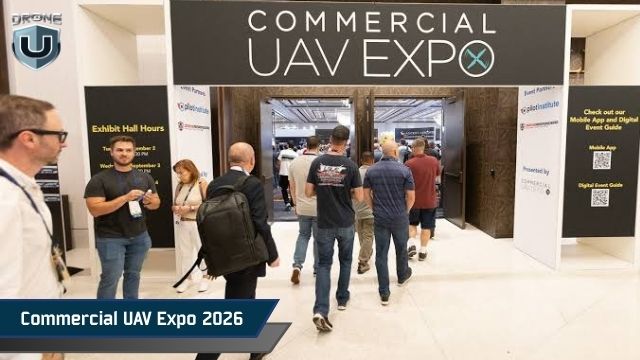
Quick AnswerThe drone industry is splitting in two. One side is the traditional DJI market. The other is a fast-growing American, NDAA-compliant market for government, utility, and public-safety work. A real U.S. supply chain is finally forming — motors, batteries, flight controllers, payloads. Standouts at the show included BRINC’s Guardian, heavy-lift aircraft from SiFly and FlyingBasket, and the H4C at around $30,000. Bottom line: keep flying DJI, but start learning American platforms now. Price jobs to match the equipment. And find customers where they actually gather, not just at drone shows. |
Commercial UAV Expo 2026 was fascinating.
Not necessarily because of one groundbreaking product announcement or a single piece of technology, but because the show offered a pretty clear snapshot of where the commercial drone industry is right now.
And perhaps more importantly, where it’s going.
Walking the floor, one thing became obvious: the drone industry is beginning to bifurcate.
Different manufacturers are showing up at different events. Different vendors are building around different ecosystems. Procurement requirements are separating operators into different markets. And increasingly, the conversations surrounding American versus Chinese drones feel almost ideological.
Commercial UAV Expo was defined as much by who wasn’t there as by who was.
And underneath all of that is an important message for commercial drone pilots:
The industry has changed. The opportunity hasn’t disappeared. It’s simply moving.
There was still plenty of conversation at Commercial UAV Expo about DJI restrictions and how those changes are negatively affecting drone businesses.
Those concerns are legitimate.
DJI has spent years building incredibly capable aircraft at price points that are difficult to match. Changing platforms isn’t always easy, and replacing an established ecosystem can be expensive.
But none of this is particularly new anymore.
We’ve known the political winds were shifting.
We’ve known government agencies, utilities, critical-infrastructure operators, and other enterprise customers were increasingly interested in—or outright requiring—American and NDAA-compliant aircraft.
We’ve known operators needed alternatives.
The people who recognized that early have already been moving.
They’re learning new platforms.
They’re developing relationships with American manufacturers.
They’re understanding which customers require compliant aircraft.
They’re adjusting their pricing to account for significantly more expensive equipment.
And they’re continuing to fly.
If you haven’t started making that transition, there’s still time.
But it’s probably time to move a little faster.
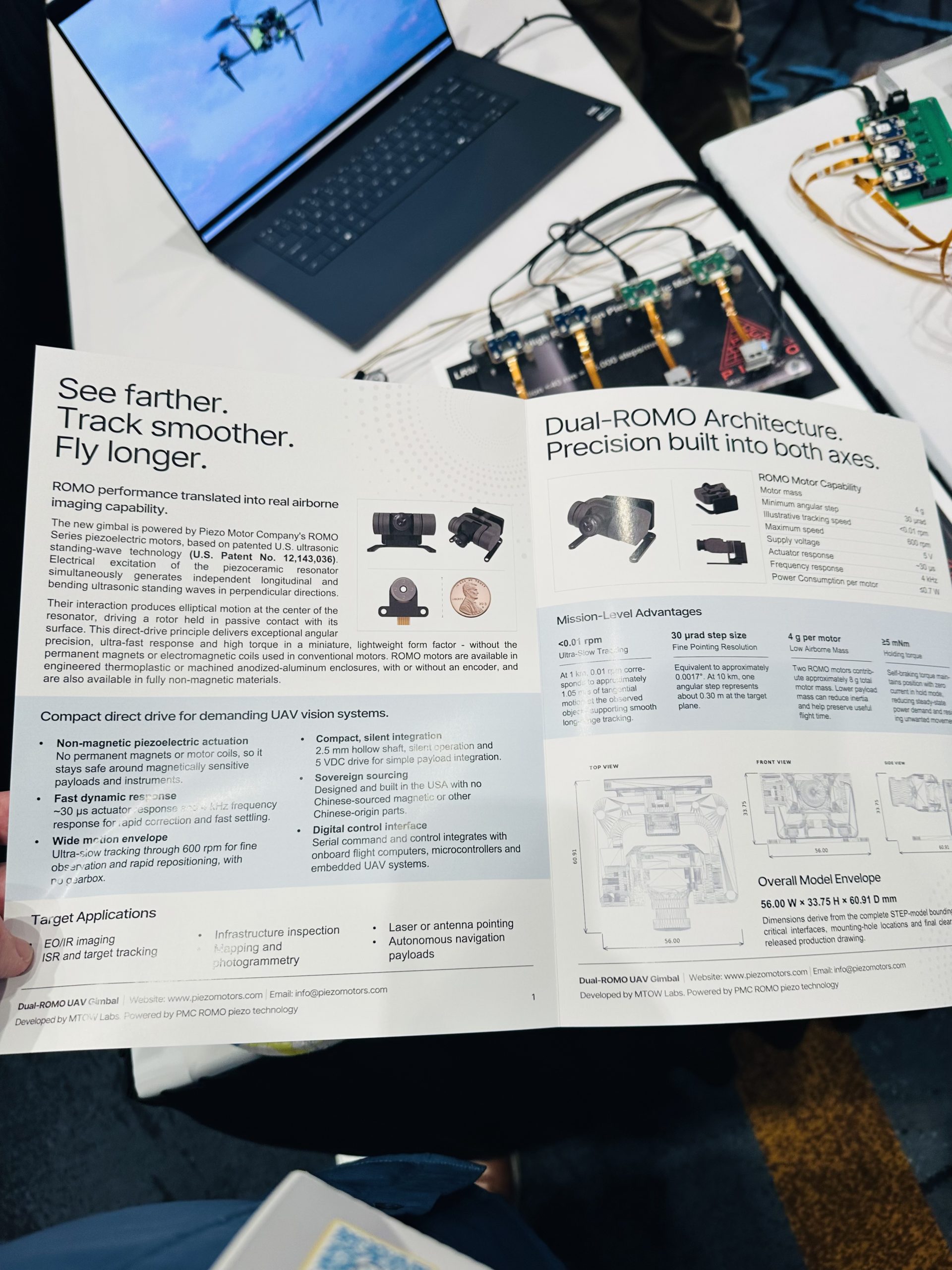
Piezo Motor Technology
One of my favorite observations from the show came from someone I spoke with on the floor.
He pointed out that there seemed to be significantly more component manufacturers this year.
That might actually be one of the most encouraging developments coming out of the conference.
Because America doesn’t simply need more companies putting their names on drones.
America needs a drone supply chain.
One particularly interesting technology we saw was piezo motor technology, a completely different motor architecture from the conventional electric motors we’re accustomed to seeing in drones.
It was unlike anything I had seen previously at Commercial UAV Expo and could potentially have applications across drones, gimbals, and other robotic systems.
That’s exciting.
Building competitive American drones isn’t simply about designing another airframe. We need competitive motors, batteries, flight controllers, communications systems, payloads, cameras, software, and manufacturing capacity.
Those pieces are starting to appear.
At the same time, many of the aircraft manufacturers exhibiting at the show appeared to be primarily systems integrators.
They’re combining commercially available motors, controllers, payloads, communications systems, and airframes into specialized aircraft.
And that’s not necessarily a criticism.
Systems integration is an important part of building a domestic drone ecosystem, particularly when customers have specialized requirements.
But there’s a difference between building a good aircraft and building a complete drone ecosystem.
DJI didn’t become dominant simply because its drones flew well.
The aircraft, batteries, cameras, controllers, firmware, software, accessories, and workflows all worked together.
That’s the standard American manufacturers ultimately have to compete against.
And increasingly, it looks like they’re trying.
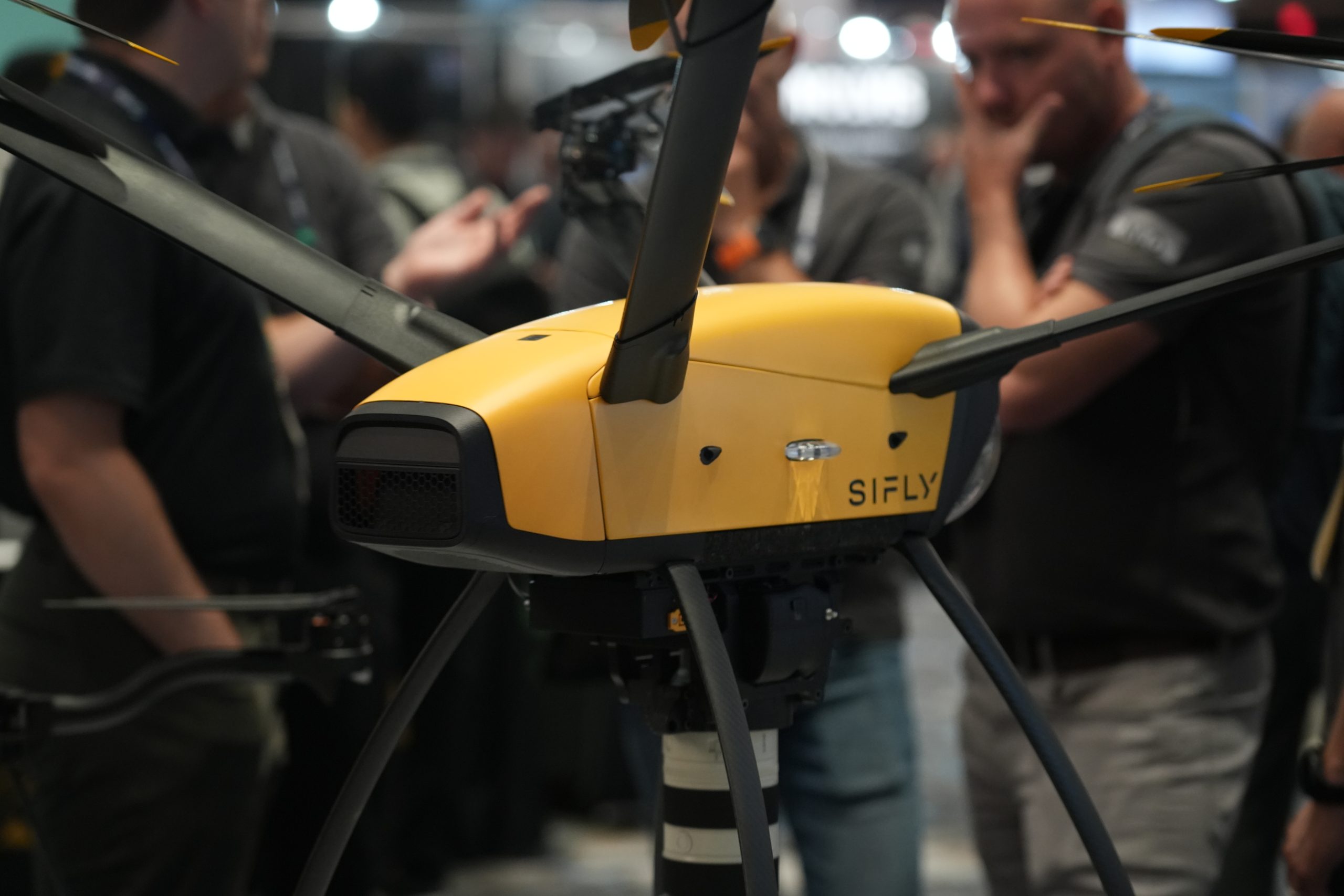
SiFly
The good news is that there were several aircraft and technologies worth paying attention to.
One of the most interesting was BRINC’s Guardian.
This is a large aircraft—closer to the scale of an M600-class platform than the compact enterprise drones most operators fly today—with serious imaging capability and an enormous thermal payload.
But the aircraft itself might not even be the most interesting part.
The combination of satellite connectivity through Starlink, docking infrastructure, and automated battery swapping opens up the possibility of something much bigger:
Dock hopping.
Imagine an aircraft operating across a network of docks, landing, swapping batteries, and continuing to another location.
That’s a very different concept of operations from launching a drone, flying a mission, and returning to the same pilot.
We also saw some serious heavy-lift aircraft.
SiFly had a heavy-lift platform on display, while FlyingBasket showcased an aircraft capable of moving payloads measured in hundreds of kilograms.
These aren’t replacements for your Mavic.
They’re entirely different categories of aviation.
And that’s exactly what’s exciting about them.
Another aircraft that caught our attention was the H4C.
It’s roughly comparable in size to an M400-class aircraft, offers different payload configurations, and can support an LR1-class camera option.
The number that really got our attention?
Approximately $30,000.
That potentially puts the aircraft roughly $14,000 below an Astro-class alternative.
We haven’t tested it yet, so we’re certainly not ready to recommend it.
But we absolutely want to fly it.
And there’s another American aircraft we’ve been watching closely that we expected to see around this conference. Its release appears to have slipped toward the end of the year or potentially into next spring.
Based on what we currently know, we think it could be significant.
Which is why we’re currently taking a somewhat patient approach to major American aircraft purchases.
We’re holding off on additional Freefly purchases.
We’re holding on additional Skydio purchases.
There are at least two upcoming platforms we want to evaluate before making major fleet decisions.
That’s a good problem to have.
Competition is finally starting to develop.
And competition should eventually mean better aircraft, better software, and—hopefully—better prices.
This was one of the strangest parts of Commercial UAV Expo.
Some of America’s most recognizable drone manufacturers weren’t meaningfully represented.
But what was even more interesting was what happened around them.
We’ve attended Skydio events.
We’ve attended Freefly Fest.
We’ve attended Drone Days and Robotics Days with enterprise customers.
At those events, we’ve seen an increasingly robust ecosystem of software companies, payload manufacturers, service providers, technology partners, and integrators supporting American drone platforms.
Many of those companies weren’t represented at Commercial UAV Expo either.
That made the absence feel bigger than a couple of empty booths.
It feels like we’re watching different drone ecosystems develop in parallel.
One remains closely connected to the traditional commercial drone market, including mapping, education, service providers, and DJI-based workflows.
Another is rapidly developing around American manufacturing, NDAA compliance, government procurement, utilities, public safety, critical infrastructure, autonomy, and defense-adjacent applications.
There’s obviously overlap.
But there seems to be less overlap than there used to be.
I’m not convinced further division is good for the drone industry.
American manufacturers can learn from what DJI has done incredibly well.
DJI can learn from the specialized requirements driving American enterprise and government customers.
Systems integrators can push manufacturers toward capabilities they haven’t considered.
Operators can provide feedback about what actually works in the field.
And competition forces everyone to improve.
That’s how industries move forward.
Being blindly “pro-DJI” doesn’t make much sense.
Neither does being blindly “anti-DJI.”
Professional operators should be pro-mission.
Use the technology that satisfies the customer’s requirements, produces the necessary deliverable, and allows the business to make money.
That’s the job.
I also want to thank the Drone U members who stopped me throughout the conference.
I probably ran into around 20 members over the course of the event, and those conversations were genuinely one of my favorite parts of the show.
It’s always interesting hearing what people are building, what they’re struggling with, and where they’re finding opportunities.
That’s also why conferences like Commercial UAV Expo still matter.
Relationships matter.
Conversations matter.
Being able to walk up to a manufacturer, engineer, or software company and actually discuss a problem has tremendous value.
But there’s another lesson commercial pilots shouldn’t overlook.
Drone conferences are fantastic places to learn about drones.
They’re not necessarily the best place to find drone customers.
If you’re trying to grow a commercial drone business, start attending the conferences your customers attend.
Want construction work?
Go to construction conferences.
Want engineering contracts?
Go where engineers go.
Want utility work?
Attend utility conferences.
Want surveying and mapping projects?
Attend geospatial events.
There may be thousands of drone pilots walking around a drone conference.
That’s useful for networking.
But imagine walking into a conference filled with hundreds or thousands of companies that have infrastructure to inspect, projects to document, stockpiles to measure, facilities to map, and problems that drones can solve.
That’s where things get interesting.
This brings us to perhaps the biggest takeaway from Commercial UAV Expo 2026.
If you’re a professional drone pilot and haven’t started familiarizing yourself with American aircraft, now is probably the time.
That doesn’t mean selling your DJI fleet tomorrow.
It doesn’t mean pretending American aircraft are perfect.
And it definitely doesn’t mean spending $40,000 simply because someone put an American flag on the box.
It means becoming educated.
Learn the aircraft.
Learn their strengths.
Learn their weaknesses.
Understand the payloads.
Understand the software.
Understand what customers require.
And critically, understand what those customers are willing to pay.
Because the economics matter.
Flying a $30,000–$50,000 enterprise aircraft under specialized procurement requirements shouldn’t necessarily be priced the same way as flying a $5,000 aircraft for a traditional commercial job.
That’s where opportunity begins to emerge.
Here’s the simplest way I can explain it.
Imagine someone told you tomorrow:
You can’t buy a Kia anymore.
Would you stop driving?
Probably not.
You’d buy something else.
So if a customer tells you that you can’t use DJI, why would you stop flying?
Learn another aircraft.
Understand its capabilities.
Price the job appropriately.
And go win the work.
Your drone business shouldn’t depend entirely on the continued availability of one manufacturer.
That’s not a technology strategy.
That’s a dependency.
Commercial UAV Expo 2026 ultimately left me optimistic.
Yes, the industry is changing.
Yes, American aircraft remain expensive.
Yes, there are still capability gaps.
And yes, the industry seems to be splitting into increasingly distinct ecosystems.
But look at what’s being built.
New motors.
New batteries.
New flight controllers.
New payloads.
New aircraft.
New docking concepts.
New heavy-lift systems.
New American supply chains.
And most importantly, new competition.
For years we’ve been asking when credible alternatives would arrive.
We’re finally starting to see some of them.
So rather than spending the next several years debating whether the industry should change, commercial pilots would be better served learning how to capitalize on the industry that is actually emerging.
The smart operators have already started.
If you haven’t, that’s okay.
Just don’t wait much longer.
Learn the platforms. Follow the technology. Understand what your customers need. Be willing to fly more than one manufacturer’s aircraft.
Because ultimately, we’re drone pilots.
And if there’s still work to be done, problems to be solved, and aircraft to fly, there’s still plenty to be excited about.
The future isn’t about DJI versus American drones.
It’s about becoming the pilot who can succeed with either.
 0
0