

Part 137 Drone License: Why Spray Drone Operators Are Multiplying (and How to Get Certified in 2026)

October 9, 2026
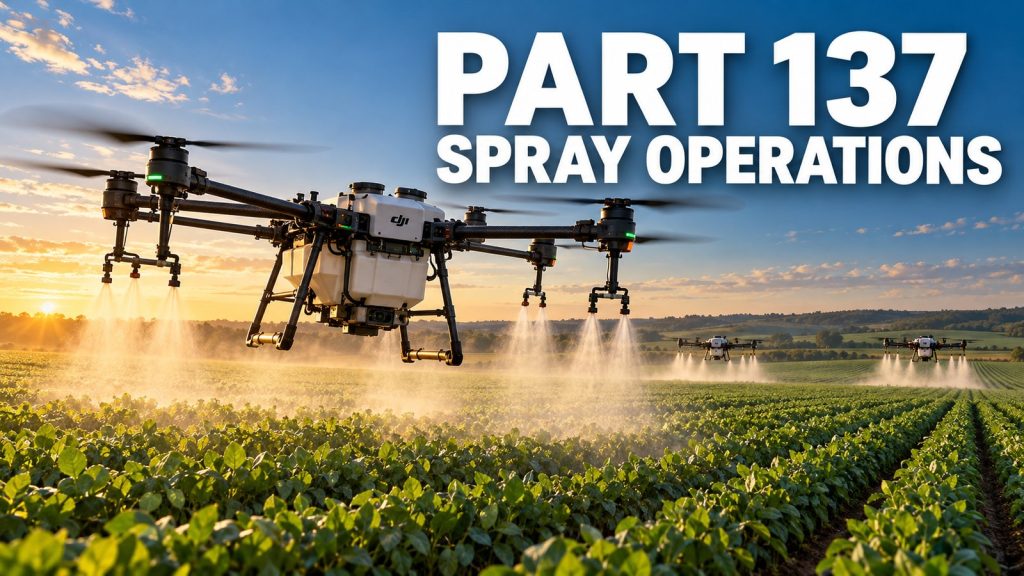
Part 137 Drone License: Why Spray Drone Operators Are Multiplying (and How to Get Certified in 2026)

The Part 137 drone license is one of the fastest-growing credentials in commercial drone work. According to the FAA, there were 1,710 unmanned Part 137 operating certificates as of June 2025, nearly matching the 1,750 crewed agricultural operators.

Technically, there’s no single card called a “Part 137 drone license.” Instead, it’s a stack: a Remote Pilot Certificate, a Section 44807 exemption and an Agricultural Aircraft Operator Certificate. Below we cover the growth numbers (as of October 2026) and the honest counterpoint. Then we walk through how certification works today.

For most spray drone operators flying under 55 lb, the stack starts with Part 107, because the exemption builds on it. If you’re not certified yet, our Part 107 drone certification course is the first step.

The growth numbers (what the FAA actually reports)

First, here’s what official and industry sources show:

  • 1,710 unmanned Part 137 certificates as of June 2025, per the FAA’s Safety Briefing (September/October 2025).
  • More than 3,400 certificated Part 137 operators in total, crewed and unmanned, also as of June 2025.
  • “Over 1,700 operator certificates issued for agricultural operations,” per the FAA’s August 2025 Part 108 proposal.
  • A 58.3% year-over-year jump in approved Part 137 UAS operators, according to the American Spray Drone Coalition’s 2025 Impact Survey, which used the FAA’s 1,710 count.

So what’s driving it? The FAA points to a “recently streamlined certification process.” Meanwhile, in the same article, FAA aviation safety inspector Ryan Smith said “this rapid growth has improved accessibility to aerial application services across a wider geographic and economic spectrum.”

Safety matters here too. Notably, the FAA wrote that agricultural drones have had “no fatalities or serious injuries reported to date.” In addition, every Part 137 drone operator must have, and comply with, an operations and training manual.

The other side of the trend (the honest take)

Growth isn’t the whole story, though. In fact, a few data points suggest the market is maturing:

  • Fewer new heavy spray aircraft. The FAA’s Aerospace Forecast reports new agricultural-spraying large UAS (55 lb+) registrations fell 58.7%, from 1,432 in 2024 to 592 in 2025.
  • Flat output per operator. The coalition’s survey estimated 16.4 million acres treated in 2025, up 58.7%. However, average acres per operator stayed flat at about 9,584.
  • Small fleets. Similarly, according to the same survey, 69% of Part 137 UAS operators run two or fewer aircraft.

In other words, more operators are entering, but each one isn’t necessarily doing more work. In our experience, that’s when training, efficiency and safety start separating the businesses that last from the ones that don’t.

What a Part 137 drone license actually includes

When people say “Part 137 drone license,” they usually mean all of the following, rather than one document:

  • A Remote Pilot Certificate for operations under Part 107 (drones under 55 lb, including payload)
  • Aircraft registration: an FA-number through FAADroneZone for drones under 55 lb, or an N-number through the FAA’s registry for 55 lb and up
  • A Section 44807 exemption covering the rules a drone can’t otherwise meet, such as §107.36 (carriage of hazardous materials) and several Part 137 rules
  • An Agricultural Aircraft Operator Certificate under Part 137
  • An operations and training manual that you actually follow
  • State pesticide applicator credentials where required. For example, under the EPA’s certification rule, restricted use pesticide applicators need a specialized certification for aerial application. States generally administer it.

Heavier drones, however, change the picture. At 55 lb or more, you operate under Parts 91 and 137 and need exemptions from parts of 14 CFR Parts 61, 91 and 137.

How to get a Part 137 drone license (step by step)

According to the FAA’s “Dispensing Chemicals and Agricultural Products” page, the process looks like this:

  1. Register your drone. First, use FAADroneZone for drones under 55 lb or the aircraft registry for 55 lb and up.
  2. Petition for an exemption. Next, file at least 120 days before you need it, per 14 CFR 11.63(d). Then submit it through the FAA’s shell docket, FAA-2007-0001-0001, on regulations.gov.
  3. Submit basic operational information. This includes your legal name and physical address (no P.O. boxes), your Chief Supervisor of Operations, your pilot in command and certificate number, and each aircraft’s make, model and registration number. If any of it is missing, the FAA sends a Request for Information.
  4. Apply for the Part 137 certificate. Finally, after you receive your exemption, email FAA Form 8710-3 and your exemption number to [email protected]. The name must match your exemption.

The good news: you no longer submit documents to your local Flight Standards District Office. That’s the streamlined process the FAA describes, and it’s a big reason the Part 137 drone license has become more accessible.

The warning: the FAA says it has found exemption holders operating outside their conditions and limitations. As a result, it’s running operational validations and sending RFIs, including checks on basics like a Remote Pilot Certificate and registration. It also says it will close petitions that don’t respond.

The knowledge and skill test (what your chief supervisor must know)

Part 137 also requires a knowledge and skill test under §137.19(e). Specifically, the knowledge portion covers:

  • Steps before starting work, including surveying the area
  • Safe handling of economic poisons and disposal of used containers
  • Effects of chemicals on plants, animals and people
  • Symptoms of poisoning, emergency measures and poison control centers
  • Your aircraft’s performance capabilities and limits
  • Safe flight and application procedures

So treat this as real study, not paperwork. After all, you’re flying chemicals near people, animals and crops.

What’s changing next (Part 108 and the FCC)

Meanwhile, two federal actions could reshape the Part 137 drone license. Neither was final as of October 1, 2026.

Part 108 (proposed)

The FAA’s August 2025 BVLOS proposal would create an agricultural operating certificate under proposed §108.575. As proposed, it would:

  • Prohibit dispensing directly over people
  • Limit certificated operations to Category 3 population density or lower (Category 1 for permitted operations)
  • Require compliance with product labels and a tailored training program
  • Amend Part 137 so it wouldn’t apply to aircraft operated under Part 108

The FAA expects agricultural operations under exemptions to transition to Part 108 as exemptions expire. Still, it’s only a proposal for now, so today’s process stays in place until a final rule says otherwise. See our Part 108 training overview for more.

FCC proposals on foreign-made drones

The FCC’s proposal in PS Docket 26-189 would stop future imports and sales of previously authorized foreign-made drones capable of dispensing “economic poison.” Separately, Docket 26-184 targets nine companies, including ag drone maker XAG. Even so, neither would ground drones you already own. For context, see our FCC Covered List explainer.

Our take for new spray drone operators

The opportunity is real, and the FAA’s numbers back that up. However, a Part 137 drone license is only the starting line. Here’s what we’d focus on:

  • Build your operation around your manual, not around the sale.
  • Price fleet purchases with the FCC proposals in mind, especially for imported sprayers.
  • Know your state’s pesticide licensing rules before your first paid job.
  • Train your crew on the same standards every time, because the FAA is now checking that operators follow their exemption conditions.

For platform options, start with our best agriculture drones guide and our post on drones for crop scouting.

Start with your Part 107 (then build your ag operation)

Every under-55 lb Part 137 operation starts with a Remote Pilot Certificate, so that’s where your Part 137 drone license really begins. Drone U has 10+ years of in-person drone training and 14+ years of online drone education, and we teach the regulations the way working pilots use them.

Get your Part 107 with Drone U for $147 (regularly $197). You get on-demand video lessons, FAA-aligned quizzes (score 90%+ and you’re ready), a downloadable study guide, the private Drone U community, lifetime access and a 14-day money-back guarantee.

Training a team? If you’re building an ag spray crew, explore our Enterprise Drone Programs or book a consultation.

0

Author

Paul Aitken
Paul Aitken - Drone U

Paul Aitken

Co-Founder and CEO

Paul Aitken is a Certified Part 107 drone pilot and a Certified Pix4D Trainer. He is a pioneer in drone training and co-founder of Drone U. He created the industry’s first Part 107 Study Guide and co-authored Livin’ the Drone Life.

Paul is passionate about helping students fly drones safely and effectively. With over a decade of experience, he has led complex UAS projects for federal agencies and Fortune 500 clients such as Netflix, NBC, the NTSB, and the New York Power Authority.
