

DFR BVLOS Waivers and Part 108: A Guide for Public Safety Drone Programs

October 23, 2026
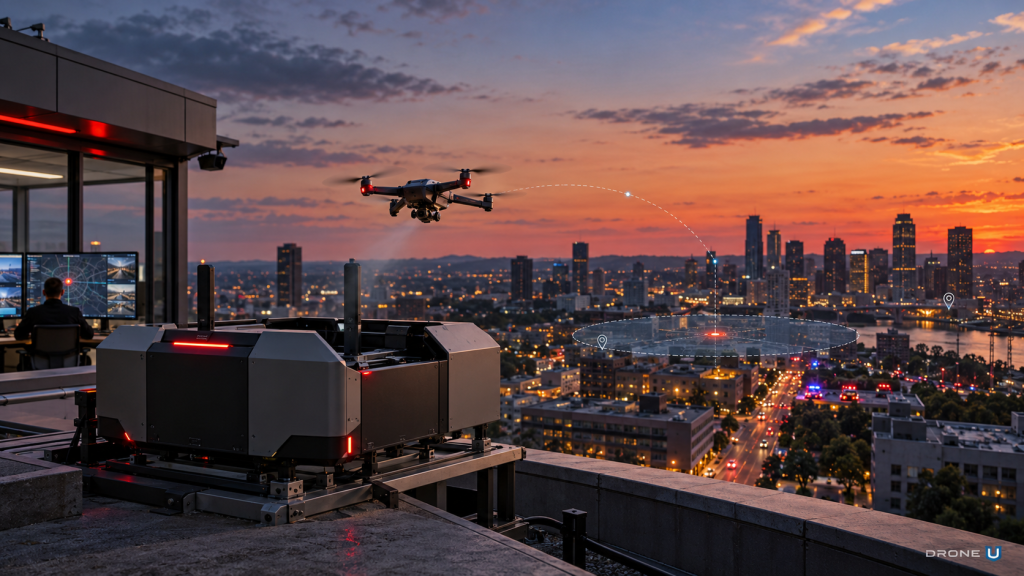
If you run or are building a drone as first responder program, the hardest question is usually not which drone to buy. It’s how to get approval to fly it beyond visual line of sight. This guide focuses on that piece: how a DFR BVLOS waiver works today, the other approval paths agencies use, and what the FAA’s proposed Part 108 rule would change. For an overview of what DFR is and why agencies adopt it, start with our main guide, Drone as First Responder.
A DFR drone launches from a dock or rooftop to a 911 call, often a mile or more away, while a remote pilot watches from a real-time operations center. That is the whole point of the program, and it collides with one of Part 107’s core rules. Under 14 CFR 107.31, the remote pilot or a visual observer must be able to see the drone with unaided vision throughout the flight. Visual observers under 107.33 help, but placing observers on rooftops across a city is expensive and limits where the drone can go.
So every DFR program eventually needs one of the approval paths below.
Agencies that operate under Part 107, including many police and fire departments, request an operational waiver of 107.31 (and often 107.33). New Part 107 waiver applications now go through the FAA’s Aviation Safety Hub, not FAADroneZone, according to the FAA’s Part 107 waivers page. The application asks you to identify yourself as a Public Safety Organization, list each aircraft, define your operating area with coordinates, and answer operational questions on line of sight, observers, population density and altitude.
A waiver doesn’t replace airspace access. Under the FAA’s order on processing UAS requests (JO 7200.23E), an airspace authorization can incorporate an operational waiver such as 107.31, and some waivers need coordination with the air traffic facility. If your city sits under Class B, C or D airspace, plan for both the waiver and the authorization.
The FAA says it aims to decide waiver requests within 90 days, recommends a start date at least 90 days after you apply, and cancels applications if you don’t answer a request for information within 30 days. Plan your program launch around that. Our Part 107 waiver guide walks through each screen of the Aviation Safety Hub application.
Government agencies that qualify as public aircraft operators can instead fly under a Certificate of Waiver or Authorization (COA). The FAA’s public safety BVLOS FAQ explains how BVLOS fits into these options. A COA is issued to the agency rather than an individual pilot, and the agency self-certifies its pilots. Some agencies choose the COA because it fits how they already manage crewed aviation units. Others stay with Part 107 because their pilots are already certified and the waiver process is familiar.
For a specific active emergency, such as a wildfire, a search and rescue or a disaster, the FAA can grant expedited Special Governmental Interest (SGI) approvals through its System Operations Support Center. In December 2025 the FAA moved SGI requests to its online Airspace Access Program system. SGI is for real emergencies and is not a substitute for the standing approval a daily DFR program needs.
On August 7, 2025, the FAA and TSA published a proposed rule, Normalizing Unmanned Aircraft Systems Beyond Visual Line of Sight Operations (90 FR 38212), which would create a new 14 CFR Part 108. The proposal would replace case-by-case waivers with performance-based rules for low-altitude BVLOS operations, and it names civic interest uses, including public safety, among the operations it is meant to enable. The original comment period closed October 6, 2025. In January 2026 the FAA reopened comments on electronic conspicuity and right-of-way issues.
As of October 22, 2026, no final Part 108 rule has been published. Until a final rule is published and takes effect, DFR programs need the waivers and COAs above. When it arrives, read the final text carefully. Details like right-of-way rules, operating areas and personnel requirements often change between proposal and final.
Listen to our podcast episode on DFR regulations, and see our drone pilot jobs guide for career paths in public safety.
Usually. Flying beyond visual line of sight without observers needs FAA approval, either a Part 107 waiver of 107.31 or a public aircraft COA with BVLOS provisions.
New Part 107 operational waivers are submitted in the FAA’s Aviation Safety Hub. Airspace authorizations still go through LAANC or FAADroneZone.
The FAA aims to decide within 90 days and recommends a start date at least 90 days after you apply. Complex requests can take longer.
No. The FAA proposed Part 108 on August 7, 2025, but as of October 22, 2026 no final rule has been published.
It depends on your organization. A COA covers a public agency as a whole, while Part 107 relies on individually certified pilots. Many agencies certify pilots under Part 107 either way.
No. SGI approvals are for specific active emergencies, not a standing DFR program.
No. As proposed, Part 108 would add a new framework for BVLOS operations. Part 107 would remain for visual line of sight operations.
Whether you are flying for work, for public safety or for the love of it, it starts with knowing the rules. The Drone U Part 107 course covers every topic on the FAA knowledge test, including airspace, sectional charts, weather, regulations and operations, with lessons from working commercial pilots and practice questions built around how the FAA actually tests. Start the Part 107 course today.
 0