
Best Travel Drone of 2026: Why the DJI Mini 5 Pro Wins

October 23, 2026
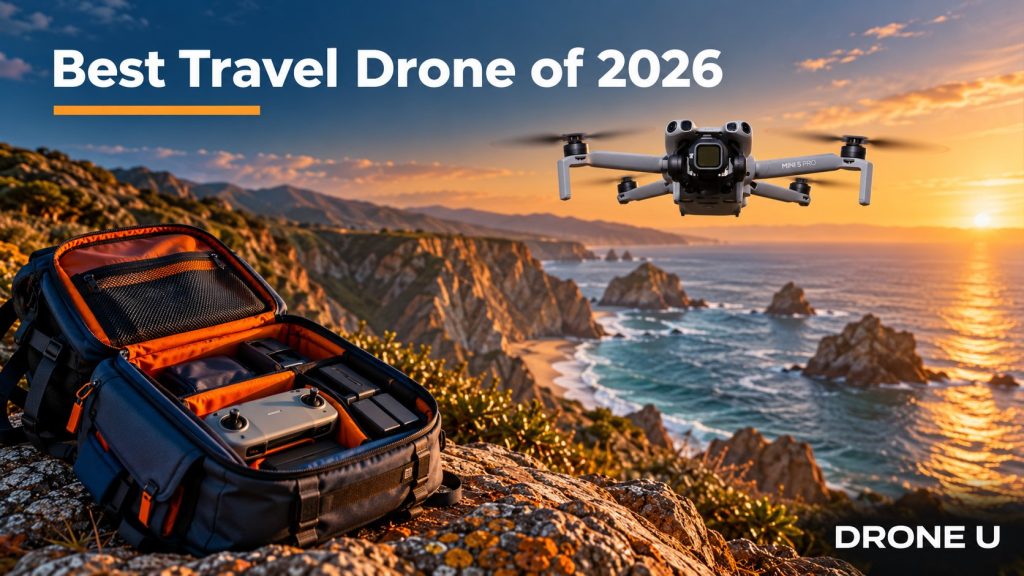
If you only get to pack one drone for a trip this year, make it the DJI Mini 5 Pro. We’ve flown just about every DJI aircraft that has come through the Drone U studio, and nothing else in 2026 gives you this much camera in a package this small, for this little money. Here’s why it’s our pick for the best travel drone of 2026, plus the one safety recommendation we give every Mini 5 Pro owner who wants to fly around people.
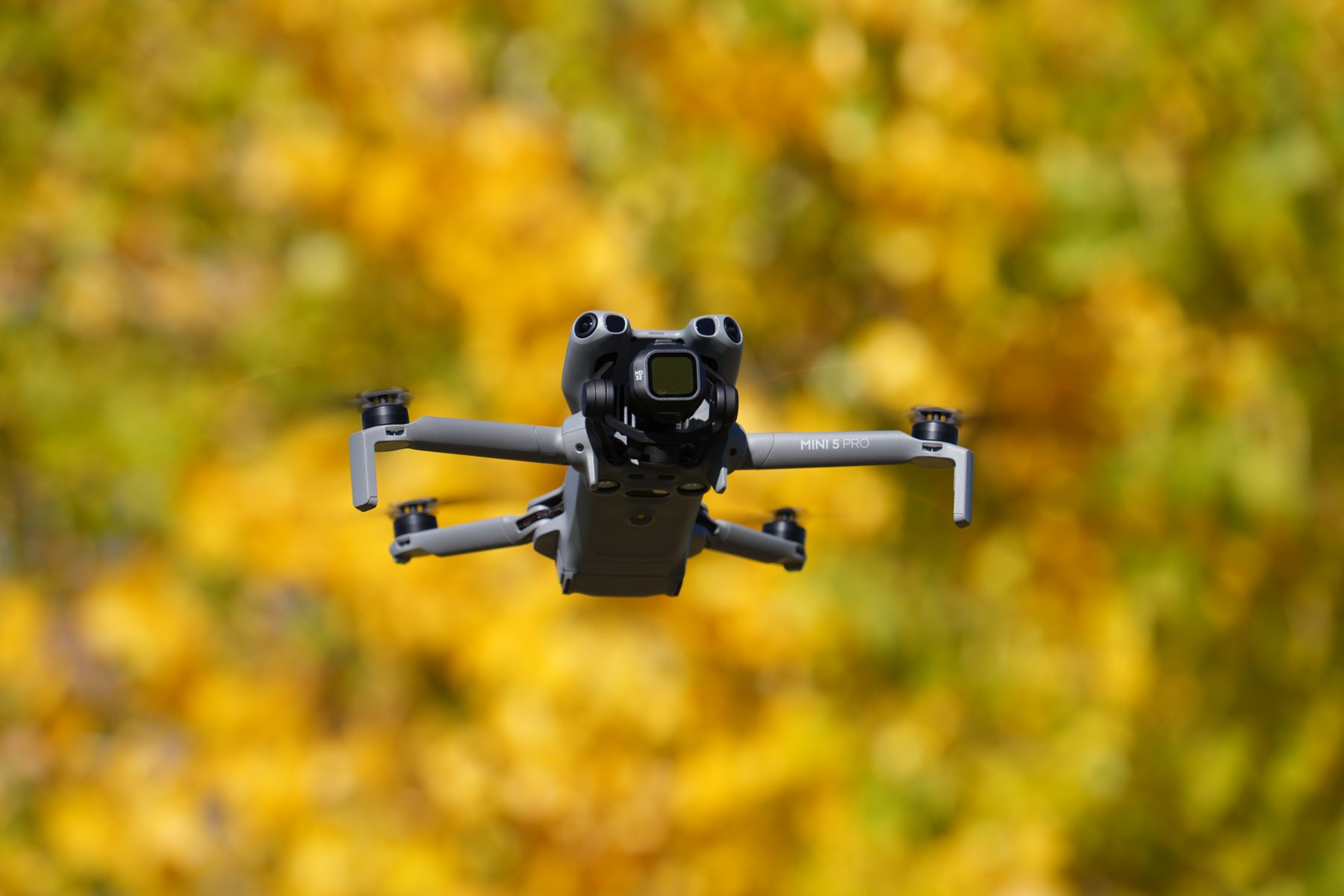
Travel drones live or die on three things: how easy they are to carry, how good the pictures are when you get there, and how well they handle real-world conditions like wind on a coastline or a mountain ridge. The Mini 5 Pro checks all three boxes.
Folded, the Mini 5 Pro measures about 157 × 95 × 68 mm, which is roughly the size of a large smartphone stacked on a deck of cards. DJI lists its takeoff weight at about 249.9 grams with the standard battery. It disappears into a camera bag or a jacket pocket, and it doesn’t eat up your carry-on allowance. When a drone is that easy to bring along, you actually bring it, and the best travel drone is the one that’s with you when the light gets good.
This is the headline. The Mini 5 Pro uses a 1-inch, 50MP CMOS sensor behind a 24 mm-equivalent f/1.8 lens. That is a huge sensor for an aircraft this small. Bigger sensors gather more light, which means cleaner sunrise and sunset shots, better dynamic range when you’re shooting bright skies over dark landscapes, and more room to push your files in editing. You can shoot 12MP or full 50MP stills in JPEG or DNG RAW, and record 4K up to 60 fps for standard video, with 4K/120 fps slow motion available.
Travel locations are windy. Beaches, cliffs, canyons and summits all tend to have gusts you don’t feel on the ground. DJI rates the Mini 5 Pro for maximum wind speed resistance of 12 m/s, which works out to about 27 mph. In practice, we tell our students to plan around roughly 20 mph as a comfortable working limit. That margin keeps you well inside the drone’s rating, leaves power in reserve for the flight home, and still covers the vast majority of days you’ll actually want to fly. Always check your app for high wind warnings and remember that wind at 300 feet is usually stronger than wind at the takeoff point.
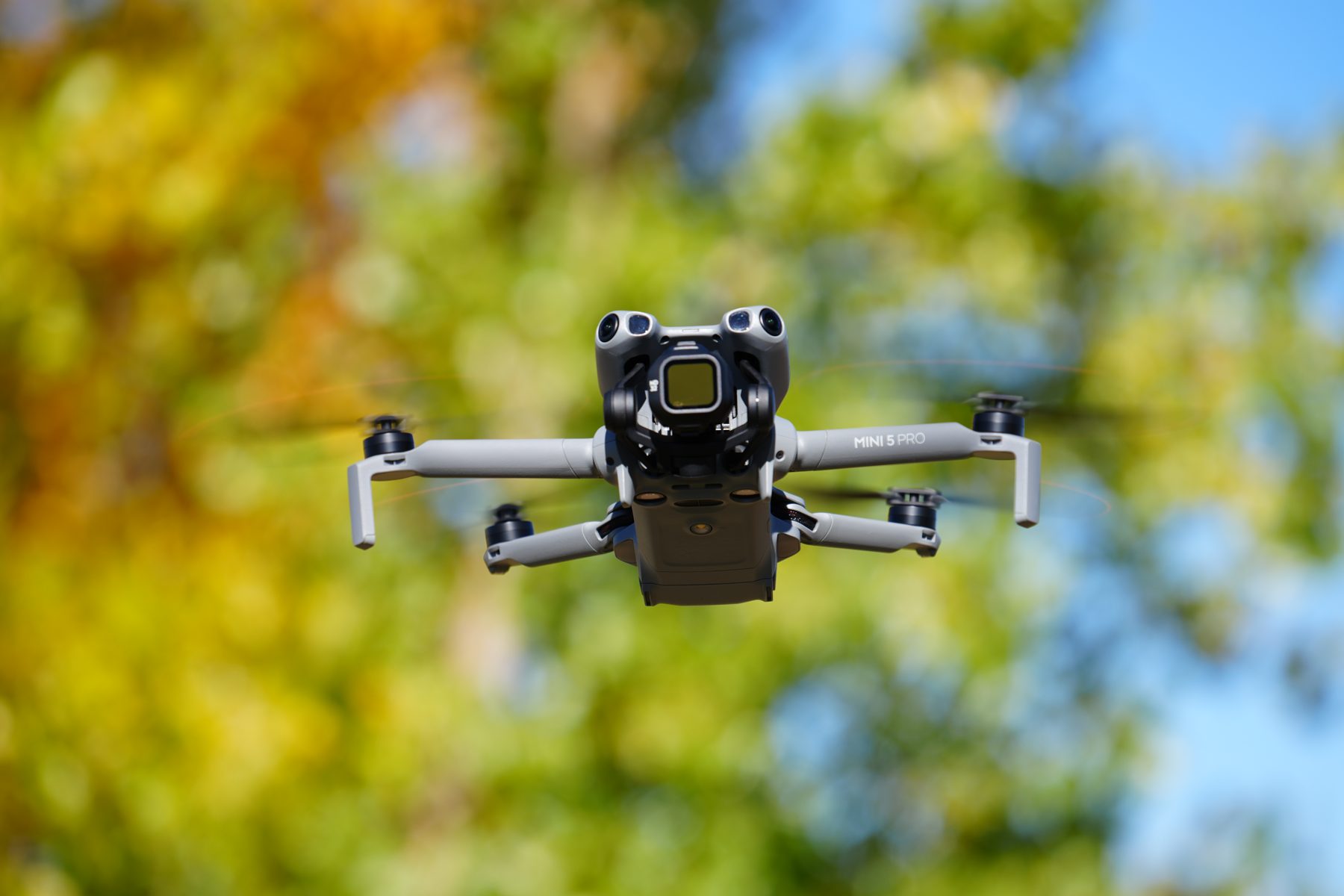
The Mini 5 Pro supports Automatic Exposure Bracketing (AEB): 3, 5 or 7 frames at 12MP, or 3 or 5 frames at 50MP, in 0.7 EV steps. Bracketing is the secret to great landscape and real estate style stills. You capture a darker frame for the sky, a brighter frame for the shadows and a middle frame for everything else, then blend them. Pair AEB with a manual panorama, where you rotate the drone and overlap your frames, and you can build huge, detailed, high dynamic range panoramas of a whole city skyline or valley. The built-in Panorama modes are also there when you want something quick for social media.
Hyperlapses are one of the best ways to tell a travel story in a few seconds: clouds rolling over a peak, traffic flowing through a city at dusk, or a boat crossing a harbor. The Mini 5 Pro’s Hyperlapse mode handles the frame capture and stitching in the drone, so you can get a polished moving time-lapse without hauling a laptop. Bring a spare battery, because hyperlapses take longer than you think.
DJI rates the standard Intelligent Flight Battery at up to 36 minutes of maximum flight time and the Intelligent Flight Battery Plus at up to 52 minutes, both measured in ideal, windless lab conditions. DJI’s own “typical” numbers are lower, about 21 minutes and 33 minutes respectively, and those are closer to what you’ll see when you’re actually flying and filming. More on that battery choice below, because it matters more than most people realize.
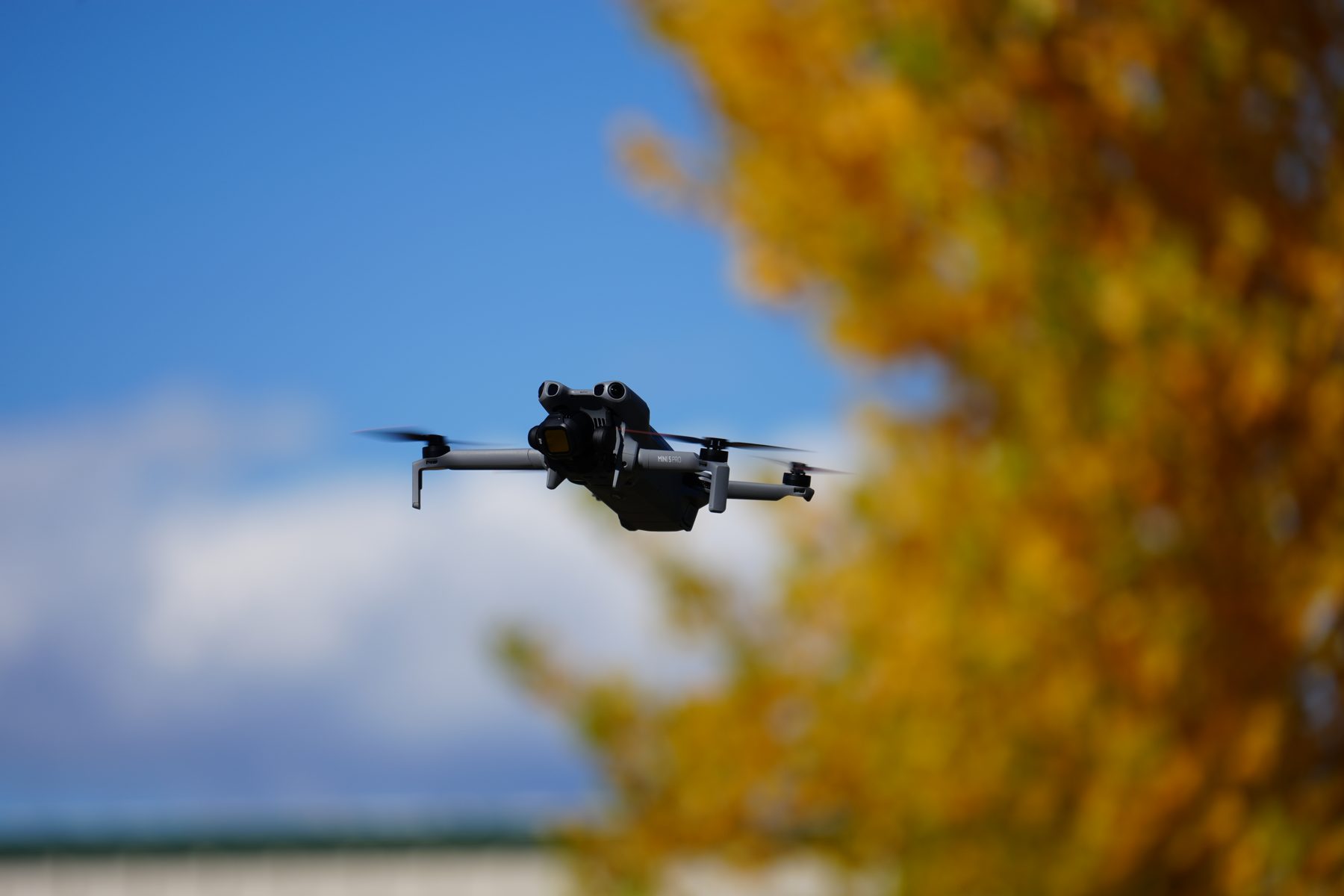
Here’s how we explain the Mini 5 Pro to people who have been flying for a while. Back in the 2016 to 2020 era, the DJI Phantom 4 Pro was the go-to drone for working pilots. It had a 1-inch 20MP sensor, and it made a living for thousands of real estate, construction and media operators. The Mini 5 Pro carries a 1-inch sensor too, now at 50MP, with a brighter f/1.8 lens and modern processing, in an aircraft that weighs a fraction of what the Phantom did. In our experience, the image quality is in the same class as that legendary workhorse, and in some situations it’s better. For a few hundred dollars, that’s remarkable.
It’s also why you’ll find Minis on professional sets. In our experience working around the film and streaming industry, productions have been known to use small DJI drones as “disposable” cameras for shots where a crash is a real possibility: tight interiors, risky low passes, or stunts where nobody wants to put a much more expensive aircraft on the line. When the image holds up well enough to cut alongside footage from big rigs, and the drone costs less than a day of rental on a cinema setup, a production can afford to take risks with it. That tells you a lot about how far this class of drone has come.
Travel almost always means people. Plazas, festivals, beaches and markets are where the great shots are, so let’s talk about the rules.
Under the FAA’s operations over people rule (14 CFR 107.110), a drone can fly over people under Category 1 if it weighs 0.55 pounds (about 250 grams) or less including everything on board or attached at takeoff, and if it has no exposed rotating parts that would lacerate human skin. Sustained flight over open-air assemblies also requires Remote ID compliance, and every other part of Part 107 still applies. If you fly commercially, you need your Remote Pilot Certificate, and our Part 107 course walks you through all of it.
Prop guards help with the “no exposed rotating parts” side of the rule. The problem is weight. The Mini 5 Pro already sits at about 249.9 grams with the standard battery, and DJI notes the actual weight can vary by plus or minus 4 grams from unit to unit. Add prop guards and you’re over the limit. Can you get a guarded Mini 5 Pro under 250 grams? Technically yes, but honestly, you’d have to take a sander to the outside of the hull to do it. That’s not a setup we’d recommend to anyone.
Here at Drone U we recommend a different approach. Run the Mini 5 Pro with the Intelligent Flight Battery Plus, which puts the aircraft at roughly 296 grams by DJI’s published battery weights (about 117 g for the Plus versus about 71.2 g for the standard battery), and apply to the FAA for an operations over people waiver for that roughly 300 gram configuration.
Why go heavier? Because we believe it’s the safer flight. The standard battery stores about 19.52 Wh at a 7.0 V nominal voltage, while the Plus stores about 33.51 Wh at 7.16 V. That’s roughly 70% more energy on board. With the standard pack, you have less power available for less time, which means less reserve to fight a headwind on the way back, to hold a steady hover in gusts, or to deal with the unexpected over a crowd. In our view, a drone with a healthy energy reserve is a safer drone to fly over people than one that’s been stripped and pushed to its limits just to hit a number on a scale.
A waiver isn’t a rubber stamp. You’ll need to explain your safety case to the FAA, including how you’ll mitigate risk to the people below. That’s exactly the kind of thinking we teach. The Plus battery is also not sold in Europe, so if you’re traveling internationally, check local rules before you pack it.
We see it every holiday season: someone buys a cheap starter drone, gets hooked, and wants a better one within a month. The Mini 5 Pro is the drone you won’t outgrow. It’s simple enough for a first-time pilot and capable enough for paid work. If you want the full breakdown of the Mini 5 Pro versus the Neo 2 and Mavic 4 Pro, read our guide to beginner friendly drones you won’t outgrow.
A drone this good deserves a pilot who knows how to use it. Our Mini 5 Pro Don’t Crash Course takes you from unboxing to confident flying: setup and firmware, camera settings for stills and video, intelligent flight modes like Hyperlapse and Panorama, AEB workflows, wind and battery management, and the habits that keep your drone out of trees and lakes. It’s the fastest way to get the most out of your new travel drone.
The DJI Mini 5 Pro is the best travel drone of 2026. You get a 1-inch, 50MP sensor, AEB, Hyperlapse, solid wind handling and Phantom-class image quality in a drone that fits in your pocket, for a price that would have seemed impossible a few years ago. Pick one up, grab a Plus battery, and take the Mini 5 Pro Don’t Crash Course before your trip.
Sources: DJI Mini 5 Pro specifications; 14 CFR Part 107 Subpart D, Operations Over Human Beings. Specs as of October 2026.
 0