

Army Trains Artillery Soldiers to Ram Enemy Drones With the Bumblebee V2 Interceptor

November 20, 2026
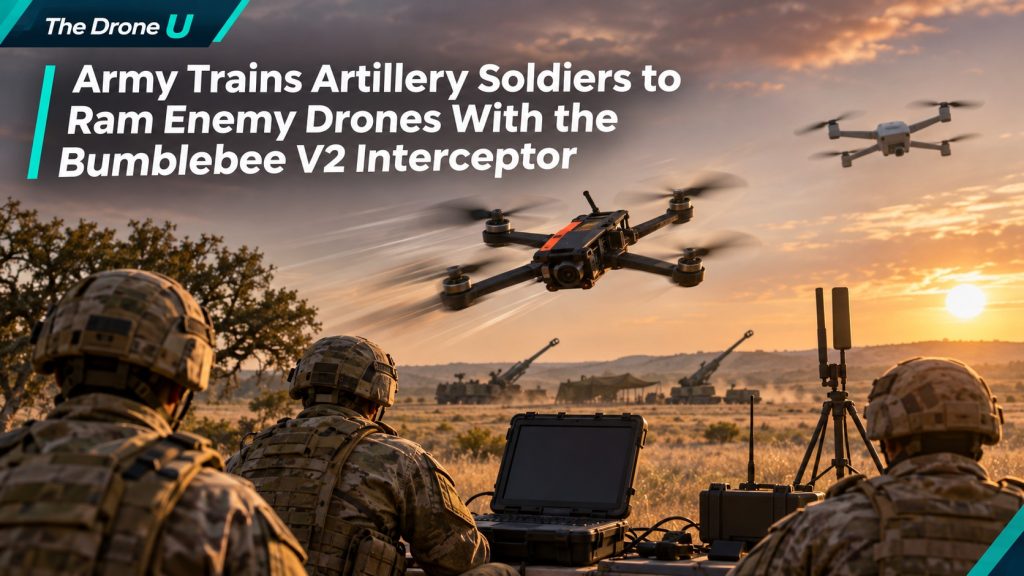
The Army is teaching artillery soldiers to knock enemy drones out of the sky with drones of their own. Joint Interagency Task Force 401 (JIATF-401), the Pentagon’s counter-drone task force, says it trained soldiers from the 1st Cavalry Division Artillery at Fort Hood, Texas, from Nov. 2 to 13 on the Bumblebee V2, a small quadcopter that defeats hostile drones by flying straight into them.
The trainees came from the division artillery’s Target Acquisition Battery sensor platoon. In the task force’s Nov. 18 release, the goals were to build operator proficiency, assess how the system fits tactically and refine counter-drone capabilities. The Army says the soldiers are integrating the Bumblebee V2 into the defense of brigade support areas and artillery positions, and that the capability will be folded into future maneuver, fires and force-protection missions.
Artillery units are an obvious target. Guns, ammunition stockpiles and support areas sit in predictable places, and cheap small drones can find and attack them with little warning. Chief Warrant Officer 2 Andrew Westerberg of the 1st Cavalry Division Artillery put it this way in the release: “Small drones can place Soldiers, equipment, and critical positions at risk with little warning.” He called the Bumblebee V2 “a practical, dual-purpose capability” that formations can put to use right away.
JIATF-401 describes the Bumblebee V2 as dual-use. It can fly intelligence, surveillance and reconnaissance (ISR) missions, and it can act as a kinetic interceptor that destroys a target drone through direct collision. The Army pitches it as a mobile, low-cost layer in a broader defense, so commanders can save more expensive interceptors for other threats.
The task force first announced the system in February, when it said it had awarded a $5.2 million agreement on Jan. 30 to Perennial Autonomy for the Bumblebee V2, with deliveries scheduled to begin in March. That earlier announcement called it a next-generation FPV multirotor that intercepts small drones in a drone-on-drone collision, leaving both aircraft inoperable, and said the approach limits collateral damage. Army photos also show a Bumblebee V2 flying during JIATF-401 training at MacDill Air Force Base, Florida, on Oct. 8.
“We are laser focused on getting effective counter-drone capabilities into the hands of our warfighters,” said Brig. Gen. Matthew Ross, the task force’s director. The Fort Hood event falls under Project Agincourt, JIATF-401’s effort to bring operators, industry and new technology together to speed up tactical integration.
The release doesn’t say how many Bumblebee V2s the division received, whether soldiers flew live intercepts against target drones or what hit rates they achieved. It also doesn’t describe a fielding decision. This was a training and assessment event, not an Army-wide rollout.
Drone-on-drone interception is spreading quickly in the military, and it adds to the counter-drone tools already in testing, from the high-energy lasers headed to a Pentagon shoot-off to the expanded federal counter-drone training for local police. Back home, civilian drone pilots won’t be on the receiving end of a Bumblebee. Federal law tightly limits who can take down a drone in U.S. airspace. But the trend matters. Military bases, including Fort Hood, are surrounded by restricted airspace and security TFRs, and the people protecting them increasingly have tools to detect drones and, where authorized, stop them.
The skills that make an interceptor pilot effective, including precise FPV control, situational awareness and airspace discipline, are the same ones that keep commercial operators out of trouble. Many military and government drone roles also expect a Part 107 certificate as a baseline. Drone U’s Part 107 course covers restricted and special-use airspace so you know where you can and can’t fly near installations.
Sources: Joint Interagency Task Force 401 Public Affairs, “DoW Accelerates Army Counter-Drone Capabilities” (Nov. 18, 2026); JIATF-401 Bumblebee V2 award announcement (February 2026).
 0