
Knoxville Police Launch Drone as First Responder Program With No Facial Recognition and a Public Flight Log

November 20, 2026
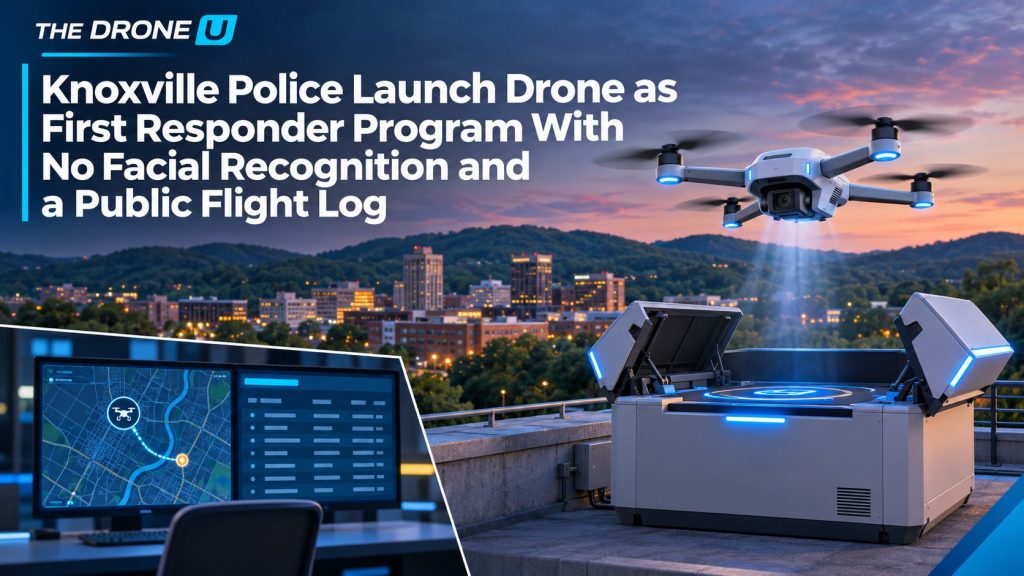
Knoxville, Tennessee, just joined the growing list of cities sending drones to 911 calls, and it did so with an unusually detailed rulebook. The Knoxville Police Department’s Drone as First Responder (DFR) program began answering calls for service on Thursday, Nov. 19, with drones launched from 12 docks across the city and a written policy that rules out facial recognition and license plate reading.
According to KPD’s Nov. 17 announcement, the drones sit pre-positioned in docks at city-owned facilities. Each can reach calls within roughly a two-mile radius of its dock. Pilots in the department’s Real Time Information Center launch and fly them remotely, so a drone can be over a 911 scene within seconds while officers are still on the way.
The hardware is Skydio. City Council approved an amended contract with Axon in January 2026 that included the Skydio drones and software needed to stand up the program. That fits a national pattern; Axon and Skydio’s public-safety partnership has become a major channel for DFR programs, as we covered in our story on Axon’s $1.2 billion Skydio investment.
Beyond police calls, KPD says the drones will respond to fires, citywide emergencies, special events and damage assessments after severe weather. Chief Paul Noel said in the release that “officers routinely respond to calls with inaccurate or changing information,” and described the drones as a way to get eyes on a call quickly and give officers better information before they arrive.
The department’s published standard operating procedure goes further than many DFR policies. Among its provisions:
One detail stands out for anyone hoping to fly public safety drones. The SOP requires every KPD DFR pilot to hold a current FAA Part 107 remote pilot certificate and to complete manufacturer-approved training before serving as pilot in command. It also requires pilots to keep their Part 107 currency every two years. The SOP defines DFR drones as flown beyond visual line of sight and requires pilots to keep any applicable FAA waivers or authorizations accessible at the ground control station.
DFR is one of the fastest-growing drone jobs in the country, and Knoxville’s policy shows what those jobs look like: remote pilots working from a command center, flying BVLOS under FAA approvals and documenting every flight for public review. A Part 107 certificate is the entry ticket. Drone U’s Part 107 course prepares you for the FAA knowledge test and the airspace knowledge these programs rely on.
For hobbyists and commercial pilots in Knoxville, expect to see more police drones overhead, especially near emergency scenes. Stay well clear of active incidents, and check for TFRs before flying near large fires or disasters. For more on the tools DFR crews are adopting, see our look at BRINC’s LiveOps app for first responders.
Sources: Knoxville Police Department announcement (Nov. 17, 2026); KPD Unmanned Aircraft (Drone) Standard Operating Procedure.
 0