

Army Lines Up 400 Drones for Its Manufacturing Rodeo as Pentagon Courts Automakers for Drone Parts

November 27, 2026
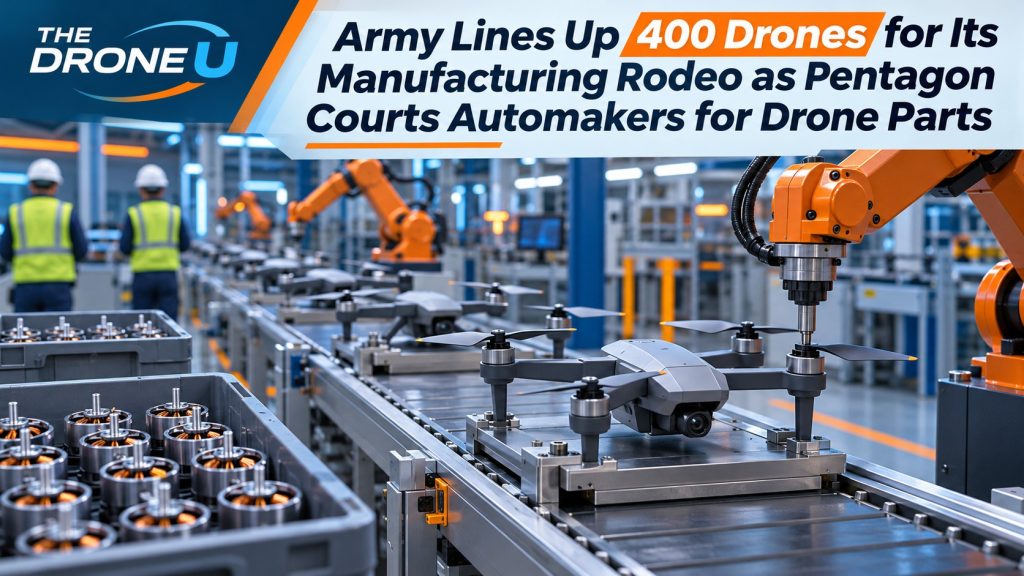
The Pentagon is attacking its drone production problem from two directions at once. The Army is setting up contracts to build hundreds of small drones on a shared government assembly line, with an option to scale up to 10,000 aircraft. Meanwhile, defense officials have reportedly been talking with General Motors, Ford and auto supplier Magna about making motors, sensors and other drone parts. DroneLife flagged both developments this week, and both point to the same goal: building drones in America at a volume the country hasn’t managed before.
In a Nov. 20 update posted to DVIDS, Army Contracting Command said it is coordinating contract awards for a project called STAMPEDE, short for Supply-Chain Testing & Advanced Manufacturing Prototype Evaluation for Defense Expansion. STAMPEDE is part of the Army’s “Manufacturing Rodeo,” which the service first announced in October at the AUSA annual meeting.
The first order is concrete: 400 drone systems and 20 durable ground control systems, to be built for the Drone Dominance Gauntlet in March 2027. The aircraft will be assembled from standardized components produced at several sites in the Army’s organic industrial base, the network of government-owned depots and arsenals. The contract also includes an option for up to 10,000 aircraft. ACC said the goal is a cooperative, high-volume assembly line that removes single-point failures in the supply chain.
That option is not a confirmed buy, as DroneLife pointed out. The idea is that private companies bring designs, software and engineering, while the government brings factory floor space. For smaller drone makers, this could mean scaling up without raising the money to build their own plants.
The second track involves the auto industry. The Wall Street Journal reported Nov. 24 that the Pentagon has held early talks with GM, Ford, Magna and some manufacturers outside the auto sector. The idea is for them to supply drone companies with parts such as actuators, engines, sensors and lidar. According to the Journal, GM is weighing whether to build drone motors. Reuters could not independently verify the report and noted that no deals have been finalized.
Ford told Reuters its talks with the Pentagon centered on military vehicles and a satellite venture, and it did not mention drones. GM declined to comment on the report directly but said its defense unit has “demonstrated our commitment to reinforce the US defense-industrial base.” A Pentagon official told Reuters the department is “actively partnering with domestic manufacturers, suppliers, and emerging tech firms” to build up capacity for unmanned and autonomous systems.
Automakers know high-volume assembly, quality control, electric motors and battery management. Those are the areas where U.S. drone makers have had the hardest time matching Chinese suppliers on price.
None of this changes how you fly under Part 107 today. These are military programs, and the 400 STAMPEDE drones are headed for a weapons-focused competition. Still, there are a few reasons commercial pilots should pay attention.
We’ve tracked how these defense programs are reshaping the industry, from DIU’s $500 million long-range strike challenge to Red Cat’s warning that defense orders arrive slowly. If you want to be ready for the jobs this build-out creates, start with your certificate. Drone U’s online Part 107 course prepares you for the FAA knowledge test.
Sources: U.S. Army Contracting Command via DVIDS (James Rawlinson, Nov. 20, 2026); DroneLife (Miriam McNabb, Nov. 25, 2026); DroneLife (Miriam McNabb, Nov. 25, 2026); The Wall Street Journal (Nov. 24, 2026); Reuters (Nathan Gomes, Nov. 24, 2026).
 0