
Airspeeder Signs Advanced Navigation as Its Flying Car Racing Series Heads to Its First Race in Adelaide
November 25, 2026
The Airspeeder electric flying car racing series has signed Advanced Navigation, an Australian navigation and autonomy company, as its official navigation partner. The deal was announced Nov. 23 in Adelaide, South Australia, shortly before the series’ first race there. It’s motorsport on the surface, but the engineering problem underneath is one every drone and eVTOL developer faces: knowing exactly where a fast aircraft is and where it’s going, with no margin for error.
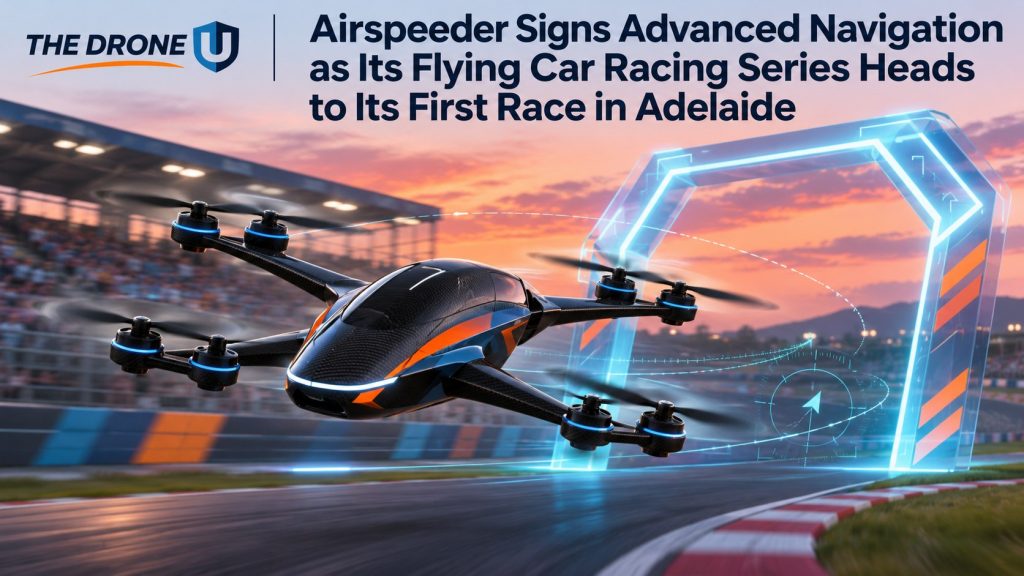
Airspeeder’s aircraft, the Mk3, is a full-size electric multicopter with eight rotors, a carbon fiber frame and a 96-kilowatt electric powertrain. Airspeeder says it can top 120 km/h (about 75 mph) and lists its weight at roughly 100 kilograms, with better than a 2:1 thrust-to-weight ratio. Nobody rides in it. Pilots fly remotely and follow virtual racecourses that augmented reality lays over the real landscape, so each “gate” exists only in the pilot’s view.
The inaugural International Series has five national teams flying identical Mk3C aircraft built in Adelaide. The pilots are Thomas Bitmatta for Australia, Mason West for the DeLorean team representing the United States, Dan Miles for Great Britain, Patrick Lombardi for Italy and Seth Moore for New Zealand. Airspeeder describes the opener as a private race in Adelaide this month, and a second race is planned for April 2027. Airspeeder says future races could be held over snow, oceans, deserts and canyons.
Hairpin turns, hard acceleration and sudden climbs and drops stress any navigation system. Under the partnership, Advanced Navigation will fit the Mk3 with high-performance sensors that report position, velocity and orientation in real time. The goal is tighter flight control, quicker response in dynamic maneuvers and dependable navigation when aircraft race close together. The same data is meant to give pilots and pit crews more insight into how each aircraft is performing. For fans, it could support live 3D tracking and virtual cockpit views.
“Airspeeder exists to push advanced air mobility systems to their limits,” said Matt Pearson, Airspeeder’s CEO and co-founder. “At the speeds we’re reaching, there is no margin for error.”
Advanced Navigation sees the series as a test bed. Engineers will use races to evaluate navigation performance and refine the sensor fusion software that blends multiple inputs into one position estimate. CEO and co-founder Chris Shaw called Airspeeder “a flying laboratory for technology uses beyond motorsport.” He said the work could support high-speed fixed-wing drones, cargo eVTOLs, autonomous helicopters and tiltrotors, including in contested or GPS-denied environments.
For more on where personal and passenger eVTOLs stand, see our coverage of the eVTOL demos at Kennedy Space Center and the HayesX 250 personal eVTOL.
Racing pilots fly big multicopters at speed using a screen and sensor data, which is the same thing commercial pilots do on a smaller scale. That makes navigation quality and failsafe behavior worth paying attention to. When GPS degrades near steel structures, under bridges or in jamming, your drone leans on its other sensors, and you need to know how it behaves when they disagree. Learn your aircraft’s attitude mode, practice flying without position hold, and plan an emergency landing spot before every flight. After the DJI ban, many pilots are moving to new platforms, so that kind of practice matters more than ever.
Also note the weight. A roughly 100-kilogram aircraft is far above Part 107’s 55-pound limit, so flying something like the Mk3 in the U.S. would need separate FAA approval. If you’re starting with smaller drones, students have been known to take Drone U’s online Part 107 course in 3 days and pass the test.
Sources: Airspeeder announcement (Nov. 23); DroneLife (Miriam McNabb, Nov. 24); Airspeeder pilot line-up (Nov. 5).
 0