

Amazon Prime Air Drone Hits a Wire and Lands on a Michigan Garage After a Shampoo Delivery

November 23, 2026
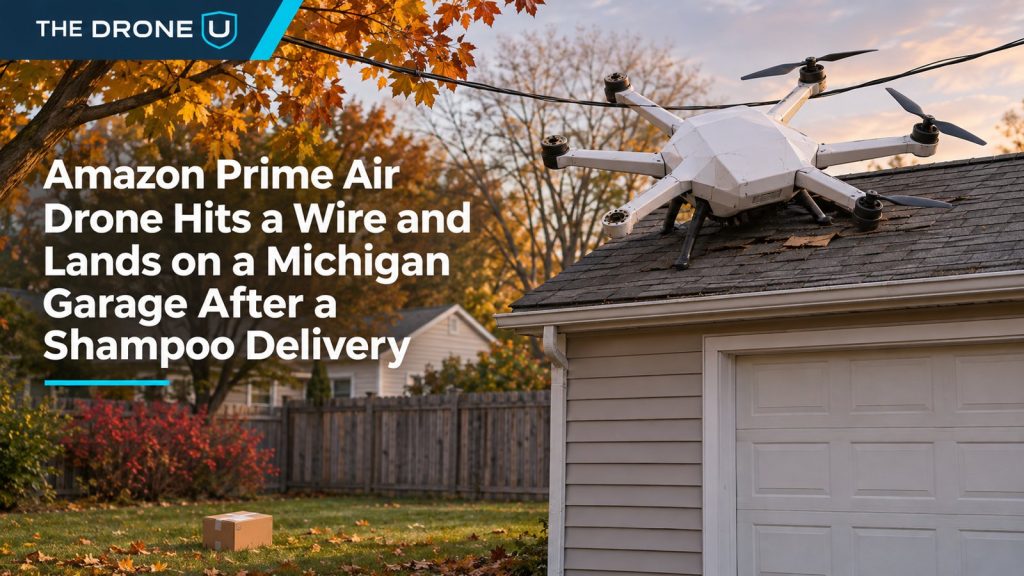
An Amazon Prime Air delivery drone came down on a garage roof in Huntington Woods, Michigan, on Friday afternoon after striking an overhead line on its way out of a customer’s backyard. Nobody was hurt. The delivery was a bottle of shampoo.
Detroit’s WXYZ-TV reported the incident, which happened just before 4:30 p.m. EST on Friday, Nov. 20. It was the household’s first drone delivery, and the family had been notified that the package would arrive by drone in about seven minutes.
Resident Jim Brennan told the station the drone came in horizontally, switched to vertical flight and descended into his backyard rather than the front yard where he was waiting. By the time he got around back, the package was on the ground and the drone was climbing again. He said it rose under a wire, caught it and lost control.
According to Brennan, the drone hit a fiber-optic line and lost a propeller, then drifted to the neighboring property and wedged itself between the garage roof and an electrical cable. Utility DTE was called out. The neighbor, Logan Coomes, told WXYZ that an Amazon Prime Air team arrived within about 10 minutes and recovered the aircraft around 7:30 p.m. with DTE’s help. He described lifted shingles and a spot near the peak of the roof that he worried could leak.
Amazon’s description differs slightly. In a statement to WXYZ, spokesperson Jack Stelzner said a Prime Air drone “landed on a resident’s shed” during a delivery, that no one was injured, that the drone had been removed and that Amazon investigates anytime a delivery doesn’t go as planned. Amazon confirmed the flight came from its Hazel Park site. Coomes said the company offered to cover damage and gave him a $100 Amazon gift card. Brennan said his home has since been put on a no-drones list.
WXYZ noted that MK30 incidents have previously been reported in Arizona and Texas. Sources told the station this wasn’t the first crash in Michigan, which Amazon denies. The company says Prime Air has delivered hundreds of thousands of packages this year and that incidents are extremely rare.
The FAA’s final environmental assessment for Amazon’s Detroit-area sites, signed in May 2026, covers the Hazel Park and Pontiac locations. It describes the MK30 as weighing about 78 pounds, with a maximum takeoff weight of about 83.2 pounds including a payload of up to 5 pounds. The drone has six motors, cruises at up to 73 mph and has an operating range of 7.5 miles from its base. En route flights typically stay between roughly 180 and 377 feet AGL, and the drone descends to release the package. The assessment evaluated up to 1,000 delivery flights per day at each site between 6 a.m. and 10:30 p.m. Prime Air operates under a Part 135 air carrier certificate and an FAA exemption that permits beyond-visual-line-of-sight flights.
For more on how communities are reacting as Prime Air expands, see our recent story on Amazon’s Nampa launch and Westborough withdrawal.
Wires are one of the oldest hazards in low-altitude flying, and this incident shows they’re still a problem for a large, sensor-heavy delivery aircraft operated by one of the world’s biggest companies. The riskiest part of almost any flight is close to the ground, where trees, lines and structures crowd in. That’s true when you’re climbing out of a backyard and when you’re descending for a roof inspection or a real estate shot.
For Part 107 operators, the lessons are familiar: walk the site before you launch, look up for lines that are hard to see against the sky, plan your climb-out path, and don’t count on obstacle avoidance to catch thin wires. If a flight ends in serious injury or property damage over $500, not counting the drone itself, you must report it to the FAA within 10 days. Those rules and the risk-management habits behind them are part of Drone U’s Part 107 course.
Incidents like this also shape how neighborhoods feel about drones in general. Every visible crash, even one with no injuries, makes it harder for every operator who flies over people’s homes.
Sources: WXYZ-TV Detroit (Faraz Javed and Jon Austin); FAA Final Environmental Assessment, Amazon Prime Air Detroit-area operations (May 2026).
 0