

Drone Pilot Training Online (2026): How to Choose a Course, What It Costs and What You’ll Learn

October 8, 2026
Drone pilot training online is the fastest, most affordable way to get your FAA Part 107 certificate and build real-world skills, but only if you pick the right course. Some courses are current and taught by working pilots. Others are recycled slide decks that haven’t caught up with the rules.
This guide covers the types of drone training, what to look for before you buy, what it really costs and how to match a course to your goal. It’s written for career changers, hobbyists going pro and anyone who wants to fly legally for work.
“Drone training” covers a lot of ground. In practice, drone pilot training falls into four buckets, and most pilots move through them in order.
This is where almost everyone starts. After all, to fly for work under 14 CFR Part 107, the FAA requires a Remote Pilot Certificate, which means passing the Unmanned Aircraft General – Small (UAG) knowledge test. Prep courses cover regulations, airspace and sectional charts, weather, loading and performance, airport operations, night operations and emergency procedures.
Our online Part 107 course is built for exactly this, with on-demand video lessons and quizzes that tell you when you’re ready.
Here’s the catch: the Part 107 test doesn’t include a flight check. So a certificate proves you know the rules, not that you can fly a tight orbit in wind or recover from a lost link. Flight skills training fills that gap with structured drills, emergency procedures and safe operating habits.
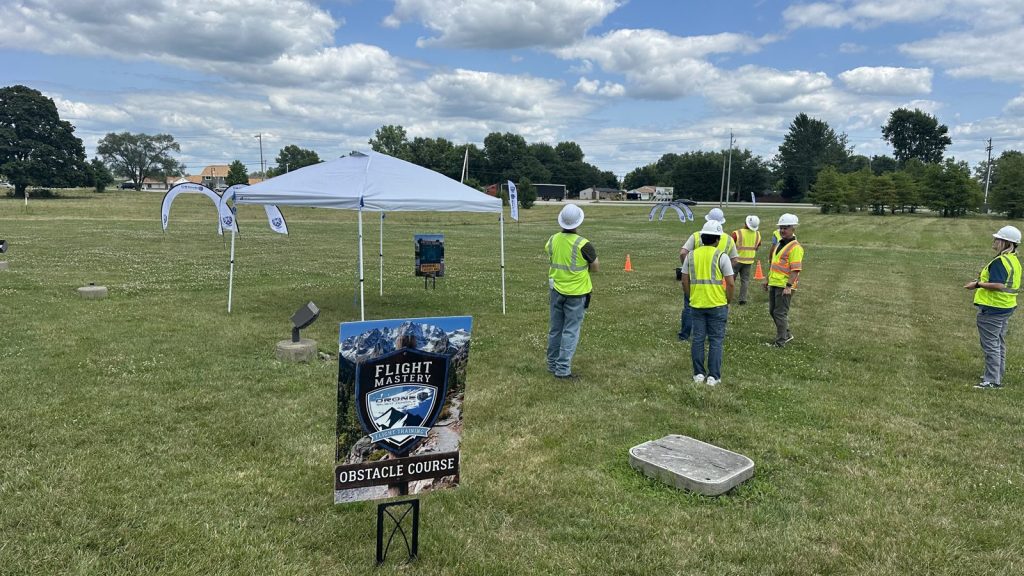
You can start for free. For example, our free courses include Drone Flying Essentials from our Don’t Crash series. For teams that need hands-on proficiency, our in-person Flight Mastery training runs through our enterprise programs.
Once you’re certified, clients pay for outcomes, not flight time. That’s why industry training teaches the workflow behind a deliverable:
Organizations need more than individual certificates. Instead, they need repeatable standards, recurrent training and proof that every pilot can perform. That’s where blended online and in-person drone pilot training comes in, delivered through programs like ours.
Both have a place. However, for most individual pilots, online drone pilot training is the right first step.
Keep in mind, though, that even with online prep, you’ll take the Part 107 test itself in person. The FAA requires you to schedule it at an FAA-approved Knowledge Testing Center and bring a government-issued photo ID.
So when does in-person make sense? In our experience, it’s worth it when you need hands-on feedback on specific maneuvers, when a team has to fly to one standard, or when the work itself carries real risk, like inspections near structures. For a solo pilot heading into real estate or mapping, by contrast, online study plus deliberate practice in open airspace covers most of what you need.
For the full comparison, read online drone training vs. in-person.
Not all courses are equal. So before you buy, check these five things.
The test changes, and courses have to keep up. For example, starting October 26, 2026, the UAG test adds image-based questions from current FAA sectional charts. A good course should already teach chart reading as a skill, not as memorized supplement figures. See our breakdown of the Part 107 test changes.
Also look for coverage of Remote ID, night operations and operations over people. The night and over-people rules took effect in April 2021, and Remote ID compliance began September 16, 2023. Any course that skips them is out of date.
Ask who built the course and what they do in the field. In our experience, real-world experience shows up in the details: how to plan a job, when not to fly and what goes wrong on site.
You want timed, full-length practice and feedback on what you missed, because that’s how you find weak spots before test day. Start with our free Part 107 practice test to see where you stand.
A money-back window lets you try the course with less risk. Our Part 107 course, for instance, carries a 14-day money-back guarantee. Similarly, lifetime access means you can come back for a refresher before your recurrent training.
Rules move. As a result, a course that’s updated, with a place to ask questions, is worth far more than a one-time download.
One honest note: the FAA publishes free study material, including the Remote Pilot Airman Certification Standards (ACS) and a Remote Pilot Study Guide. They’re worth reading. But the study guide is dated August 2016, so it predates the 2021 night and over-people updates. That’s where a current course earns its keep.
In short, the cheapest course isn’t a bargain if it teaches you the wrong rules.
Drone U has 10+ years of in-person drone training and 14+ years of online drone education. Here’s how we’d match your goal to a starting point:
| Your goal | Where to start |
|---|---|
| Pass the Part 107 test | Part 107 course |
| Get certified and build flight skills | New Pilot Bundle |
| Real estate photo, video and tours | Real Estate Drone Bundle |
| Mapping and 3D models | Comprehensive Mapping and Modeling Bundle |
| Construction documentation | Construction Drone Bundle |
| Inspections | Inspections Bundle |
| Explore thermal | Intro to Drone Thermography (free) |
| Train a team or agency | Enterprise Drone Programs |
Want everything instead? A Drone U membership includes 47+ courses across every high-paying vertical, plus monthly coaching calls with our instructors and members. See membership details.
The good news: getting certified doesn’t take a big budget. Here are the numbers we can confirm for drone pilot training and certification:
| Item | Cost |
|---|---|
| FAA Part 107 knowledge test | About $175 at testing centers (per the FAA) |
| Drone U Part 107 course | $147 (regularly $197), lifetime access |
| Drone U membership (all courses) | $97/month, cancel anytime |
| Part 107 drone registration | $5 per drone, valid 3 years |
| FAA recurrent training (ALC-677), every 24 calendar months | Free |
There are free options, too. Specifically, our free courses include a Part 107 Test Prep Starter Kit. For a deeper breakdown, read our drone license cost guide.
What you don’t need: an expensive drone to pass the test. The knowledge test doesn’t involve flying, so you can study first and buy the right aircraft once you’ve picked a niche.
Online courses only work if you finish them. Here’s the routine we recommend:
Meanwhile, keep flying. The best programs pair study time with stick time, so the rules and the flying click together.
Can I get my drone license entirely online?
You can complete your drone pilot training online, but the UAG knowledge test is taken at an FAA-approved Knowledge Testing Center. However, pilots who already hold a Part 61 certificate with a current flight review can instead complete the FAA’s online Part 107 Small UAS Initial (ALC-451) course.
How long does online drone training take?
Many students finish our Part 107 course in 7–14 days with 1–2 hours of study per day. Some pass in as little as 3 days.
Do I need to know how to fly first?
No, because the Part 107 test doesn’t cover flight skills. Still, we strongly recommend flight practice before you take paid work.
Is online drone training worth it?
In our experience, yes, if the course is current and taught by working pilots. Otherwise, you’re paying to learn outdated material.
How do I keep my certificate current after training?
Complete the FAA’s free online recurrent training (ALC-677) every 24 calendar months. Our Part 107 renewal guide walks through it.
Every path in this guide starts with the Part 107, and every good drone pilot training plan keeps going after it. We don’t teach hype. We teach what works—because we fly it ourselves.
Start with Part 107 for $147 (regularly $197). You get on-demand video lessons, FAA-aligned quizzes (score 90%+ and you’re ready), a downloadable study guide, the private Drone U community, lifetime access and a 14-day money-back guarantee.
Training a team? Explore our Enterprise Drone Programs, or book a consultation to build a training plan for your organization.
Sources
 0
0
