
Online Drone Training vs. In-Person: Which Option Is Right for You?

August 27, 2026
Quick AnswerOnline drone training works best for most people. It costs less. You study on your own schedule. Most courses give you everything you need to pass the FAA Part 107 exam. In-person training costs more, but it moves faster. You get live feedback from an instructor. You also get hands-on help with hard topics like airspace and sectional charts. Both paths lead to the same FAA Remote Pilot Certificate. The right choice depends on how you learn, what you can spend, and how fast you need your license. |
Choosing how to train is one of the first big decisions on your way to a drone license. Get it right, and you save time and money. Get it wrong, and you waste both.
This guide breaks down online drone training in full. You’ll learn what it includes, what it costs, and how long it takes. You’ll also see how it stacks up against in-person courses. By the end, you’ll know which path fits you best.
Online drone training prepares you for the FAA Part 107 exam. You learn through video lessons, study guides, and practice questions. You do it all online, on your own time. No classroom. No fixed schedule.
It’s the most popular way to prepare for the Part 107 Remote Pilot Certificate. This certificate lets you fly drones for commercial work.
Online drone training covers the same core topics as in-person courses:
One thing online drone training usually skips: hands-on flight instruction. The Part 107 exam doesn’t test your flying skills. So most online courses focus only on the written test. If you want to learn to fly well, plan for separate flight training after you pass.
Next, let’s look at what a strong course actually includes.
Good online drone training courses share a few common features. Top providers typically include:
Some premium tiers add live Q&A webinars or direct instructor messaging. This closes part of the feedback gap that self-paced courses usually have.
Next, let’s look at what these courses actually cost.
Most reputable online drone training courses cost $99 to $300 for full access. That’s roughly one-third to one-fifth the price of in-person training.
This makes online drone training the most budget-friendly structured option available. Self-study with free FAA materials costs even less. But it lacks structure. It also lacks any feedback loop.
Many online drone training providers offer money-back guarantees. Some reimburse your exam fee if you fail. Read the fine print first. Most guarantees require you to finish the course. You also need to score well on practice exams before you qualify.
Cost is only half the equation. Let’s look at how much time you’ll actually need to invest in the next section.
Course ads often promise certification “in a few weeks.” Some even push a “14-day challenge.” The real number looks different.
Most students need 15–20 total study hours to feel ready. You’re likely fitting this around a full-time job. So it usually takes 2–4 weeks of steady study.
Inconsistent study stretches this timeline. Some students take 2–3 months to finish. The lesson here is simple: consistency matters more than course length. Set a weekly study goal and stick to it. A structured practice test can help you track your progress along the way.
With cost and timeline covered, here’s a clear look at the upsides and trade-offs.
| Pros | Cons |
|
|
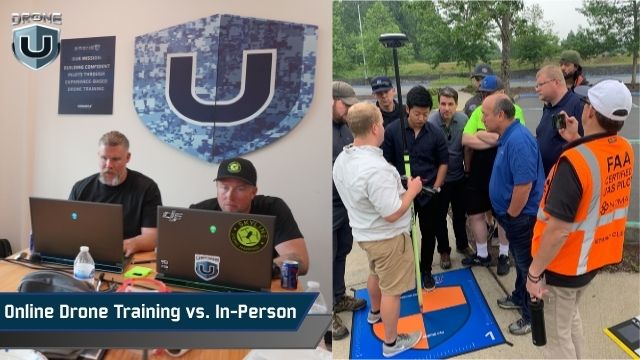
Now that you know the trade-offs, let’s compare online training directly against the in-person option.
| Factor | Online Drone Training | In-Person Training |
| Typical cost | $99–$300 | $400–41,500 |
| Typical time to complete | 2–4 weeks (15–20 study hours) | 1–2 days |
| Schedule flexibility | High. Study anytime | Low, fixed dates and location |
| Live instructor feedback | Rare (some premium tiers only) | Immediate |
| Best for airspace and sectional charts | Moderate(rewatchable video) | Strong (live Q&A) |
| Accountability | Low to moderate | High |
| Flight skills practice | Rarely included | Often included |
| Networking opportunity | Minimal (online communities) | Strong (in-person classmates) |
| Best learner type | Self-motivated, visual, or independent learners | Hands-on learners who need live feedback |
Both paths lead to the same exam. You’ll answer 60 multiple-choice questions in 120 minutes. You need a 70% score to pass. The exam costs about $175 per attempt. If you fail, you wait 14 days before you can retake it.
For a full breakdown of exam rules and scoring, see our Part 107 exam guide.
With the numbers laid out, let’s explore which path actually fits you.
Online drone training fits you if:
In-person training may fit you better if:
If speed and structure matter more to you than cost, read our full guide on in-person Part 107 training options before you decide.
Freelance drone pilots earn $25 to $200 per hour, depending on the job. Full-time drone pilot roles pay roughly $35,000 to $88,000+ per year. Specialized fields often pay more.
You can see full salary ranges by specialty in our drone pilot career guide.
A failed Part 107 exam costs $175 to retake. You also lose 14 days waiting to try again.
Online drone training gives you the lowest-cost path to the same FAA certificate. If you’re disciplined, there’s no financial reason to spend more. The math shifts only if speed matters.
If a faster license means you start earning sooner, the extra cost of in-person training can pay for itself fast. One paid drone job often covers the price difference.
Cost aside, not all courses deliver the same value. Here’s what to check before you enroll.
Not every online drone training course delivers the same value. Before you pay, check for:
Once you’ve picked a course, don’t stop at video lessons. Practice testing is what actually gets you ready.
Watching a video and understanding a topic are two different things. You need to apply that knowledge under real exam conditions. That’s what practice testing builds.
Look for a system that includes:
Most instructors recommend a score of 85% or higher on practice exams before you schedule the real test. That buffer covers exam-day nerves and the random question set you’ll actually see. Try our Part 107 Practice Test and Exam Readiness System to check where you stand.
Even with a solid course and strong practice scores, a few pitfalls trip up students again and again.
Most students who fail the Part 107 exam don’t fail because the material is too hard. They fail because of a few avoidable habits. Watch out for these five mistakes.
1. Underestimating airspace and sectional charts. These topics cause the most first-attempt failures. Don’t treat them as just another chapter.
2. Confusing course completion with exam readiness. A finished progress bar doesn’t mean you’re ready. Your practice-test scores tell the real story.
3. Choosing the cheapest course without checking quality. A $99 course with a thin question bank can cost you more in a failed $175 retake than a better course would have.
4. Ignoring your own track record with self-paced learning. If you’ve dropped online courses before, that’s useful information. An in-person deadline might be worth the extra cost.
5. Skipping flight practice entirely. Passing Part 107 makes it legal to fly for pay. It doesn’t make you skilled. Build in real flight time before you take paid jobs. Local instructors can help. Nashville Drone Co offers hourly hands-on lessons in Nashville. You get stick time without committing to a multi-day class.
Online drone training gives you the most accessible, cost-effective way to prepare for the FAA Part 107 exam. It fits most self-motivated learners well. It won’t fit everyone, though.
If you’ve struggled with self-paced study before, or you need your license fast, in-person training may serve you better. The same goes for hands-on flight practice alongside exam prep.
Whichever path you choose, don’t skip practice testing before exam day. It’s the single biggest predictor of a first-attempt pass, no matter how you studied.
Start with our free Part 107 practice questions to see where you stand today.
 0
0