
Forsyth County Sheriff Builds the First U.S. A2Z AirDock Network for Drone as First Responder Flights
November 24, 2026
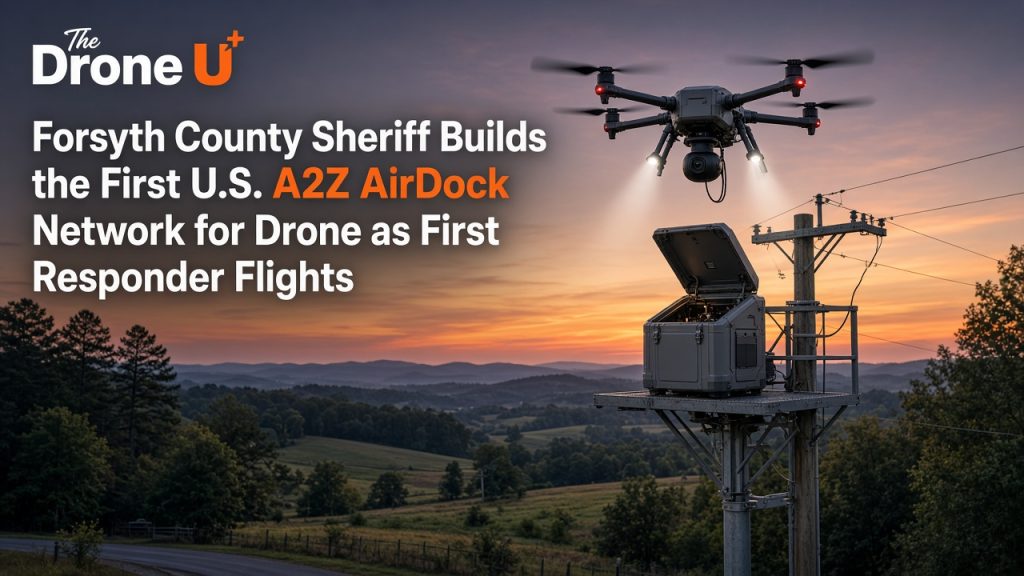
The Forsyth County Sheriff’s Office in North Carolina has put drones in automated docks around its county so they can launch on a 911 call without a deputy driving out to each one. The agency is the first in the U.S. to deploy A2Z Drone Delivery’s AirDock stations. It’s an early look at how drone as first responder (DFR) programs grow beyond a single rooftop launch site.
A2Z, based in Torrance, California, announced the deployment last week. The sheriff’s office has three AirDock stations installed so far. According to A2Z, they give the agency’s drone team a service area of up to 200 square miles around Winston-Salem. The docks launch, recover and recharge the aircraft automatically, so nobody has to travel to each site to swap batteries or service the drone between missions. A2Z says the docks have no moving parts, a “solid state” design meant to cut maintenance and the cost of each site.
The aircraft is A2Z’s Longtail Patrol. The company lists these capabilities:
The agency is using the system for calls for service, search and rescue, criminal investigations and getting automated external defibrillators (AEDs) to the scene. In its first few weeks, the program flew more than 500 miles over 25 flight hours, according to A2Z.
“Drone as first responder technology gives us another tool to help protect our community, provide deputies with critical information sooner, and reach people who need assistance,” Sheriff Bobby Kimbrough Jr. said in the announcement.
Cpl. John Lasley, who leads the department’s drone team, pointed to staffing. “Something that drone operators often forget about when setting up operations is just how many hands-on people you actually need for these missions,” he said. “The AirDocks drastically reduce the manpower needed for the whole operation.”
Docked drones only pay off if they can fly beyond the operator’s line of sight. The FAA has published a Certificate of Waiver for the Forsyth County Sheriff’s Office (91.113-2026-00525). It covers public aircraft operations within and beyond visual line of sight and is effective from April 28, 2026, to April 30, 2030. Under its special provisions, BVLOS flights can go without a visual observer if the drone stays at or below 200 feet above the ground. In Class G airspace it can also fly up to 100 feet above an obstruction within 100 feet of the aircraft, capped at 400 feet AGL. In controlled surface-area airspace, it must stay at or below 200 feet or the facility map altitude, whichever is lower. The remote pilot must also use a detection system to spot aircraft broadcasting ADS-B Out, and any flight that comes within 500 feet of a crewed aircraft must be reported to the FAA. The waiver doesn’t name A2Z or the docks, so it isn’t clear whether every dock flight runs under it.
For other approaches to DFR, see our coverage of Knoxville’s new program and BRINC’s LiveOps app.
Docks are changing the job for public safety pilots. With aircraft already in place, the pilot’s work shifts from carrying and launching to remote monitoring, airspace awareness and decision-making, often for several aircraft spread across a county. Low-altitude limits like 200 feet AGL, ADS-B detection and strict reporting rules are what make that possible, and they’re worth understanding even if you never fly for an agency.
If you’re in the Winston-Salem area, expect to see sheriff’s drones more often, and give them plenty of room. Agencies building programs like this need pilots who know the regulations well. Drone U’s Part 107 course is a practical first step toward that kind of work.
Sources: A2Z Drone Delivery; Police Magazine (A2Z announcement, Nov. 19); FAA Certificate of Waiver 91.113-2026-00525.
 0