

Drone for Hunting: Tennessee’s Deer Recovery Rule and Why It Requires Part 107

October 23, 2026
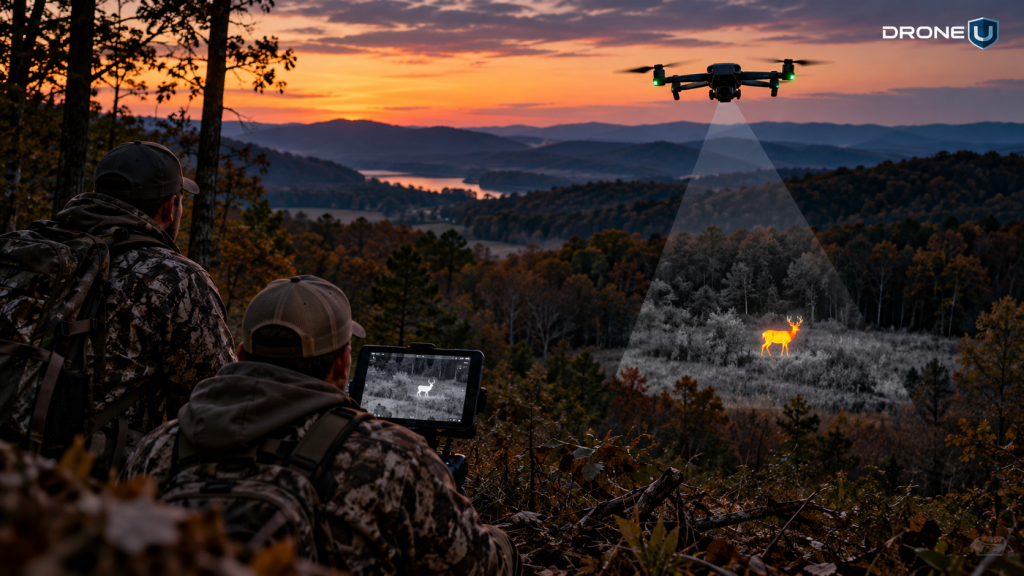
Search for a drone for hunting and you quickly hit a hard truth: in nearly every state, you cannot use a drone to hunt. What a growing number of states now allow is narrower and far more practical. Hunters can use a drone, usually with a thermal camera, to recover an animal that has already been shot. Tennessee is one of the newest states to open that door, and its rule comes with a requirement that catches a lot of hunters off guard: the pilot must hold an FAA Part 107 Remote Pilot Certificate.
This guide walks through what the Tennessee law and the Tennessee Wildlife Resources Agency (TWRA) rule actually say, how the FAA’s rules stack on top, what gear works, and a step-by-step recovery workflow you can use this season.
Tennessee’s drone recovery rule came together in two stages.
In 2025 the General Assembly passed HB 175 / SB 130. It cleared the House 86-0 and the Senate 32-0, was signed on May 21, 2025 and became Public Chapter 478. The law did not legalize drone recovery on its own. It authorized the Tennessee Fish and Wildlife Commission to write rules allowing drones to be used solely to locate and retrieve wounded deer, on private property only. As TWRA’s 2025 legislative roundup noted, drone use was not allowed until those rules were written.
The Commission approved the drone recovery rule at its January 2026 meeting in Dyersburg. TWRA set August 1, 2026 as the target effective date, subject to review by the state Attorney General and the legislature’s Joint Government Operations committee, according to TWRA’s meeting summary. The rule, TWRA Rule 1660-01-33-.02 (Deer Recovery Using Unmanned Aircraft), now appears in Tennessee’s 2026 hunting regulations and on the TWRA hunting page. Before you fly, check that page for the current version.
According to TWRA:
The rule draws a bright line between finding a deer and hunting one. You can’t use a drone to scout game before a hunt, push deer toward a stand, or look for a wounded animal while carrying a rifle or bow. If the animal is found alive, the drone’s job is over. The rule’s no-weapon requirement means the follow-up has to happen separately and within the rest of Tennessee’s hunting rules.
Tennessee treats paid recovery services differently from people recovering their own deer.
Commercial operators must complete a one-time, no-fee registration through TWRA’s ReadyOp Drone Operator Registration Form. It asks for contact information, an FAA Remote Pilot Certificate number and the regions you cover (or a statewide designation). Before and after every recovery attempt, successful or not, commercial operators also file a Drone Operator Pre-Recovery form and a Drone Operator Post-Recovery form.
Private landowners and non-commercial hunters do not report through ReadyOp. They still must follow every other part of the rule: the Part 107 certificate, the time window, landowner permission, the thermal requirement and the no-weapon rule.
A hunter arrows a buck on his family’s farm at last light and loses the blood trail. At 7:15 p.m., well past 30 minutes after sunset, his brother, who holds a Part 107 certificate, flies a thermal drone over the farm while both men leave their bows in the truck. No ReadyOp forms are needed, because nobody is being paid.
Across the county, a recovery business gets a call about a deer on a neighbor’s lease. The owner has registered with ReadyOp, confirms the landowner’s permission, files the pre-recovery form before launch, and files the post-recovery form afterward, even if the deer is never found.
If you charge for recovery, you’re flying for compensation, and that is a Part 107 operation in every state. Tennessee goes further and requires the certificate even for a hunter recovering his own deer. That puts the Part 107 knowledge test at the top of every Tennessee hunter’s drone checklist.
It also means the federal rules apply in full. The ones that matter most for night recovery:
For legal recovery in Tennessee the non-negotiable feature is a thermal camera. Beyond that, look for:
For sensor tips and technique, read our guide to thermal drones for hunting.
Drone recovery rules differ widely. Some states allow it with conditions, others ban drones in any part of the hunt. Always read your state wildlife agency’s current regulations. Our episode Is Hunting With a Drone Legally Allowed? covers the broader legal picture.
No. Drones cannot be used to hunt any wildlife in Tennessee. They may be used only to recover a deer reasonably believed to be mortally wounded.
Yes. TWRA requires every drone recovery pilot to hold a current FAA Remote Pilot Certificate, even when no money changes hands.
From 30 minutes after sunset through 3:00 a.m., over private land with landowner permission.
Only in one case: quota elk hunters may use a drone on North Cumberland WMA to recover elk with manager approval. Otherwise, recovery is limited to private land.
Only if you run a commercial recovery service. Commercial operators register once through ReadyOp and file pre- and post-recovery forms for every attempt.
No. Neither the pilot nor the hunter may possess a hunting weapon while the drone is in use.
Whether you are flying for work, for public safety or for the love of it, it starts with knowing the rules. The Drone U Part 107 course covers every topic on the FAA knowledge test, including airspace, sectional charts, weather, regulations and operations, with lessons from working commercial pilots and practice questions built around how the FAA actually tests. Start the Part 107 course today.
 0
