USA Drone Laws & Regulations By State [2026]

March 11, 2026
Fly Your Drone Without Second-Guessing Yourself
Pick your drone model and learn the exact habits that help you avoid crashes, mistakes, and stressful flights. Free training from Drone U.

Thank you!

Thank you. You will now be redirected to your requested resource.

USA Drone Laws & Regulations By State [2026]

What’s Changed — March 2026 

Remote ID enforcement has been fully active since 2024. The FAA is no longer in a grace period. Several states (TX, FL, CA, AZ) tightened their drone privacy laws in 2025. Before you fly anywhere, open the FAA B4UFLY app and check your state section below.
 

What Does This Guide Cover?

Scope: This guide covers:(1) federal FAA rules that apply to every drone flight in the United States, and (2) state-level laws that layer on top of FAA rules. Both sets of rules apply simultaneously. Complying with FAA regulations does NOT automatically make you compliant with your state’s laws, and vice versa. Who this is for: Recreational pilots, Part 107 commercial operators, foreign visitors, and drone business owners operating anywhere in the 50 U.S. states.
Disclaimer: This guide is for informational purposes only. Always check the latest guidelines on the FAA website. Here is a quick overview of the new drone laws in the USA.

Quick Overview of FAA Drone Laws

  • The Federal Aviation Administration (FAA) controls all U.S. airspace and drone operations nationwide.
  • Register drones over 250 g (0.55 lb) with the FAA. It’s $5, valid for 3 years, and non-negotiable.
  • All registered drones must comply with Remote ID broadcasting rules.
  • Keep your drone within visual line of sight (VLOS) at all times.
  • Maximum altitude is 400 feet above ground level (AGL) in uncontrolled airspace, unless you have specific FAA authorization.
  • Rules differ for recreational pilots (TRUST), commercial pilots (Part 107), and foreign operators.
  • Never fly under the influence of drugs or alcohol.
  • Always yield to crewed aircraft and emergency operations.
  • Do not fly over people, moving vehicles, or large crowds without FAA authorization.

5 Step Checklist to Verify Drone Laws Before You Fly

Use this checklist before every flight, whether you’re flying recreationally or commercially.
Step 1   Check the FAA B4UFLY app or AirMap for your exact GPS location. Look for TFRs (Temporary Flight Restrictions), controlled airspace, and national security zones.
Step 2 Look up your state’s drone law in the State-by-State section below. Note any preemption rules, park bans, and privacy restrictions.
Step 3 Check with your city or county. Even in preemption states, some local rules persist, especially around events, parks, and beaches.
Step 4 If flying in controlled airspace (Class B/C/D/E), obtain LAANC authorization via the FAA DroneZone portal or a LAANC-enabled app before you fly.
Step 5 Confirm your FAA registration and Remote ID are current. Carry proof of registration and TRUST completion (recreational) or your Part 107 certificate (commercial).
Pro Tip: Save the FAA B4UFLY link as a bookmark on your phone. Laws change frequently, especially TFRs, wildfire zones, and event-based restrictions that activate with little notice.
Most Pilots Aren’t Taught the Basics That Prevent Problems
If you’ve ever felt unsure before takeoff, you’re not alone. Confidence comes from knowing what to check, what to expect, and how your drone responds. Inside the training, you’ll learn:
  • What to do before every flight
  • The mistakes that cause most crashes
  • How to stay in control if something feels off
  • Simple habits that make flying smoother and safer
And you’ll learn it based on your specific drone.

Thank you!

Thank you. You will now be redirected to your requested resource.

FAA New Rules and Drone Laws in the USA

FAA New Rules and Drone Laws in the USA It is legal to fly drones in the United States as long as you follow the rules set by the Federal Aviation Administration (FAA). The FAA regulates U.S. airspace and sets the rules all drone pilots must follow. To make things easier for you, we’ve divided the information into four key sections.
  1. General Drone Rules – Basic regulations every pilot must follow
  2. Rules for Recreational Pilots – For hobbyists or those flying just for fun
  3. Rules for Commercial Pilots – For professionals looking to earn money with drones
  4. Rules for Foreign Pilots – For non-U.S. citizens who want to fly drones in the U.S.
Let’s start with the general rules.

1. General Drone Flying Laws

General UAS Flying Regulations These are some of the most common rules when flying drones in the U.S., but there may be additional regulations in certain states. No matter your purpose, all drone pilots must adhere to these fundamental regulations:
  • Fly at or below 400 feet above ground level (AGL) unless the FAA authorizes otherwise.
  • Register your drone with the FAA if it weighs more than 250 g.
  • Display your FAA registration number on the exterior of your drone.
  • Use the FAA’s B4UFLY Mobile App to check airspace and flight restrictions before every flight.
  • Obtain LAANC (Low Altitude Authorization and Notification Capability) authorization before flying in controlled airspace.
  • Avoid no-fly zones and follow all airspace restrictions, especially near airports. 
  • Keep your drone within visual line of sight (VLOS) at all times.
  • Follow Remote ID rules unless you fly a non-remote ID inside an FAA-Recognized Identification Area (FRIA).
  • Always yield to crewed aircraft and emergency operations. 
  • Never fly carelessly or recklessly.
Note: Anyone flying a drone in the U.S. National Airspace System (NAS) is responsible for flying within the FAA guidelines and regulations.

2. Drone Rules for Recreational Pilots (TRUST)

Drone Regulations for Recreational Pilots If you’re flying drones as a recreational pilot or for fun, you must: If you’re not sure whether your operation counts as commercial or not, fly under Part 107 (commercial rules).  There are some exceptions for Limited Recreational UAV Operations. You can read Advisory Circular 91-57C  for more information.

3. Drone Rules For Commercial Drone Pilots (Part 107)

Drone Regulations For Commercial Drone Pilots If you want to fly your drone for work, such as mapping, filming, or public safety, it is considered a commercial activity. To fly commercially, you must:
  • Hold a valid Part 107 Remote Pilot Certificate.
  • Pass the initial aeronautical knowledge exam: “Unmanned Aircraft General – Small (UAG)”.
  • Be at least 16 years old.
  • Read, write, speak, and understand English.
  • Be physically and mentally fit to operate a UAV safely.
  • Create an IACRA (Integrated Airman Certification and Rating Application) profile and obtain an FAA Tracking Number (FTN).

Operating Rules Under Part 107

  • You may fly at night if your drone has proper anti-collision lighting.
  • You may fly over people or moving vehicles only when your aircraft and operation meet FAA requirements.
  • You must obtain airspace authorization to fly in controlled airspace, whether you fly during the day or at night, under 400 feet.
To learn more about how to get a Remote Pilot Certificate, check out our guide.

4. Drone Laws for Foreign Pilots Visiting the USA

Regulations for Foreigners Visiting the USA Foreign visitors planning to fly drones in the United States must follow the applicable drone laws:
For Recreational Use For Commercial Use
Follow all rules for Recreational Flyers (TRUST exam) Comply with all applicable rules and requirements for Commercial Flyers (Part 107 exam)
Register through the FAA’s DroneZone portal Obtain a foreign aircraft permit issued by the Department of Transportation before any U.S. commercial operations
Complete the “Exception for Recreational Flyers” process Follow the 14 CFR Part 375 permit process
Note: For foreign operators, the FAA considers the issued certificate as recognition of ownership rather than a U.S. aircraft registration certificate. Make sure your travel insurance includes drone liability coverage. Next, let’s discuss an important rule announced by the FAA.

FAA Remote ID Drone Rules [2026]

Remote ID works like a digital license plate for your drone. It broadcasts identification and location data during flight. For more information, check out our article on Remote ID. All drones requiring FAA registration must comply with Remote ID via one of three methods:
  • Standard Remote ID drone with built-in broadcast capability
  • Remote ID broadcast module attached to a non-Remote-ID drone
  • Fly at an FAA?Recognized Identification Area (FRIA) for eligible non?Remote ID or legacy drones
Note: Remote ID enforcement is fully active. Ignoring Remote ID rules can result in FAA civil penalties. The FAA can also forward violations to the Department of Justice. We’ve covered the key drone laws and regulations so far, but you might still have questions about registering your drone. Let’s explore that in the next section.

How to Register A  Drone With the FAA

To determine what type of drone pilot you are, use the FAA’s User Identification Tool or visit the Getting Started page for more information.
You must register your drone if it weighs more than 250 grams (0.55 lb) OR if you fly commercially under Part 107.
Registration Detail Information
Cost $5 per drone
Validity 3 years from the date of registration
Minimum Age 13 years old (parent/guardian registers for under-13)
Eligibility U.S. citizens or legal permanent residents (standard registration)
Method Online via the FAA DroneZone portal (under 55 lbs) or by mail
What to provide Make/model, email, physical address, payment method, Remote ID serial (if applicable)
Transfer Registration cannot be transferred between the recreational and Part 107 categories

Drone Laws by State — All 50 States

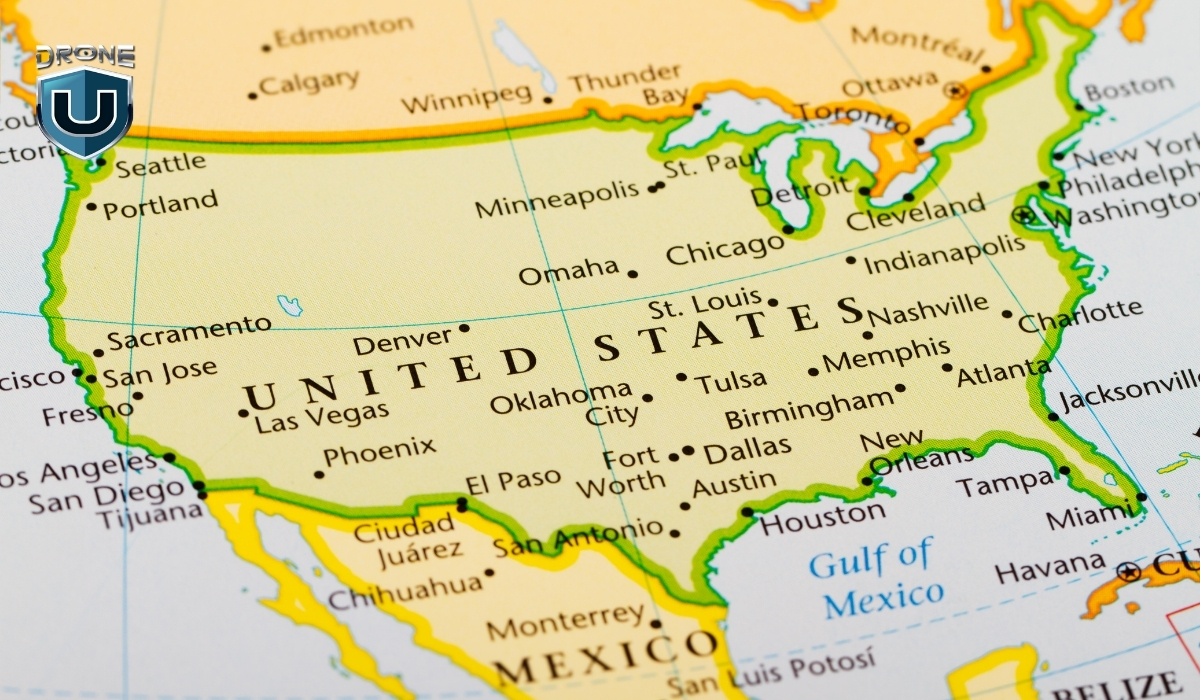
Here’s where it gets specific. Every state below follows federal FAA rules — these notes cover what’s different or additional at the state level. Some states have preemption laws that simplify things (you only have to follow state + federal rules, not dozens of city ordinances). Others leave room for local governments to add their own restrictions. Both situations are noted below. Tap any state in the Interactive State Map to jump directly to state resources.  You can select any state to see its drone laws, permit links, and links to official state statutes in one place.
State State Drone Law Notes (Plus FAA Rules Always Apply)
Alabama No state-specific drone law beyond FAA rules. Some local ordinances may apply.
Alaska Drones are banned in most state parks without a permit. Remote wilderness areas have additional restrictions.
Arizona Preemption law: only the state and the FAA can regulate drones. Local drone ordinances are generally invalid. Wildfires and TFRs are common. Always check B4UFLY before flying.
Arkansas State law bars local governments from regulating drones. FAA rules apply statewide.
California AB 856: privacy law restricts flying over private property below 350 ft without permission. State parks require permits. Read the privacy statute before flying over residential areas.
Colorado No preemption. Denver, Boulder, and other cities can (and do) have their own ordinances. Rocky Mountain National Park is a no-fly zone. Check local rules for any Front Range city you plan to fly near.
Connecticut Requires written permission from the landowner before taking off or landing on private property. No statewide preemption, so individual towns may have additional rules.
Delaware State parks ban drones. FAA rules apply otherwise. No preemption statute. The state is small and heavily trafficked by Philly and NYC airspace, so check LAANC carefully.
Florida §330.41: Local governments cannot regulate drone operation beyond FAA rules. Law enforcement drone use is regulated.
Georgia Strong preemption law. Drones are prohibited over critical infrastructure (prisons, water treatment plants).
Hawaii State parks ban drones. Special restrictions around volcanoes and federal lands. Island TFRs are frequent.
Idaho No preemption. Some cities have local rules. Wildfire TFRs are common in summer.
Illinois Chicago has its own specific drone restrictions, and the state’s Home Rule doctrine gives cities broad authority here. State law restricts drones near correctional facilities. Expect to do some local research if you’re flying near Chicago or any major metro.
Indiana Preemption law. Drones are prohibited over law enforcement facilities and correctional institutions.
Iowa No preemption. Drones are banned over correctional facilities. FAA rules apply otherwise.
Kansas No preemption. Drones are prohibited near state correctional facilities.
Kentucky Preemption law. Special rules for drones used by law enforcement. Limited local authority.
Louisiana Preemption law. Critical infrastructure protection statutes. Petrochemical facility no-fly zones.
Maine State parks restrict drones. No preemption. Some municipalities have local ordinances.
Maryland No preemption. Baltimore has specific drone rules. Washington DC SFRA extends into Maryland.
Massachusetts State parks require permits for drones. No preemption. Boston Logan creates Class B restrictions.
Michigan Preemption law. Drones are banned in state parks without a permit. Limited local authority.
Minnesota No preemption law. The Minneapolis/St. Paul metro area has Class B airspace restrictions. State parks vary. Check each park individually.
Mississippi No specific state drone law. FAA rules apply. No preemption statute.
Missouri No preemption. Kansas City and St. Louis have local rules. FAA rules apply broadly.
Montana No preemption. Restrictions in Glacier NP and Yellowstone. Wildfire TFRs are common.
Nebraska No preemption. FAA rules apply. Limited local ordinances.
Nevada No preemption. The Las Vegas Corridor has heavy airspace restrictions. National parks have no-fly zones.
New Hampshire State parks prohibit drones without a permit. No preemption statute.
New Jersey State parks ban drones. No preemption. NJ Turnpike prohibits overflights. NYC SFRA nearby.
New Mexico No preemption. Near tribal lands require separate tribal permission. White Sands area restrictions.
New York State parks ban drones. NYC has specific rules. NYC SFRA extends 30 NM from JFK (Class B).
North Carolina Preemption law. Restrictions near nuclear facilities. FAA rules apply statewide otherwise.
North Dakota No preemption. Oil field operations have local rules. FAA rules apply broadly.
Ohio No preemption. Cleveland Hopkins and Columbus Port Columbus airspace restrictions. Some local ordinances.
Oklahoma No preemption. Tornado season may trigger TFRs. No major state drone laws beyond the FAA.
Oregon State parks restrict drones. No preemption. Crater Lake NP is a no-fly zone.
Pennsylvania No preemption. Philadelphia Class B airspace. Pittsburgh has local rules. State forest rules vary.
Rhode Island No preemption. Small state; Providence airspace is Class C. Limited drone-specific laws.
South Carolina Preemption law. Coastal conservation areas may restrict drones. FAA rules apply statewide.
South Dakota No preemption. The Mount Rushmore area has federal restrictions. Badlands NP no-fly zone.
Tennessee Preemption law. Critical infrastructure protected. Nashville Class C airspace restrictions.
Texas Comprehensive drone law. Privacy restrictions near residential properties. Bans drones over correctional facilities, critical infrastructure, and certain sports venues.
Utah No preemption. Arches, Zion, and Bryce Canyon NPs are no-fly zones. Salt Flats have specific rules.
Vermont No preemption. Green Mountain NF has restrictions. Limited state drone statutes.
Virginia No preemption. Washington DC SFRA extends into Northern Virginia. State parks restrict drones.
Washington No preemption. Seattle has local rules. National parks (Rainier, Olympics) ban drones.
West Virginia No preemption. Limited state laws. Coal mines and industrial areas may have local restrictions.
Wisconsin No preemption. State parks restrict drones. Milwaukee Class C airspace restrictions.
Wyoming No preemption. Yellowstone and Grand Teton NPs are federal no-fly zones. Limited state laws.
How to Flag an Outdated State Law: Drone laws change frequently. If you notice a state law that needs updating, email us at [email protected] with the source citation. We will review and update within 30 days. 
Feel Calm and In Control Every Time You Fly
No more wondering if you missed something important. After this course, you’ll have:
  • A clear pre-flight routine
  • Better control in the air
  • Fewer surprises during flights
  • More confidence with your drone
It’s the foundation most pilots wish they had from day one.

Thank you!

Thank you. You will now be redirected to your requested resource.

16

FAQs

1. Do FAA rules override state drone laws?

2. What is a preemption law, and which states have one?

3. I have a Part 107 certificate, doesn’t that cover me everywhere?

4. Can a city ban drones if the state has a preemption law?

5. Do I need to register my drone in every state I fly in?

6. Can states pass privacy laws that restrict drone photography?

Author

Paul Aitken - Drone U

Paul Aitken

Co-Founder and CEO

Paul Aitken is a Certified Part 107 drone pilot and a Certified Pix4D Trainer. He is a pioneer in drone training and co-founder of Drone U. He created the industry’s first Part 107 Study Guide and co-authored Livin’ the Drone Life.

Paul is passionate about helping students fly drones safely and effectively. With over a decade of experience, he has led complex UAS projects for federal agencies and Fortune 500 clients such as Netflix, NBC, the NTSB, and the New York Power Authority.

Add Your Comment