
How to Spot a Drone at Night: Lights, Sound, Remote ID and What to Do Next

July 21, 2026
Quick answerTo spot a drone at night, look for a tight cluster of lights that can stop and hover. A drone’s lights sit within inches of each other and include a sharp pulsing strobe — white in the US, green in the UK and EU. An airplane’s lights are spread across its wingspan and never stop moving. Then open a Remote ID app. Most drones legally broadcast their position, altitude, and takeoff location to any phone within about a kilometre. The 30-second test:
Never shoot at a drone or jam it. In the US, damaging a drone is a federal felony under 18 U.S.C. § 32, carrying up to 20 years. |
Knowing how to spot a drone at night used to be a niche skill. More than a million drones are now registered in the U.S. Night flying is now legal across most of the world. And one ambiguous light over a rooftop can now trigger a police call, a neighbourhood group thread, or a whole regional panic.
That happened across New Jersey in December 2024. Investigators later found that almost every reported sighting was a plane, a helicopter, or a star.
Drones are not hard to see. The problem is that the night sky removes every cue your brain relies on. You cannot judge size or distance. Colour misleads you. Sound misleads you.
This guide teaches you to read four independent channels: light, sound, movement, and radio. Any one channel can fail. No drone can defeat all four at once.
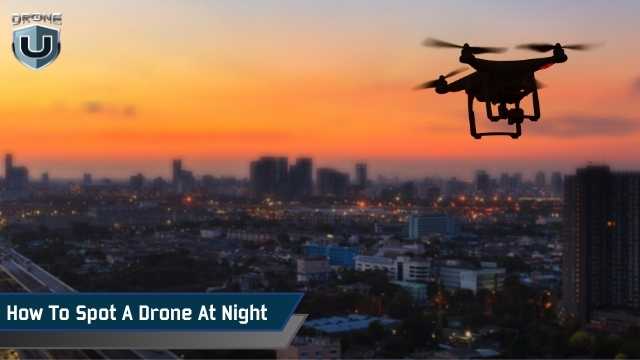
A drone at night looks like a small, tightly grouped cluster of lights. You usually see a bright pulsing strobe beside dimmer steady red and green LEDs. The cluster can stop dead in the air, pivot on the spot, or climb straight up.
Three features together identify it:
No airplane, satellite, or star can produce all three.
Do this first. It works, and it takes one minute.
Now read the result. Does it hover, show clustered lights, and appear in a Remote ID app? Then it is a drone, and you know roughly where the pilot stands. Does it hover, show clustered lights, and appear nowhere? That is the case worth reporting.
Lights give you the strongest signal, but only once you know how to read them. Every drone runs two separate lighting systems. People confuse these constantly.
Navigation lights follow the old maritime convention that aviation inherited. Red marks the port (left) side. Green marks the starboard (right) side. These lights usually glow steadily rather than flash.
On consumer drones, they are dim and low-mounted, because they exist to help the pilot track which way the drone points. From a few hundred feet, these lights are too faint to see.
Anti-collision lighting is the strobe. It is bright, it pulses, and the law requires it on every night flight. It exists so other aircraft can see the drone from a distance. This one light separates a drone you can see from three miles away from a drone you cannot see from three hundred feet.
Remember it this way: the strobe is what you spot. The navigation lights are what you confirm once it comes close.
The required strobe colour varies by location. It changes from country to country.
| Jurisdiction | Required Night Lighting | Legal Basis | Notes |
| United States | Anti-collision light visible for at least 3 statute miles, flashing fast enough to prevent collision. In practice, a white strobe. | 14 CFR § 107.29 | Applies to night and civil twilight operations under Part 107. The rule sets no colour. Pilots choose white. |
| United Kingdom | A green flashing light, on for the entire night flight. | UK Reg. (EU) 2019/947, UAS.OPEN.060(2)(g) — in force 1 Jan 2026 | The rule sets no brightness, flash rate, or range. The remote pilot carries the responsibility. Many sub-250 g drones need a retrofit light. |
| European Union | A green flashing light during night operations. | Reg. (EU) 2019/947, UAS.OPEN.060(2)(g) | Applied to the Open Category from December 2021. |
Regulators chose these colours so that people on the ground could tell a drone from a crewed aircraft. This is why the green light is especially important in the UK and EU. Since crewed aircraft do not use flashing green lights, a compact aircraft displaying one is a strong indication that it is a drone.
Don’t assume that red and blue lights mark a police drone. Although some public safety agencies use these colors, no official standard reserves them for police drones. Hobby drones can also use red, blue, orange, and purple strobes. Instead of relying on light colour, identify a drone by its behaviour.
Pilots bolt on third-party strobes all the time, in colours no regulation intended. So a drone can show a light signature that matches no chart.
Two things hold up regardless:
Everything above assumes the drone pilot follows the rules and uses the required lights. Someone flying for surveillance, smuggling, or trespassing may simply switch the strobe off.
An unlit drone at 200 feet on a moonless night is invisible to the naked eye. It is a dark object against a dark background, and many airframes use matte finishes to kill glint. You will not see it, and over a suburb with any road noise, you will not hear it either. Detecting one requires a sensor.
In most situations, human eyesight and hearing are not enough to detect an unlit drone. Detecting one usually requires specialized equipment, such as radar, radio frequency (RF) detectors, acoustic sensors, or thermal cameras.
Hearing a drone at night can be easier than seeing one, but only under the right conditions. Many people describe the sound as a swarm of bees or an electric buzz, yet it changes depending on the drone’s size, speed, altitude, and surroundings. Understanding what creates that sound and how it behaves can help you tell the difference between a drone and other common nighttime noises.
A drone’s distinctive buzzing sound comes from its propellers. Every time a propeller blade passes through the air, it creates a sound wave. The faster the propellers spin, the higher the pitch.
A quadcopter has four motors, and each motor constantly changes speed to keep the drone stable. Their overlapping tones beat against each other, producing the familiar buzzing or “electric wasp” sound that many people associate with drones.
The pitch shifts when the drone manoeuvres. That shift is your tell. A steady, unchanging tone means you are not hearing a drone. A distant motorcycle holds pitch. A hovering drone never quite does.
But the buzz vanishes fast. Sound drops about 6 dB every time distance doubles.
| Distance | Approximate Level | Can You Hear It |
| 10 m (33 ft) | ~55 dB | Obviously |
| 100 m (328 ft) | ~35 dB | Faintly. Any breeze masks it |
| 122 m (400 ft- the legal ceiling) | ~33 dB | No. Below suburban ambient |
| 200 m (656 ft) | ~29 dB | No |
Suburban night-time ambient noise runs 40 to 45 dB. A drone at the legal 400-foot ceiling is quieter than the room you are standing in. This is why “listen for the buzz” fails exactly where people want it most.
Sound confirms at close range. It does not detect. If you hear it, it is close. If you do not hear it, you have learned almost nothing.
A pilot can switch off the lights. Distance defeats the sound. But a drone cannot hide its movements. It hovers, spins, and darts because that is how a multirotor flies.
The four movement signatures worth memorising:
It holds absolutely still against a fixed object for more than about 15 seconds. Wind makes a real drone bob and correct, so you may see a few feet of drift, then recovery. This micro-correction is a strong positive. It shows a flight controller fighting gusts.
It rises in discrete increments, pausing between them. A pilot is working the altitude manually while watching a screen.
The light cluster’s brightness or colour arrangement changes abruptly, but the object does not travel. The drone is rotating to aim its camera. This is the strongest sign that the drone is looking at something.
The object flies parallel straight passes, turns 180° at each end, spaces them evenly, and repeats. This is an automated survey or a search grid. It rarely means surveillance of one property. It means mapping, inspection, or search and rescue.
Almost everything people report as a drone turns out to be one of seven other things. Each has one test that settles it.
| Object | Motion | Decisive Test |
| Drone | Hovers, yaws, snaps, and step-climbs | It hovers and the lights cluster |
| Airplane | Smooth, constant heading and speed | Lights span a wingspan |
| Helicopter | Can hover, translates slowly | It hovers but you hear a rotor thump |
| Satellite | Dead straight, crosses in 2–5 min | It never hovers, flashes, or turns |
| Starlink train | A line of points on the same path | The formation itself |
| Star or planet | Fixed against other stars | Still in the same place ten minutes later |
| Sky lantern | Drifts with wind, rises then falls | Warm orange flicker, no strobe |
| Plane on final approach | Appears to hover — it is flying at you | Wait 90 seconds, and it resolves |
Notice that a drone and a helicopter share almost every move. Motion alone will not tell them apart. Sound and light spread will. A helicopter announces itself with a rotor thump you can hear for a mile. So if it hovers and you hear nothing, it is not a helicopter.
One trap catches people again and again. An airplane flying straight at you, landing lights on, looks exactly like a hovering bright light. You see no sideways motion because there is none. The plane is coming toward you, not across your view. This single trick of geometry explains a large share of “hovering drone” reports near airports.
In November and December 2024, thousands of people across New Jersey and neighbouring states reported swarms of drones. The FBI received more than 5,000 reports. Officials later confirmed that many reports involved manned aircraft, helicopters, or other objects.
The people who reported these sightings were not lying. Their visual systems simply did what human visual systems often do at night.
Stare at a single light against a dark background for 10 to 20 seconds, and it will appear to move. It can wander, drift, even trace loops. With no reference frame, your brain reads tiny involuntary eye movements as movement of the target.
Never judge motion by staring. Keep a fixed foreground object in view, a roof edge, a wire, a branch, and judge the light against that.
Your brain cannot work out an object’s size and distance independently. A light cluster could be a 14-inch drone at 130 feet, or a 45-foot aircraft at 1.4 miles. Both produce an identical image on your retina. So your brain guesses from expectation, which is why, once a community expects drones, everything becomes a drone. Never estimate altitude by eye. Use Remote ID, which reports it directly.
Yes, and it costs nothing. Most drones overhead are legally required to announce themselves, and a free app picks up the signal. This is the single most useful tool in this guide, and almost nobody knows it exists.
Remote ID is a mandatory broadcast identification system for drones. It is a digital licence plate for drones. FAA rule 14 CFR Part 89 has been in effect in US airspace since 16 September 2023. The drone transmits an unencrypted radio broadcast over Bluetooth (4 or 5) or Wi-Fi (NAN/Beacon). Anyone nearby can receive it.
For spotting, one field matters most. The broadcast includes the takeoff location, which indicates roughly where the operator is standing. It never carries the pilot’s name. (For how the standard works in full, see our dedicated Remote ID guide.)
iPhones cannot see Wi-Fi Remote ID. Apple does not grant apps the needed access. DJI dominates the consumer market and broadcasts over Wi-Fi, so a DJI drone overhead usually shows nothing on an iPhone. Use Android if you take this seriously.
Exemptions exist. Drones under 250 g flown recreationally need not be broadcast.
Anyone breaking the law switches it off. Remote ID identifies the compliant, not the malicious.
A drone that hovers over your property, shows no strobe, and broadcasts no Remote ID is breaking three rules at once. That one is worth a call to the police.
In the UK, Remote ID arrived on 1 January 2026 and becomes mandatory on 1 January 2028 for drones 100 g and above.
Yes, and better at night than during the day. Most people assume the opposite.
A drone’s motors and battery generate heat, which creates a temperature difference between the drone and the cold night sky. This can make an unlit drone appear as a bright spot on a thermal camera.
For drone detection, choose higher resolution over higher magnification. Scan the open sky rather than rooftops or buildings, which can create thermal clutter.
Night vision works differently. It amplifies available light, so it may struggle to detect an unlit drone against a dark sky. However, it can reveal infrared lights that are invisible to the human eye.
For more information, see our guides on thermal drones.
Most drones over your neighbourhood at night do something boring. Here is how to tell.
Behaviour that suggests a legitimate operation:
Behaviour that warrants documentation:
What about police drones?
Public-safety agencies fly at night, and they fly more every year. Identify them by behaviour, never by colour.
Now a hard truth. A drone genuinely conducting covert surveillance of you would fly unlit, high, and silent. The drone hovering visibly over your garden is, for that reason alone, the least likely candidate.
If one does hover over your house, do this:
Never shoot at it. The FAA classifies drones as aircraft, so 18 U.S.C. § 32 applies — a federal felony carrying up to 20 years, wherever the drone flew and however justified you feel. Never jam it either; the FCC bans jamming equipment outright, and jamming triggers return-to-home or an uncontrolled descent rather than a landing.
In the US, only a small number of federal departments can lawfully disable a drone. Detection is legal. Mitigation is not.
Spotting a drone at night comes down to four channels, and you now know all of them.
Light tells you the most, fastest. Look at the spacing, not the colour. Everything on a drone sits within inches. Everything on an airplane spreads across a wingspan.
Sound confirms, but only up close. If you hear the buzz, the drone is near. If you hear nothing, you have learned nothing.
Movement cannot lie. A drone hovers, snaps, yaws, and reverses. Nothing else in the sky does all four, and a helicopter can announce itself.
Radio finishes the job. Open a Remote ID app. Most drones will hand you their altitude, their position, and the spot where their pilot took off.
If one hovers over your garden tonight: film it, log it, check the app, and call the non-emergency police line. Detection is legal everywhere. Mitigation is not.
Want to learn more about drones, how they work, and how to fly them safely and legally? Join Drone U and learn from experienced drone professionals with practical training built for real-world pilots.
 1
1