
Pro Travel Videography and Photography Rig 2026: Sony a7 V, 70-200 GM II, RS 5 and Mavic 4 Pro

October 23, 2026
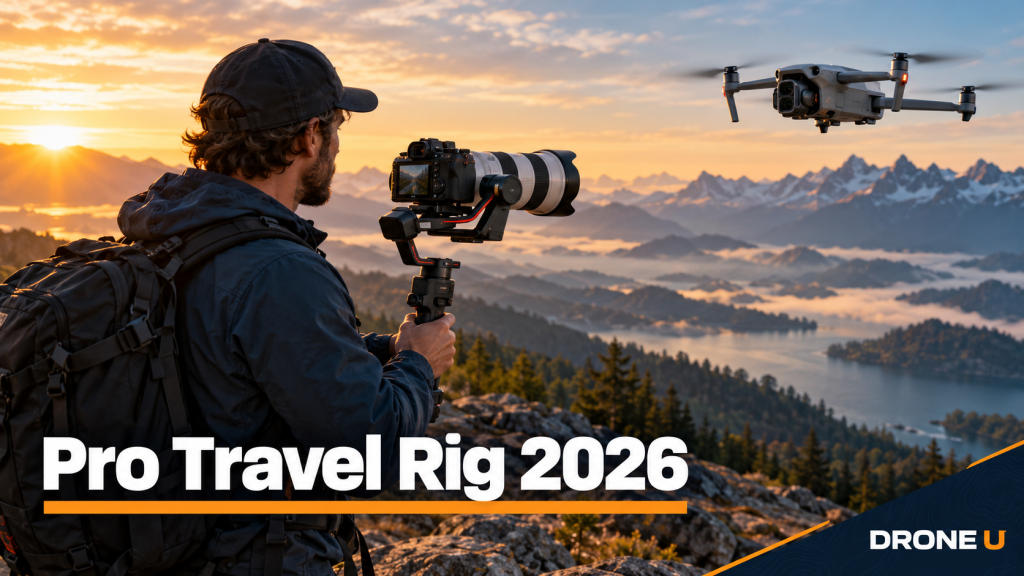
Our best travel filmmaking kit of 2026 proves you can cover aerials, gimbal shots and POV for under $3,000. But if you’re getting paid for your work, or you want the kind of images that make clients say “how did you get that?”, it may be time to spend a little more. This is the professional travel videography and photography rig we’d build in 2026: a full-frame mirrorless camera, a pro telephoto zoom, a real gimbal, and a flagship drone.
Sony’s a7 series has been the default hybrid camera for working shooters for years, and the Alpha 7 V, which launched in late 2025, is the most capable “basic” a7 yet. It’s built for people who need to shoot excellent stills and excellent video in the same day, often on the same assignment.
Sony lists the Alpha 7 V with the 28-70mm kit lens at $3,099.99 in the US. For this rig we’d buy the body only and put that money toward glass.
If you only add one premium lens to a travel kit, make it a 70-200mm f/2.8. It’s the lens that separates professional travel work from snapshots. It compresses mountains behind a lone hiker, isolates a street vendor from a busy background, pulls in wildlife you can’t get close to, and turns ordinary city scenes into layered, cinematic frames.
Sony’s second-generation G Master version is the one to get:
It’s expensive, with a price of about $2,800 at major retailers, but it’s a lens you’ll keep through several camera bodies.
You may hear people call it a “Ronin 5.” The current model in DJI’s Ronin family is the DJI RS 5, announced in January 2026. It’s the right size for a mirrorless camera like the a7 V.
DJI isn’t selling the RS 5 through its own US store, but major US retailers including B&H and Amazon list it at about $569, or about $719 for the combo with the tracking module and electronic briefcase handle.
One honest note: a 70-200mm on a gimbal is a specialty shot. For most moving gimbal work you’ll want a wider lens, such as a 24-70mm or a fast prime, and save the telephoto for locked-off, handheld or tripod shots where the a7 V’s stabilization does the work.
A pro rig deserves a pro drone, and the DJI Mavic 4 Pro is DJI’s flagship consumer-class aircraft.
For panoramas, the Mavic 4 Pro is in a different league. When each individual frame is already 100MP, a stitched multi-row panorama becomes large enough to print on a wall. Combine that with exposure bracketing and you can capture a sunrise over a city or a mountain range with detail in both the sky and the shadows. Amazon has listed the Mavic 4 Pro with the DJI RC 2 at around $2,199, and the Fly More Combo at about $2,750, though prices move often.
Master smooth tilts, perfect video, epic panos and more with the Drone U Don’t Crash Course on the Mavic 4 Pro!
If you’re traveling light, the DJI Mini 5 Pro is still our pick for the best travel drone of 2026. If you’re delivering to clients, printing large, or need telephoto aerials, the Mavic 4 Pro is worth the extra size and cost. Our guide to beginner friendly drones you won’t outgrow breaks down the trade-offs.
Approximate late-October 2026 US prices:
All in, you’re looking at roughly $8,500 to $9,500 depending on bundles. That’s a serious investment, but it’s a fraction of what this level of capability cost even five years ago, and every piece can earn its keep on paid jobs.
The drone is the piece of this rig most likely to end up in a tree or a lake, and the Mavic 4 Pro is not a cheap thing to replace. Before you take it on a trip or a client job, take our Mavic 4 Pro Don’t Crash Course. It walks you through setup, camera and telephoto workflows, intelligent flight modes, obstacle sensing, wind and battery management, and the pre-flight habits that keep a flagship drone flying. If you’re doing any paid work, you’ll also need your FAA Remote Pilot Certificate, and our Part 107 course is the fastest way to get it.
If the under-$3,000 travel filmmaking kit is where you start, this is where you grow: a Sony Alpha 7 V, a Sony 70-200mm f/2.8 GM II, a DJI RS 5 gimbal and a DJI Mavic 4 Pro. Together they cover full-frame stills and video, long-lens storytelling, smooth motion and 100MP aerials, everything a professional travel shooter needs.
Sources: Sony Alpha 7 V specifications; Sony Electronics US listing; PetaPixel on the DJI RS 5; DJI Mavic 4 Pro. Prices as of late October 2026.
 0