

Switchblade Drones: Revealing the Secrets of Suicide Drones!
AeroVironment’s Switchblade drones provide a powerful folding aircraft to Ukrainians running Kamikaze drone missions.
What exactly are these folding Switchblade drones we keep hearing about in the news? Is the weapon system being sent to Ukraine really even a drone? The interest in these Kamikaze aircraft has grown increasingly popular since the Ukrainian deployment. These aircraft systems have been commonly confused with drone systems.
Before we deep dive into understanding all about the Switchblade or Suicide drones, first, let’s understand what exactly is a switchable drone. How does it differ from other drones?
Switchblade “Drones” or “Missile Systems”?
Many drone pilots have been fielding questions on these Kamikaze systems since Russia’s invasion of Ukraine. The popularity of this particular platform has garnished significant attention as the system has provided a substantial tactical advantage for the Ukrainian forces.
While many in the media have called this system a Drone, even manufacturer AeroVironment classifies the system as a weapons system on the website. Since pilots do not have direct manual control of the aircraft, it is not remotely controlled. The pilot can initiate a loitering pattern to regain the targeting lock. The pilots’ controls beyond loitering are limited.
We would lean away from classifying this Swaitchblade aircraft as a drone or UAV. However, the system does provide a great opportunity for Pilots who are accomplished at creating flight plans.
Also, the U.S. military regulations classify the Switchblade as a weapon rather than a remote-controlled aircraft. They prefer to use the term “loitering munition” instead of “drones”.
Switchblade uses infrared cameras, and radio frequency to operate and it also locks on to moving and stationary targets using an “aided target tracker”.
What is a Switchblade Drone?
There are generally two types of drones – fixed-wing drones and rotary-winged drones.
Fixed-winged drones are powered by propellers whereas rotary-winged drones are powered using rotor blades.
A switchable drone is a hybrid between both the aforementioned types of drones. This type of drone uses both the propeller and rotor blade system.
Switchblade drones or Kamikaze drones (also known as suicide drones) designed by AeroVironment are unmanned aerial vehicles (UAVs) that can be flown by remote control and have blades for propulsion. These suicide drones are small enough to be carried in a backpack and sharp enough to fly to the targeted destination and crash into their intended targets.
The term “switchblade” defines the folding of spring-loaded wing blades that fold up inside a cylindrical container and unfold once they’re released.
The first Switchblade drone, the Switchblade 300, was introduced in 2011. Its much larger and very different anti-armor version Switchblade 600 was revealed in 2020. The BlackWing, an unarmed variant of SwitchBlade 300, was released in 2015.
Models of Switchblade Drones by AeroVironment
The Switchblades come in two distinct models, the Switchblade 300 and Switchblade 600.
Let’s get an insight into each of them.
Switchblade 600 by AeroVironment
The SwitchBlade 600 is a man-portable, anti-armor smart missile system that can be set up in less than ten minutes. It has the best-in-class target acquisition sensor suite and mission planning on a tablet controller.
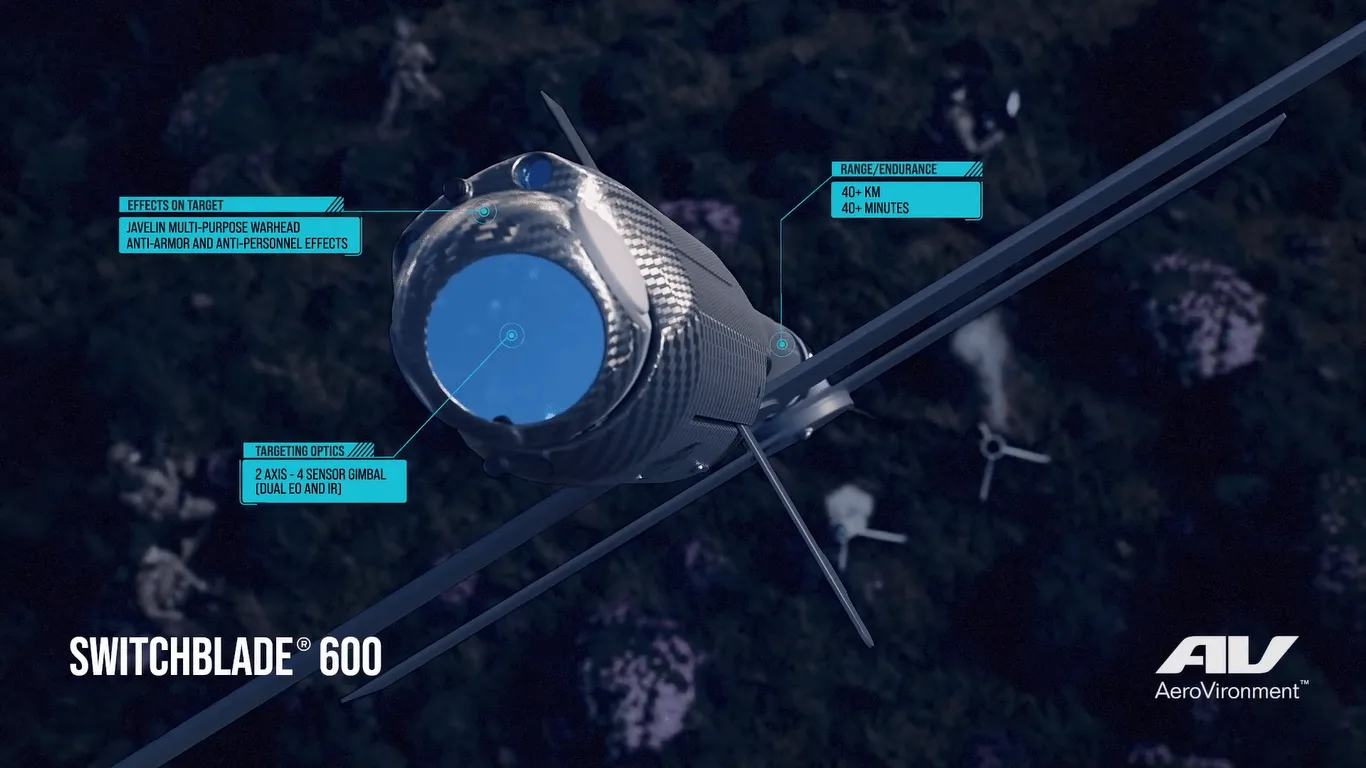 Credit: AeroVironment
Switchblade 600 represents a new generation of long-ranged loiterers, offering unparalleled Reconnaissance, Surveillance, and Target Acquisition (RSTA) support and boasting high-precise optics, as well as an anti-armor warhead for engaging toughened targets at larger distances.
Switchblade 600 is an all-in-one, man-portable system that comes with everything needed to properly plan and carry out missions. The Switchblade 600 provides the warfighter with the capability to operate, detect, and engage non-LOS (line-of-sight) targets and armored vehicles with precise lethality without the need for external intelligence, surveillance, and reconnaissance (ISR) or fire support assets.
With patented “wave-off” and “recommit” capabilities, Switchblade operators can abort missions at any time and then engage the same or different targets multiple times.
Switchblade 300 by AeroVironment
The Switchblade 300 drone series system is a relatively light single-use weapons system and is designed as an expendable UAV to improve the accuracy of fire from platoons of soldiers.
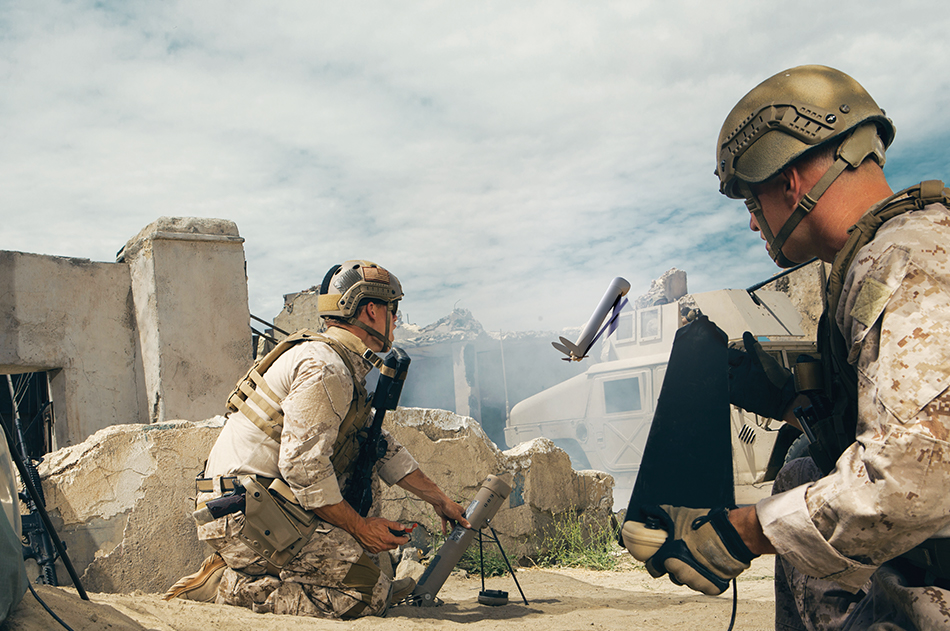 Credit: AeroVironment
It has a range of up to six miles (10 km). It has a short battery power of just ten minutes so it won’t run for long. It’s not suitable for scouting, but it’s good for cheaply reaching out to long-range targets and helping relieve units pinned down by the enemies’ fire.
The drone uses a color sensor and GPS locating technology to detect, track, and engage its target, and can also be pre-programmed on a collision path. Its warhead has an explosive force equal to a 40mm grenade and can demolish light-armored soldiers and vehicles.
Supporting conventional or special operations forces in the field or from fixed defensive positions, the combat-proven Switchblade 300 with its patented wave-off feature is the ideal loitering missile for use against beyond-line-of-sight targets. Backpackable and rapidly deployable from air, sea, or ground platforms, Switchblade 300 delivers increased warfighter lethality with real-time GPS coordinates and video for precise targeting with low collateral effects.
Switchblade 300: Loitering Missile
With its distinctive wave-off function, the combat-proven Switchblade 300 is the perfect loitering missile for use against beyond-line-of-sight targets, supporting conventional or special operations forces in the field or from established defensive positions. Switchblade 300 is portable and easily deployed from any platform i.e. land, air, or water.
Its real-time GPS coordinates and video feed increases warfighter lethality and allow operators to target precisely with minimum collateral damage.
The excellent ISR capabilities of AeroVironment‘s sUAS (small unmanned aircraft systems) and the precise attack capabilities of the Switchblade loiterer missile come together with the Switchblade Sensor to Shooter (S2S).
S2S technology enables the SUAS to automatically send targets to the Switchblade using machine-to-machine (M2M) communications, which reduces the time required for operators to engage targets.
S2S delivers switchblade operators real-time video downlink capability for a complete view of the operation area and the capability to match sUAS-Intelligence, Surveillance, and Reconnaissance (ISR) and Switchblade 300 camera feed images on one screen.
Features of Switchblade 300 vs Switchblade 600
|
Switchblade 300 |
Switchblade 600 |
| Automated waypoint navigation | Intuitive touch tablet controller |
| Armor Piercing | Tank Busting Performance |
| Backpackable | Integrated Training Simulator (T-sim) |
| Less than 2-minutes setup & launch | Less than 10 minutes system setup & launch |
| Patented wave-off feature & recommit capability | Antenna and GCS with self-contained tube-launcher |
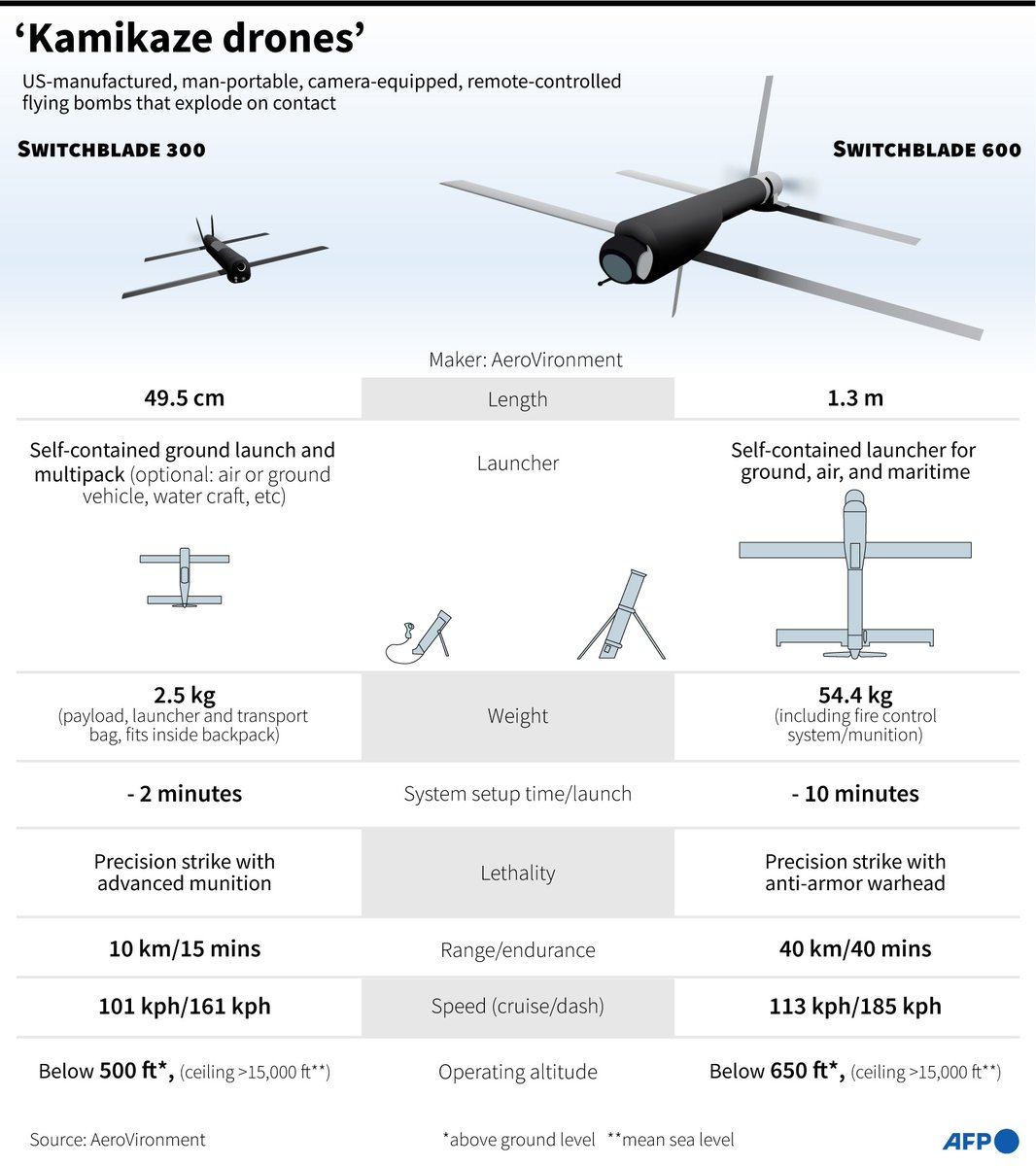
Comparison of Switchblade 300 vs Switchblade 600
| Switchblade 300 | Switchblade 600 |
| It is a loitering missile. | It is a loitering missile. |
| It has a wingspan of 68.6cm, a length of 49.5cm, and a weight of 2.5kg. | It has a length of 1.3m and weight of AUR is 22.7kg and a system (1 AUR and FCS) is 54.4kg. |
| It has a range of 10km, an endurance of 15 min, and a speed of 63mph (Cruise) and 100mph (Dash) | It has a range of more than 40km, an endurance of more than 40 minutes, and a speed of 70mph (Cruise) and 115mph (Dash). |
| A self-contained ground launch and multipack are the methods to launch Switchblade 300. | A self-contained launcher for ground, air, and maritime are the methods to launch Switchblade 600. |
The AFR New Group shared a great comparison on Twitter to showcase the difference in specifications.
Types of Targets Vulnerable to Switchblade Attack
The Switchblade 300 offers a small explosive, armor-piercing payload meant for small arms and personnel attacks. They built this Switchblade drone to eliminate targets like a machine gun bunker or mortar bunker and not really meant for larger targets or machinery.
The Switchblade 600 offers a massive “Anti-Armor” payload designed to debilitate and destroy armored vehicles, machinery, and more.
The Switchblade 600 (drone) was designed for the destruction of personnel carriers, vehicles, and small aircraft.
The AeroVironment demonstration video showcases multiple Switchblade 600’s destroying a tank and helicopter. In the same video, they demonstrate how the Puma Drone is made for reconnaissance, working with the Switchblades to provide location intelligence.
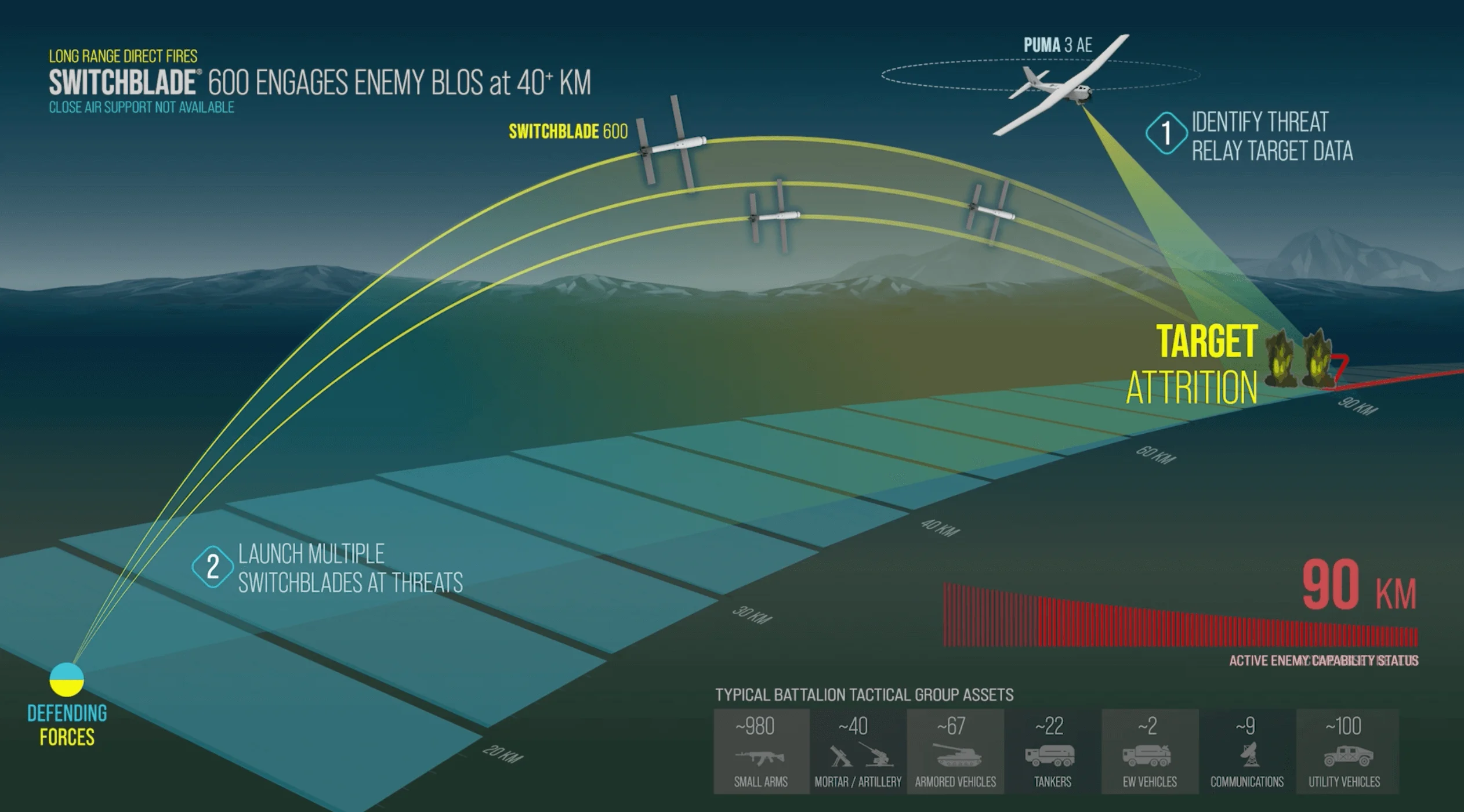 Source: AeroVironment
Commercial Tube Launched Drones
Many people may ask drone pilots if there are commercial equivalents to the Switchblade drones. While there may not be many tube-launched drones available to commercial pilots now, there will surely be solutions coming soon.
Cal Poly State published research on how to build and manufacture tube-launched drones. These drones could be a tube-launched solution but probably will not offer kamikaze-like operational solutions.
The University of South Hampton also showcased a commercially viable tube-launched aircraft as well.
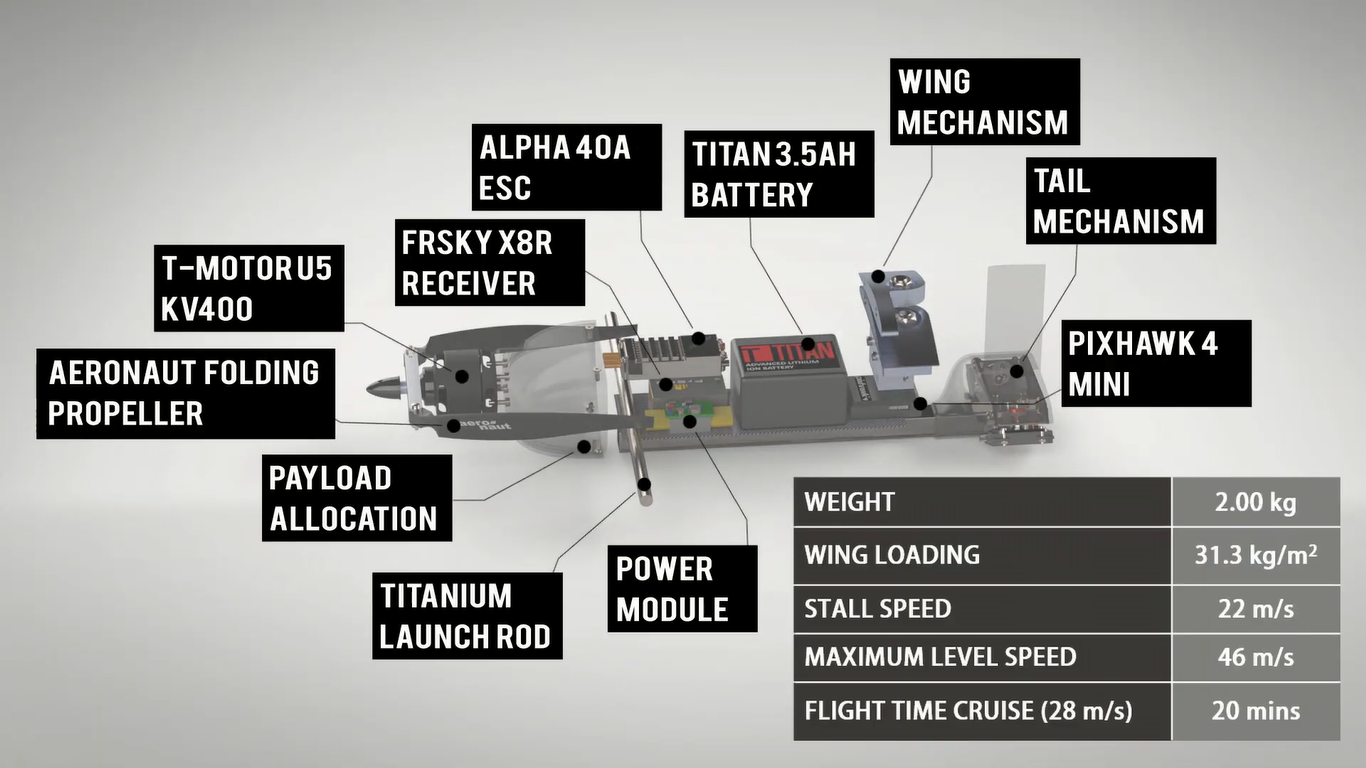 Source: UOSDesign
Not really commercially viable, but Lockheed Martin created the Outride Tube Launched Drone system.
Drones Involved in Ukraine Combat
As we have discussed on the TJ Trout Show on KKOB, there are many other drones helping the war in Ukraine.
According to popular mechanics, you can find these drones flying around various war zones. The use of Chinese drones on both sides creates a bigger issue, making the operation of the counter-UAS system cumbersome.
According to Popular Mechanics, these are the drones being flown in Ukraine.
- Skydio X2
- Autel Evo 2 Dual
- Mavic 3
- Mavic 2 Enterprise Dual Advanced
- Teal Golden Eagle
- Brinc
Frequently Asked Questions (FAQs)
Who makes the Switchblade drones?
AeroVironment, Inc. was founded by Dr. Paul B. MacCready, Jr., in 1971 and is a leading manufacturer of Unmanned Aircraft Systems, Unmanned Aerial Vehicles, Tactical Missile Systems, and other Unmanned Ground Vehicles.
Can Switchblade drones destroy tanks?
Yes, they can. These drones have been designed for use against armored vehicles such as tanks. The drone uses infrared sensors to detect heat from the engine block of the tank. Once detected, the drone fires a missile which destroys the tank.
How many Switchblade drones has the US sent to Ukraine?
The U.S. shipped over 700 Switchblade drones to Ukraine as a package of military aid after Russia invaded Ukraine in 2022.
Why Pay Hundreds, Even Thousands Per Course Somewhere Else?
Become a lifetime member of Drone U by purchasing its membership, which would grant you access to all of its courses for the rest of your life. Alternatively, if you prefer more flexibility, you can simply choose the individual courses that interest you the most.
We’d love to start working together soon!
 0
0
Discover the Best DJI Drones for Every Industry [2023]
Are you looking for DJI drones for your specific industry? If so, you’ve come to the right place.
No matter what industry you’re in, DJI offers unparalleled versatility, performance, and reliability.
In this article, we’ll delve into the vast landscape of DJI drones and also pick the best drone based on your industry.
Before moving any further, here are the industries we will be covering in this article:
- Enterprise Drones
- Education Drones
- Agricultural Drones
- Construction Drones
- Government Drones
- Cell Tower Inspection Drones
- Media And Entertainment Drones
Let’s get started right away.
Introduction to DJI Drones
Founded in 2006 in Shenzhen, China, DJI continues to dominate the drone technology industry with its cutting-edge designs and high-quality manufacturing. The versatility and range of capabilities offered by DJI drones have made them a popular choice among industries ranging from agriculture to construction, government to emergency response.
DJI unmanned aerial vehicles (UAVs) are equipped with the latest technology, including high-quality cameras, advanced features, and user-friendly controls, making them a top choice for aerial photography, videography, surveying, mapping, and more.
But the benefits of DJI drones go beyond just their impressive features. These cutting-edge UAVs collect data for drone mapping, inspect cell towers with precision, and also capture breathtaking fly-through videos.
The versatility offered by DJI drones has made them a go-to solution for nearly every industry and vertical you can imagine.
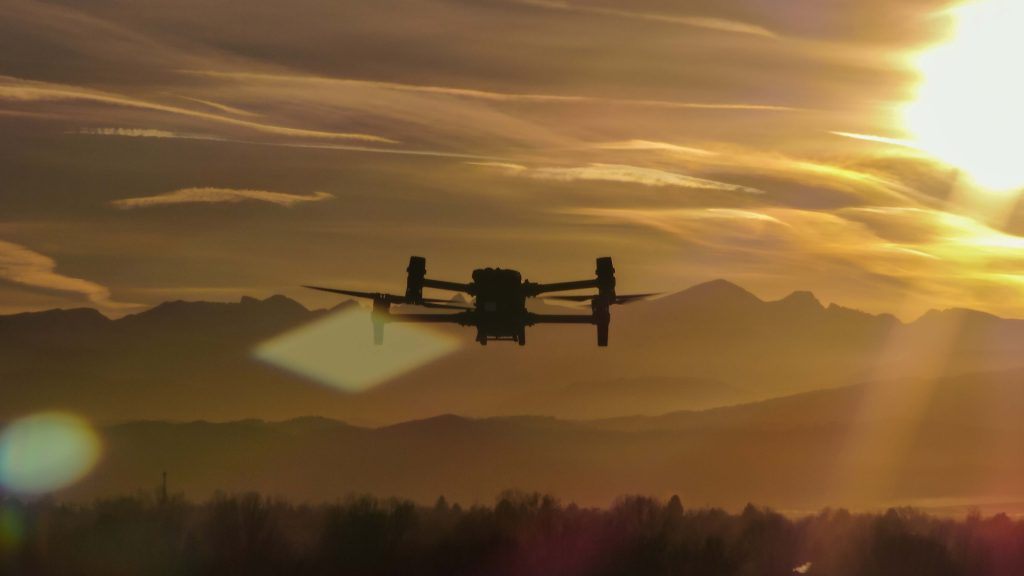
M30t Drone Flying in Rocky Mountains
DJI Consumer Drones and Their Popularity
DJI dominates the consumer drone market with a global market share of over 70%. Its flying platforms and handheld devices are available in over 100 countries and regions, solidifying its position as a leading provider of innovative drone technology.
That being said, DJI has also solidified its position in the enterprise market.
Enterprise Drones
Enterprise drones are Unmanned Aerial Vehicles (UAVs) designed specifically for use in a commercial or industrial setting. Enterprise drones are engineered for ease of use with a streamlined learning process. They feature industrial-grade operating systems, durable batteries, highly accurate GPS, and additional accessories such as speakers and spotlights.
Moreover, DJI’s enterprise drones are equipped with advanced features such as obstacle avoidance, advanced sensors, and long battery life, making them ideal for a variety of applications, including mapping, surveillance, and more.
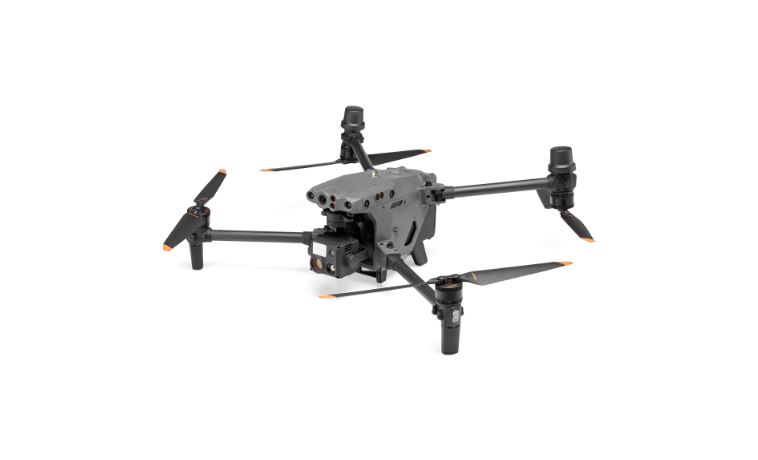
Matrice 30T | Source: DJI
The DJI M30T is one of the best enterprise drones. It comes with amazing payload capabilities and fantastic camera features, making it a perfect fit for enterprise use. Examine the features and capabilities of the DJI Matrice 30T to uncover what it offers for selective drone pilots, read the complete review of the M30T here.
Education Drones
Education drones transform the way students learn and interact with the world through Unmanned Aerial Vehicles (UAVs).
With the ability to positively affect both education and real-world applications, education drones are a valuable tool worth investigating and one of them is the DJI Tello drone.
DJI Tello offers kids a methodology for learning to code drones. Students can program the Tello drones to do flips, and fly patterns and answer instructions via hand motions.
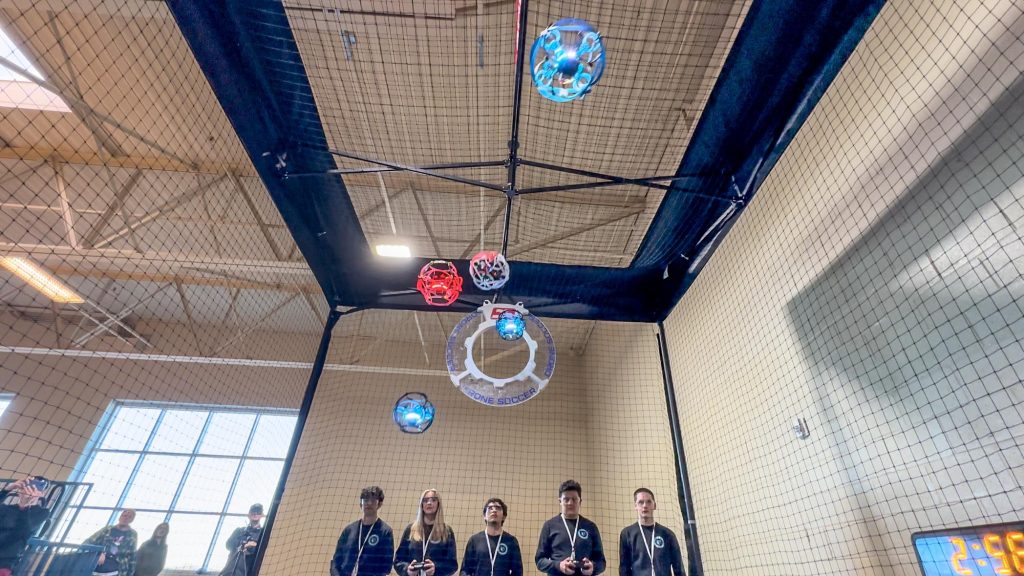
Drone Soccer Game played at Colorado Campus
Education drones engage and inspire learners in fields such as geography, science, and technology. These unmanned aerial vehicles come equipped with cameras, sensors, and projectors. It can also be paired with additional tools like robots and rovers, making them incredibly versatile.
We recommend the Drone Soccer program for schools as part of a comprehensive STEM education. The program involves drone building, drone programming, and competing against teams from around the world. Drone soccer has created a program that flies above and beyond the DJI tello offerings. Drone soccer offers kids a longer runway for learning and competing. Truly challenging kids to master their flight skills.
Agricultural Drones
DJI established DJI Agriculture in 2015 with a vision to bring its advanced drone technology to the agricultural industry.
Many industries like farming and ranching, forestry, and wildlife management use DJI agriculture drones due to their perfection. These agriculture drones allow farmers to save time, gather valuable data, and resources, and help in increasing yields and profitability.
According to research conducted in 2019 on “The Drones’ Impact on Precision Agriculture,” National Geographic’s report confirmed the rapid evolution and progression of farming technology in recent years. The implementation of specialized agricultural drones has enabled farmers to swiftly detect disease and pest afflictions, monitor irrigation water in real-time, and apply fertilizers to specific areas of the farm based on soil needs, surpassing the efficiency of conventional methods.
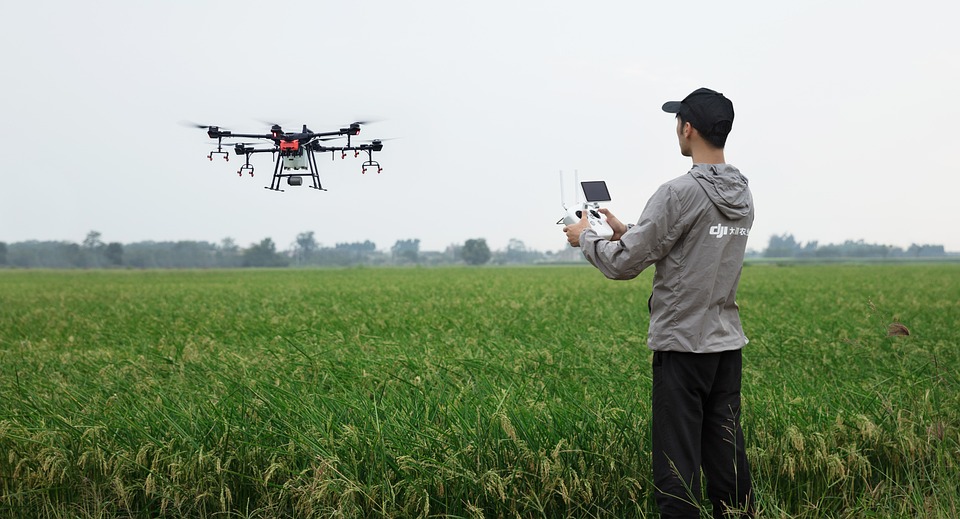 Agriculture Drone
DJI offers a suite of agricultural drones such as the MG-1, MG-1P, Phantom 4 RTK, Phantom 4 Multispectral, Mavic 3M, and a series of Agras drones for crop spraying.
And that’s not just limited to the hardware alone.
DJI also offers the DJI Agriculture Data Management Platform (DJI SmartFarm App), a specialized software designed for agricultural use.
The multispectral bands help farmers discern plant health from the camera payload. This enables data collection, disease mitigation, digitizing, indexing plants for inventory, and other agricultural applications.
Multispectral drones offer multiple lenses that read specific bands of light. These high-tech drones feature cameras, sensors, and sprayers and boast advanced capabilities such as obstacle avoidance, advanced sensors, and long battery life. They are commonly used for tasks like crop monitoring, soil analysis, and pesticide application.
However, in addition to the precise plant-specific spraying capabilities of the DJI Agras T40, DJI also offers a range of other options for agricultural use.
DJI Agricultural Drones: Our Top Picks
Our top three picks for agriculture drones are the Phantom 4 Multispectral, Wingtra, and Yamaha R-Max.
The Phantom 4 Multispectral is ideal for data collection crop inspections to determine disease and crop health as a whole. The Mavic 3 Multispectral has replaced the Phantom 4 multispectral data. The Wingtra One drone offers drone pilots the ability to map and interpret large crop fields and farms at lightning speed. Paired with PPK remote, it can georeference maps and models
NOTE: If you’re mapping large agricultural sites, the Wingtra Drone might be a better choice due to its high-grade accuracy across larger areas.
Construction Drones
Construction drones are used in construction and engineering projects. These drones are equipped with high-resolution cameras with mechanical shutters for aerial photogrammetry or drone mapping. These drones can also include LiDAR sensors, and other tools that help in capturing images, videos, and data. These payloads can be used for various tasks such as site inspection, surveying, and mapping.
Use of Drones in Construction
Construction drones can be used in a variety of applications such as building inspections, volume calculation, topographical mapping, and progress monitoring.
Drones can help in reducing the time and costs associated with traditional manual inspection methods, increase safety, and provide more accurate results.
Drones in construction are typically used for:
- Keeping projects on schedule
- Auditing Material Deliveries with Volumetric Measurement
- Measuring Cut-Fill Efficiencies
- Remote Monitoring Site Safety
- Auditing Record of Installation (volumetrically measuring the concrete laid on a given day)
- Logistics, Planning, and Project engineering by using PointClouds layered over VDC models to ensure the accuracy of installation.
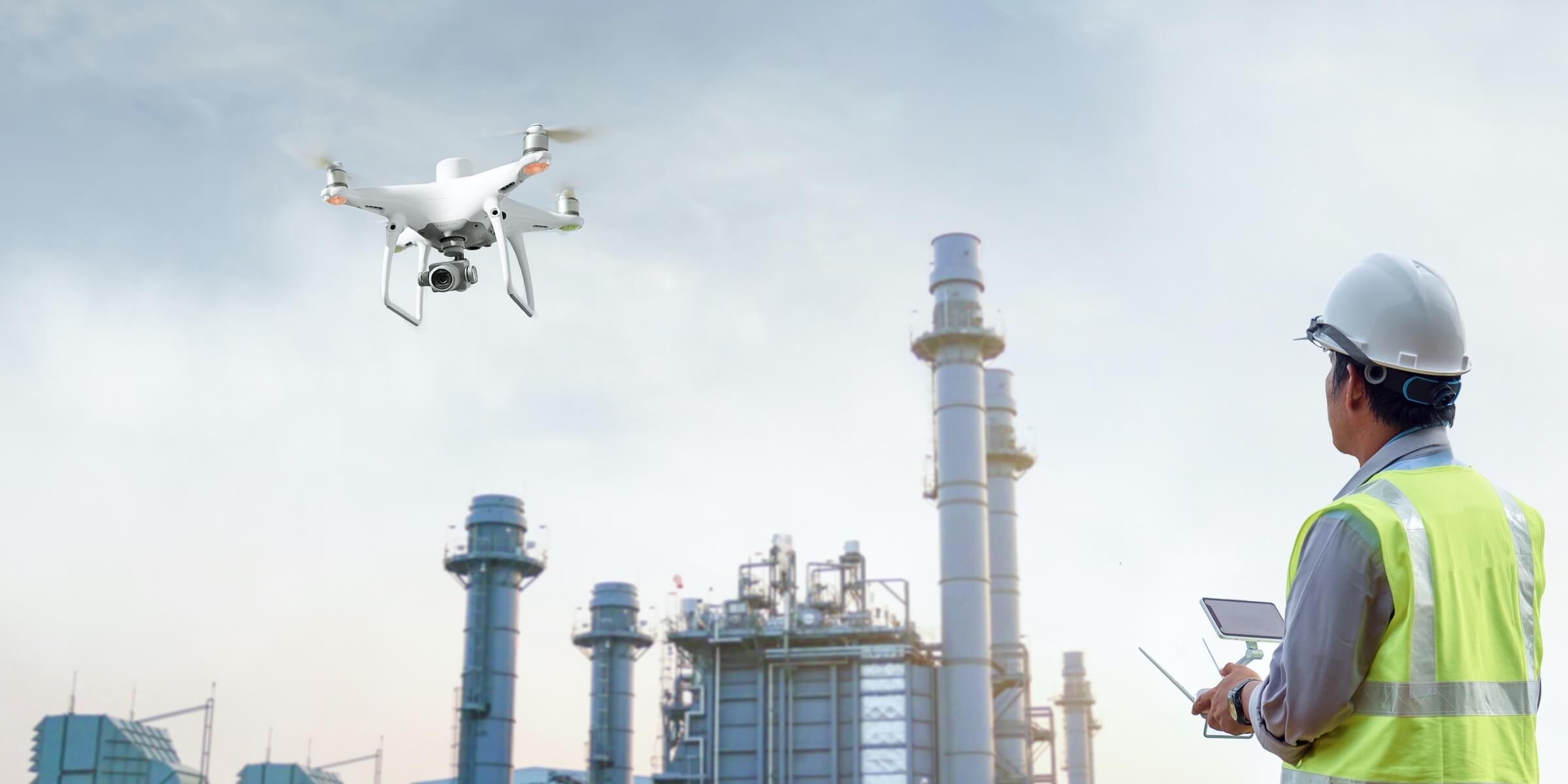 Use of Drones in Construction Site | Source: DJI Enterprise
Types of Construction Drones
Construction drones typically fall into two categories: those with strong mapping capabilities and those with zoom capabilities for focusing on specific areas. Drones with zoom capabilities often have limited mapping options due to the style of the shutter in the camera.
Best DJI Drones for Construction
Among DJI’s offerings, the Phantom 4 Pro, Mavic 3 Enterprise, and M30T are considered the best drones for construction.
DJI offers several drones that are ideal for construction, including the Phantom 4 Pro, Mavic 3 Enterprise, and M30T.
The Phantom 4 Pro excels in data collection and mapping, making it a valuable tool in construction.
The Mavic 3 Enterprise is ideal for aerial videography and mapping, making it useful in construction projects.
Finally, the M30T boasts advanced mapping capabilities, along with the ability to inspect with zoom and thermal imaging, making it a versatile choice for construction professionals.
However, with advancements in drone technology, and shifts in the construction drone market, the older models are being phased out.
For instance, the Phantom 4 Pro, once a popular choice for construction, is now being replaced by the Mavic 3 Enterprise for high-quality mapping drones.
Likewise, the Mavic 2 Enterprise Dual Advanced, previously a favorite for inspections, is being succeeded by the DJI Matrice 30T as the new construction powerhouse.
Government Drones
Government drones are unmanned aerial vehicles used by government agencies for all kinds of missions such as – surveillance, inspection, mapping, and search and rescue operations.
The DJI drones ideal for government use include the Mavic 2 Enterprise Dual Advanced, M30T, Matrice 300, and Phantom 4 Pro. The Phantom 4 Pro is perfect for government operations that require data collection and mapping.
The Mavic 2 Enterprise Dual Advanced (EDA) offers a versatile solution for government agencies looking for advanced aerial imaging capabilities. Its thermal imaging and limited zoom capabilities make it ideal for a range of applications, from capturing high-quality aerial footage to thermal inspections. The compact and portable design of the Mavic 2 EDA also makes it a convenient tool for government agencies operating in the field.
The M30T drone is particularly useful for mapping, long-range zoom, pinpoint measurement features, and a speaker as an optional add-on.
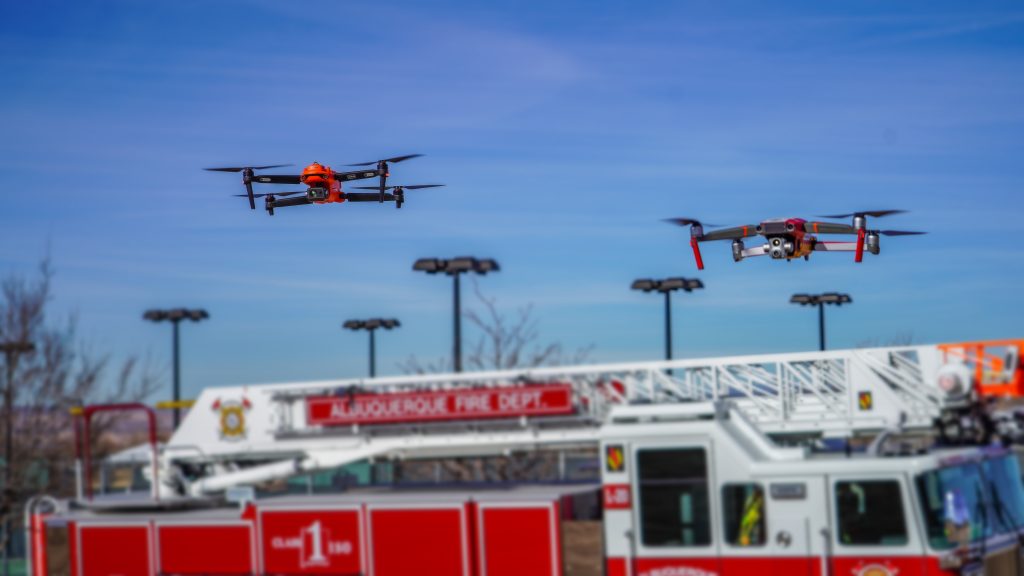
The Matrice 30T can be an ideal drone choice for government entities that prioritize security and data protection. The drone features a local data-only mode that ensures that sensitive information remains secure and only accessible by authorized personnel.
Additionally, the M30T offers a no-network option, although the network must be turned on to activate the drone.
To further enhance security and compliance, government entities can choose DJI’s government-edition drones or use DHS-compliant and approved control software applications.
This ensures that the drone is operated within the boundaries of federal regulations and helps to maintain the confidentiality of sensitive information.
Cell Tower Inspection Drones
Communications drones are specifically designed for use in the telecommunications and broadcasting industry. These drones allow companies to access hard-to-reach areas and collect important data more efficiently and cost-effectively.
These drones are proving to be valuable tools for the telecommunications and broadcasting industry.
What to look for in a Drone for the Telecommunication and Broadcasting Industry?
Before I recommend you the best DJI drone for the Telecommunication and Broadcasting industry, I would like to talk about a few important criteria for such UAVs:
These drones must be equipped with powerful zoom capabilities to inspect cell phone towers and read barcodes, as well as the ability to create a digital twin or map of the tower.
With a digital twin, communications companies can create a life-like 3d model of the tower. This would create a digital inventory of cell phone antennas.
These 3d models allow communications companies to measure antenna placement to ensure maximum coverage for clients.
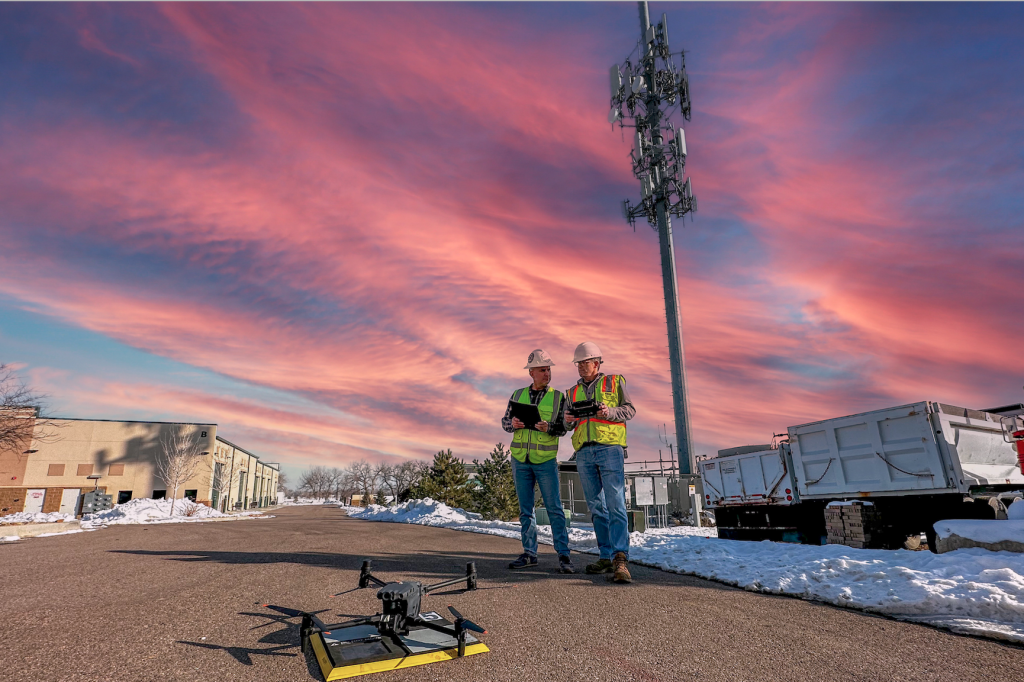
The Best DJI Drones for Communications
The best DJI drones for communications are the Phantom 4 Pro, M30T, and M300.
The Phantom 4 Pro is ideal for data collection and surveillance, making it an excellent choice for communication purposes.
The M30T is designed for aerial inspections and zoom photography, making it suitable for communication tasks that require high-quality visuals.
Finally, the M300 is ideal for mapping and surveying with its advanced P1 and L1 payloads, making it a powerful tool for communication applications. However, it is more expensive and bulky compared to the other two options.
DJI drones mentioned above are well-suited for use in the telecommunications industry and are used for a range of applications, from broadcasting and surveillance to security. Their obstacle avoidance technology, advanced sensors, and long battery life ensure that these drones can perform various tasks with ease and reliability. These features make DJI’s drones an excellent choice for a wide range of communications-related activities, from data collection and barcode reading to aerial inspections and more.
Media and Entertainment Drones
DJI drones have become a staple in the media and entertainment industry – right from film and television production to concerts and sporting events. They offer incredible versatility and flexibility with features such as attitude mode and dual operator controls.
With exceptional speed, agility, and stability, DJI drones are unmatched in the drone market.
DJI Drones for Media and Entertainment: Our Top Picks
The best DJI drones for media and entertainment are the Inspire 2 with X7 camera, the Mavic 2 Pro hacked with attitude mode, and the DJI FPV drone. The Inspire 2 X7 offers a camera raw at large file sizes but shoots in a native 2.44:1 due to the Super 35mm sensor.
The Mavic 2 Pro is perfect for travel aerial videography, hacking it to have attitude mode for faster speed tracking. It offers a great color gamut with the Hasselblad sensor making it perfect for media and entertainment use.
For media and entertainment applications, DJI’s drones boast interchangeable lenses, raw video output, and the sought-after 2.44:1 cinematic filming mode, making them ideal for capturing professional-grade footage.
Finally, the DJI FPV drone offers a bird’s eye perspective. The DJI FPV drone offers a new level of immersion for viewers making it perfect for media and entertainment use.
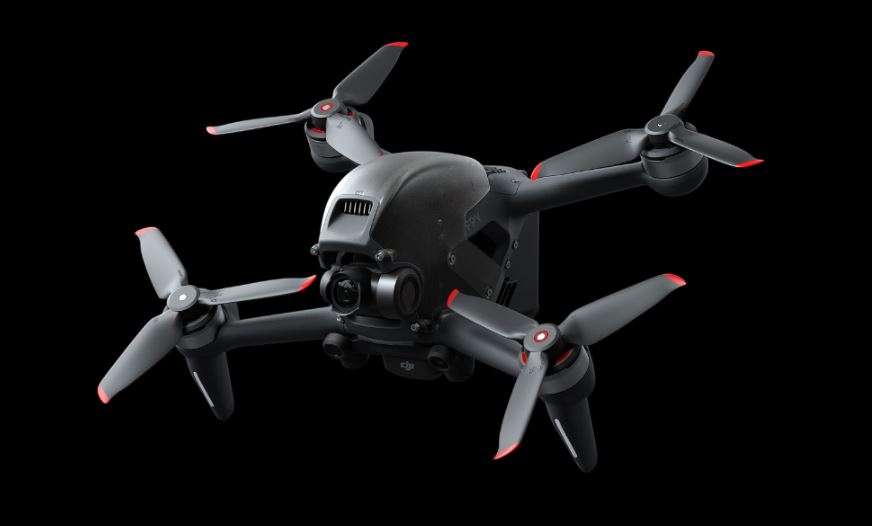 DJI FPV Drone | Source: DJI
Summarizing Drone Recommendations For You
To help you find the best DJI drone for your industry, we have summarized them below:
| Industry/Sector | Our Recommendation |
| Enterprise Drones | DJI M30T |
| Education Drones | DJI Tello |
| Agricultural Drones | Phantom 4 Pro, Mavic 2 Pro, & Inspire 2 |
| Construction Drones | Phantom 4 Pro, Mavic 3 Enterprise, & M30T |
| Government Drones | Mavic 2 EDA, M30T, Matrice 300, and Phantom 4 Pro |
| Communication Drones | Phantom 4 Pro, M30T, and M300 |
| Media And Entertainment Drones | Inspire 2 with X7 camera, Mavic 2 Pro, & DJI FPV |
Conclusion
DJI drones are a revolutionary tool transforming the way industries work.
With a range of options, including the Phantom 4 Pro, Mavic 3 Enterprise, M30T, DJI FPV drone, and the DJI Avata, there is a DJI drone to meet the needs of every industry.
These birds offer unparalleled versatility and reliability. From agriculture to construction, media, entertainment, and beyond, there is a DJI drone that can meet the unique needs of each industry.
Unlock the full potential of DJI drones with the Drone U community where you will get access to 41+ drone courses and a thriving community of like-minded professionals.
0
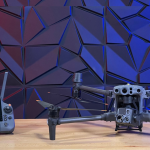
DJI M30T Drone Review: Best Enterprise Drone of DJI Matrice Series
Are you looking for a drone platform with enterprise capabilities minus the size and complexity? If so, the DJI Matrice 30T drone from the DJI Matrice 30 series – The best drone for the money, might have caught your attention.
The DJI M30T has created a buzz in the enterprise world. Its compact design, powerful performance, and versatility have got everyone excited.
But is this drone really true to its promise?
Well..we conducted a series of maneuvers and test flights to find out the truth.
In this article, I am going to talk about my experience flying this bird. So you can determine if it’s the right platform for your needs. We will also take a closer look at the features and capabilities of the DJI M30T and see what it has in store for discerning drone pilots.
The DJI M30T is a part of the DJI Matrice 30 series.
Unlike the DJI M300, which is bulky and heavy, the DJI M30T offers a powerful payload in a foldable package.
With the Matrice 30T, DJI offers unmatched dual-vision and ToF sensors, a robust remote controller, and even a docking station for truly remote operations.
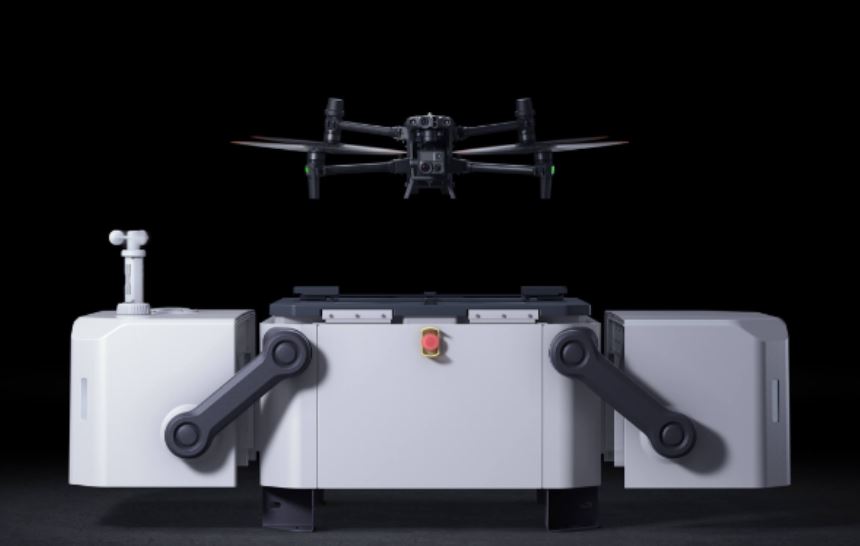 DJI M30T with Dock Station | Source: DJI
So before we go any further, let us take a look at the price and variants.
How Much Does DJI Matrice 30T Cost?
The Worry-Free Plus Combo of DJI Matrice 30T costs USD 14,700 and the Basic Combo costs USD 13,999.
The DJI Matrice 30 series (M30 or M30T) core package includes a DJI RC Plus, two TB30 Intelligent Flight Batteries, one BS30 Intelligent Battery Station, and a storage case for the aircraft.
This little powerhouse DJI M30T is like a Mini Me to the M300, delivering the ultimate camera payload for your inspection needs.
When we evaluated the DJI Matrice 30T, the following factors were on top of our minds:
- Camera Quality: A 3 high-resolution cameras and the ability to create 2D Maps and shoot in 4K or higher.
- Longer Flight Time: Look for a drone with long battery life, typically around 30 minutes or more.
- Long Range: Important for professional applications such as inspections or surveillance.
- Portability: Look for a model that is lightweight and can fold down to a compact size for easy transport.
- Intelligent Features: Like obstacle avoidance, ActiveTrack, autonomous missions for mapping, and automatic takeoff and landing.
Now, let’s delve into the specifications of the Matrice 30T to see how it measures up.
Specifications of DJI Matrice 30 Series
The DJI Matrice 30 Series (M30 or M30T) is an advanced enterprise drone with a suite of advanced features and specifications.
Let’s take a sneak peek into the performance and capabilities of the DJI M30 Series:
- Camera: 12mp 1/2″ CMOS Sensor (wide)
- Zoom Camera: 48MP zoom camera with 16x Optical zoom, 200x Hybrid Zoom
- Thermal Camera: 640p Thermal with Isotherms, Temperature Alarm
- Operating Temperature Range: -20° to 50° C (-4° to 122° F)
- Gimbal Angular Vibration Range: ±0.01°
- Operation Frequency: 5.725-5.850 GHz
- Max Service Ceiling: 7000m
- Max Tilt Angle: 35° (N-mode and Forward Vision System enabled: 25°)
- Unobstructed Max Transmission Distance: 15 km (FCC); 8 km (CE/SRRC/MIC)
- Vertical Surface Measuring Range: 0.5×12 m vertical surface with 20% reflectivity
- Battery Station: Supports battery station with an output power of 65 W (USB-C port Max) and an output power of 10 W (USB-A port Max)
- Vision System enabled with Obstacle Sensing Range:
Forward: 0.6-38 m and Upward/Downward/Backward/Sideward: 0.5-33 m
Lots of Upgrades
The aircraft offers so many upgrades to every aspect of the traditional quadcopter that it is difficult to succinctly state the insane value this drone offers.
Wide Camera
The wide camera can be used to capture color-rich video and be used for autonomous mapping missions. The zoom camera offers 16x optical zoom but allows the user to zoom in 200x on the remote…with digital zoom. The key difference between other DJI enterprise drones and the M30t, is the ability for the M30t to record all 4 cameras at once.
A Brand New Remote and App
The new remote and DJI Pilot 2 app offers programmable flight modes, a laser rangefinder, pinpoint drop, and even integrated checklists.
360-Degree Obstacle Avoidance
The aircraft has 360-degree obstacle avoidance which displays on the screen in a useful, yet simple interface.
Feel Like a Fighter Pilot
At times, the DJI Matric M30 can make you feel like a fighter pilot with boots on the ground.
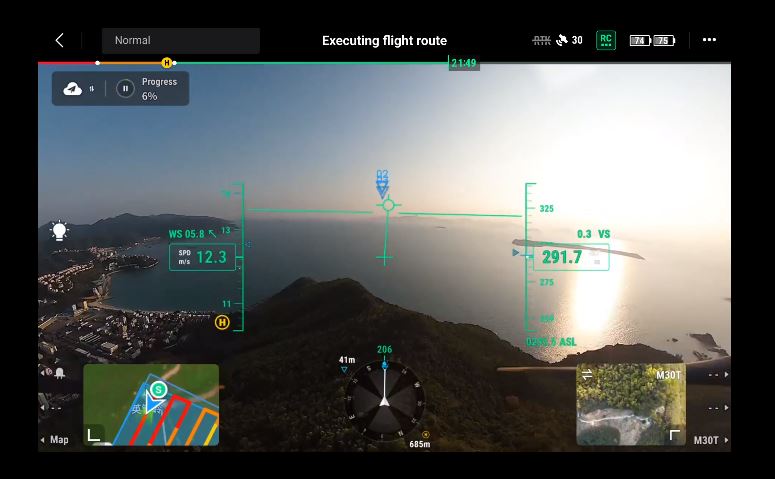 Source: DJI
Flying this drone leaves you amazed by its stability and agility. The heads-up display puts all the necessary information right at your fingertips.
Programmable Flight Modes
The programmable flight modes allow pilots to switch to attitude mode to avoid emergencies or fly in difficult situations.
Empower Drone Teams
The DJI Matrice 30T offers features to empower drone teams and programs. Multiple users can set up remote customization and save them in the remote. Thereby making aircraft sharing easy and convenient.
The new remote is nothing like the “Smart Controller,” offered with the DJI M300. The DJI M30T remote offers numerous methodologies for completing the same tasks. This remote makes it easy to switch between cameras, drop pins or even measure distances or temperatures.
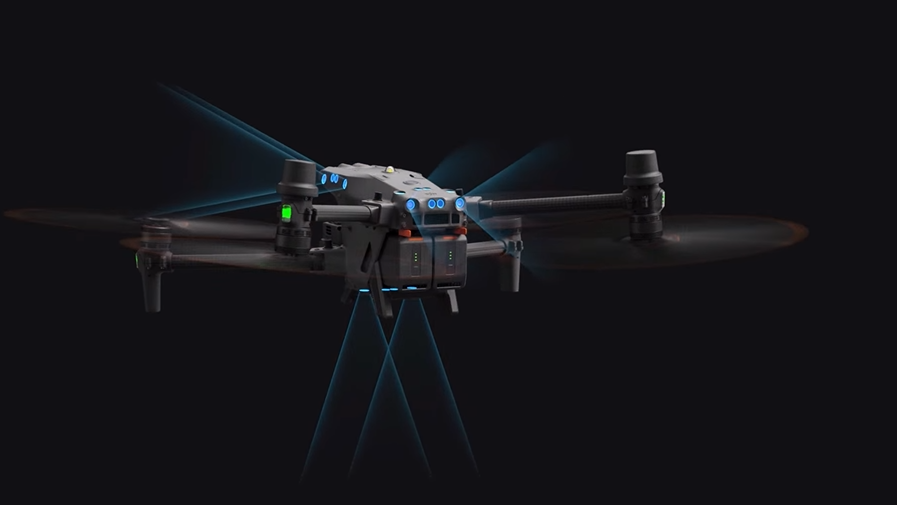 Dual-vision and ToF sensors in Matrice 30 Series | Source: DJI
Battery Maintenance is Easier Than Ever
Battery maintenance has always been an issue in the enterprise environment. Since multiple hands use the aircraft, it often results in greater wear and tear. The good news is – DJI’s new battery charger makes battery maintenance easy.
The charger offers 3 distinct modes for charging batteries and storing them.
- The first setting will charge the batteries to 100% and set a maximum discharge rate of 8 days. The batteries will automatically self-discharge to 95% after 2 days
- The second charging setting will charge the batteries to 90% and keep them there.
- The last charging setting is for storage. The charger will charge the batteries to 50% and keep them there for storage.
DJI even included expanded instructions for deep cycling the battery. These features will help programs and departments maintain batteries over a longer time. It also allows you to maintain mission readiness with the aircraft.
Is DJI M30T the Best Inspection Drone in the Market?
Probably yes.
Here are a few reasons why the DJI Matrice 30T is the best inspection drone on the market:
Advanced Cameras
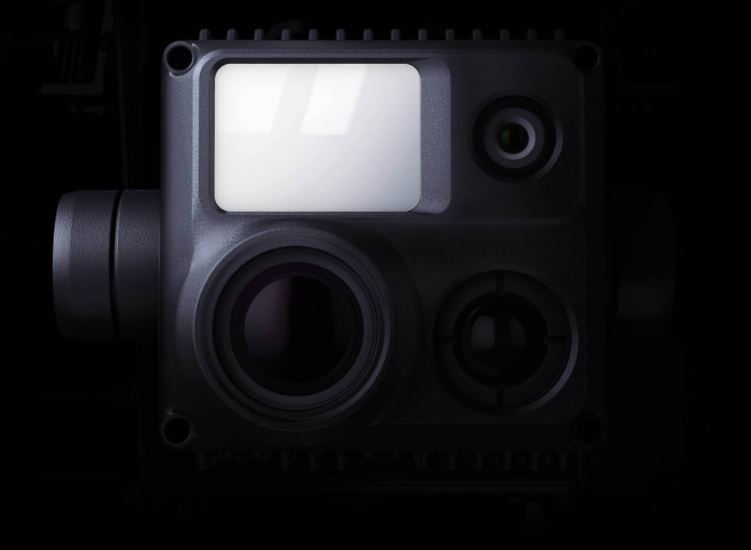 Wide Camera, Zoom Camera, Thermal Imaging Camera, and Laser Rangefinder | Source: DJI
As mentioned earlier, the M30T’s triple camera payload includes a high-resolution 48MP main camera, a thermal camera, and a 12 mp wide-angle lens camera. This allows the M30T to capture a wide range of images and video footage, including thermal imagery, which is essential for many inspection tasks.
When capturing numerous perspectives, allows drone pilots to choose the best-looking video after the flight.
Long Flight Time
With a flight time of up to 41 minutes, the M30T can cover large areas and complete inspections efficiently. This is particularly useful for inspections of large structures such as bridges or buildings, where a long flight time is essential.
Rugged Design
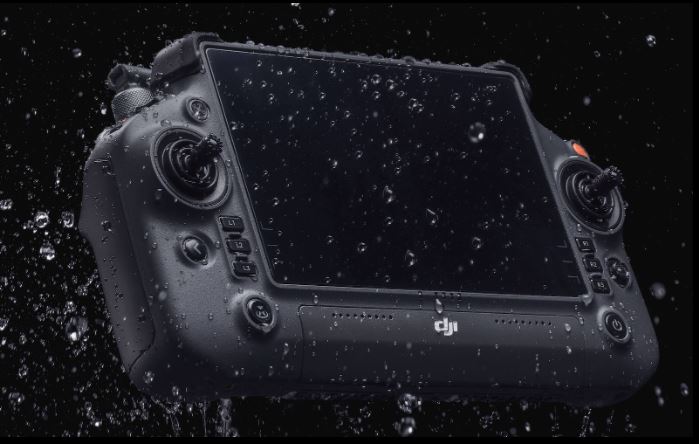 Water and Dustproof Design of Matrice 30T | Source: DJI
The M30T has enterprise environmental adaptability, featuring a robust, weather-resistant frame. This enhances its reliability for inspections in challenging conditions, such as high winds or inclement weather, making it ideal for harsh environments.
Advanced Software
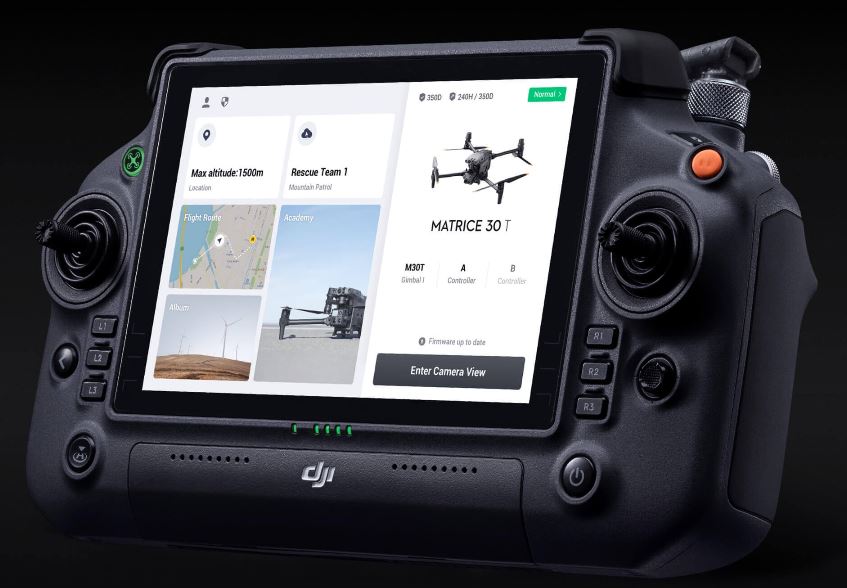 Flight Interface in DJI Pilot 2 | Source: DJI
The advanced software inside M30T allows you to perform autonomous flights and follow pre-programmed inspection routes. This helps ensure that inspections are thorough and consistent, and allows operators to focus on other tasks while the M30T is in the air.
Enhanced Transmission
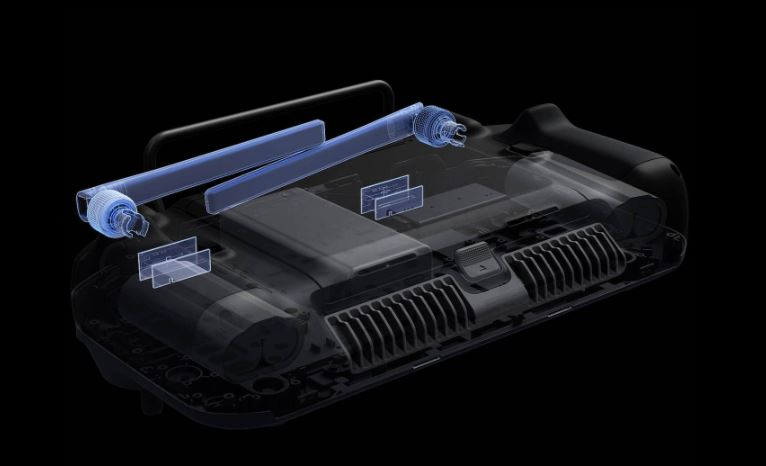 Four Antenna OcuSync 3 Enterprise | Source: DJI
The enterprise drone Matrice 30T is equipped with four built-in antennas that support OcuSync 3 Enterprise, allowing for triple-channel 1080p video transmission and the ability to seamlessly swap between input feeds even in challenging environments.
Night Flight
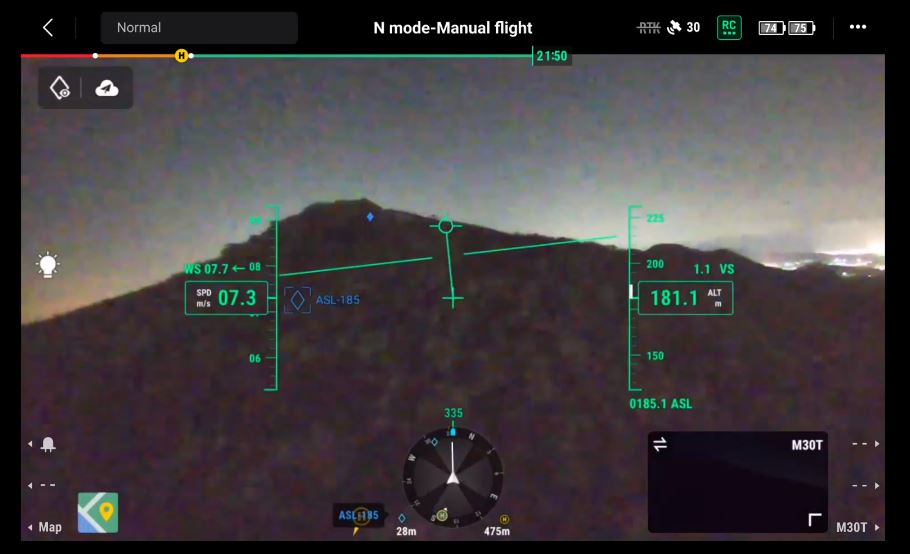 Night Flight Mode | Source: DJI
The FPV camera is optimized for low-light conditions. This ensures clear visibility of the ground and skyline, even at night.
More Power at Half the Price
While the Mavic 3 Enterprise drone may be a better solution for Mapping Missions, the M30T offers the ultimate camera payload suite to service just about any drone job. At 1/4 the size of the DJI M300, the DJI M30T offers better camera sensors at half the price.
In conclusion, the DJI Matrice 30T is the best drone for the money for inspection professionals. Its advanced camera payload, long flight time, rugged design, and advanced software make it a reliable choice for demanding inspection jobs.
DJI Matrice 30T Summary
The DJI Matrice 30T drone is a game-changer for the enterprise industry, providing an innovative solution for various inspection tasks.
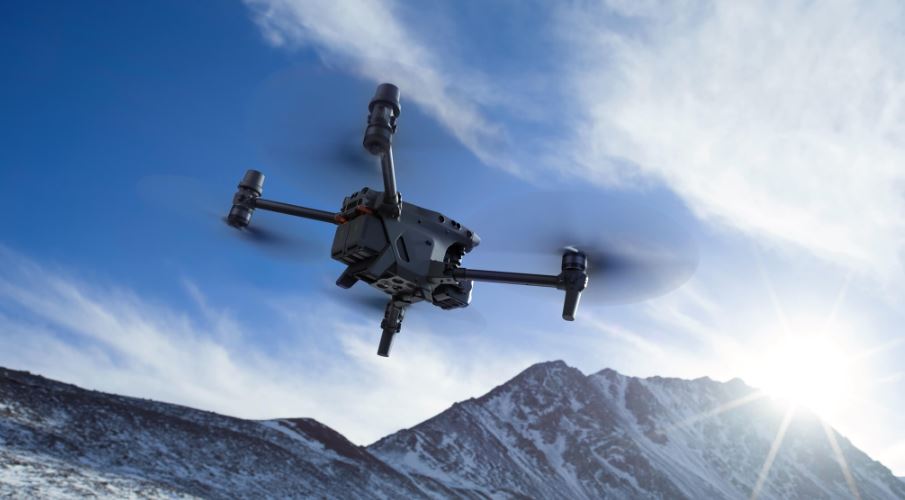 Entreprise Drone from DJI Matrice 30 Series | Source: DJI
Whether you are conducting infrastructure inspections, search and rescue missions, or other industrial applications, the DJI M30T drone offers a range of benefits that set it apart from other enterprise drones in its class.
Summarizing the features of DJI M30T
- Triple camera payload with extreme zoom (M30T offers 48MP Zoom Camera, vs 20MP on DJI M300).
- Large thermal cameras with “super-resolution,” to up sample media, and set temperature alerts and isotherms.
- Laser rangefinder for better depth perception of objects.
- Pinpoint Capability: Mark a subject and easily communicate its position & location to the incident command.
- Programmable flight modes
- Charging battery redundancy with decent flight times
- The intelligent flight battery capacity of the internal battery and external battery configuration powers 6 hours of battery life and allows for hot-swapping for seamless, increased operational efficiency.
- Extreme remote customization – customized by the user.
- Small folding form factor (Fits in a case smaller than a phantom)
- Battery management and maintenance are easy.
So if you’re searching for a drone that can handle tough conditions and provide excellent results, the M30T is definitely worth considering.
Limitations of the DJI Matrice 30T
Despite its impressive capabilities and being the best drone for the money today, the DJI M30T is not without its limitations. Understanding these limitations is crucial for enterprise professionals who are considering incorporating the DJI M30T into their operations:
- Wide Camera is only 12mp elongating mapping missions
- Autonomous Missions are limited with DJI Pilot 2 app.
- Hyper Sensitive Obstacle Avoidance
- Lack of Intelligent flight features like Point of Interest or Orbits
- Apps are difficult to download, Drone Sense works, but with limited functionality.
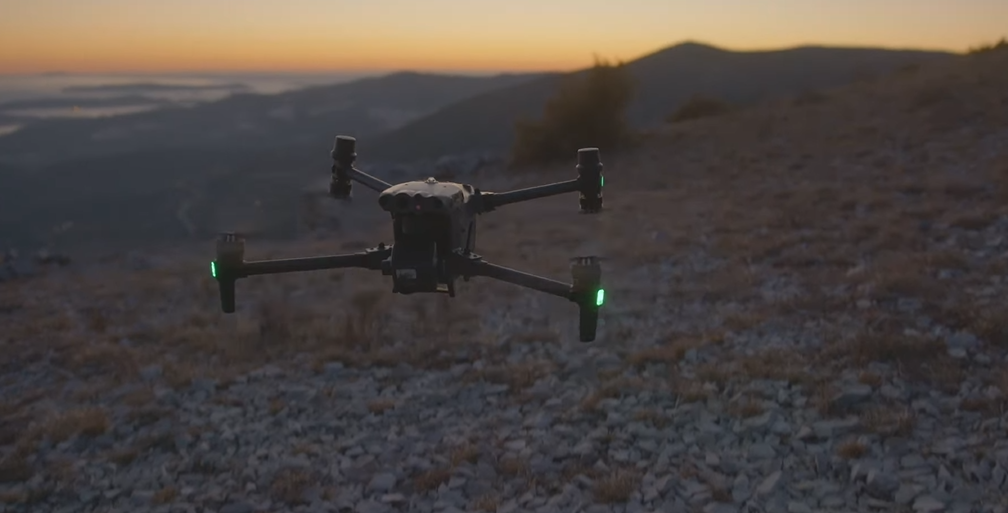 DJI M30 Series | Source: DJI
Frequently Asked Questions
What is the difference between DJI M30T and M30?
The DJI Matrice 30 series consists of two models: the M30, equipped with a gimbal and camera featuring three sensors (wide-angle, zoom, and laser rangefinder), and the M30T is the best drone for the money with a gimbal and camera featuring four sensors (wide-angle, zoom, laser rangefinder, and thermal imaging).
How long does DJI M 30 take to fly?
The M30 provides 41 minutes of flight time and can reach a maximum flight speed of 23 m/s.
How fast does DJI Matrice 30 go?
The DJI Matrice 30 offers higher operational efficiency with a wind resistance of 15 m/s, a max tilt descent speed of 7 m/s, and a maximum speed of 23 m/s.
What is DJI Matrice 30 used for?
The DJI Matrice 30 is an excellent drone suitable for search and rescue, inspection, and safety applications. Among enterprise drones, the DJI M30T stands out as the best option so far.
What is the maximum range of DJI Matrice 30?
The DJI Dock (M30 Series Dock Version 5) boasts flagship-level performance, featuring a maximum operation range of 7 km.
Transform Your Drone Operations with the DJI M30T Series and Our Exclusive “Don’t Crash” Course! Get the most out of your investment, sharpen your skills, and elevate your performance to new heights. Click here to enroll.
0

Where to find the best Cell Tower Inspection Drone Jobs
Looking to find the best Cell Tower Inspection drone jobs, drone pilots might find them with data management and processing companies instead of traditional means. Continue reading
0
Where to find the best drone jobs for Pilots
When it comes to finding the best drone jobs, drone pilots should be looking in new outlets like software processors and large scale drone teams. Continue reading
0
Lessons Learned from working with Drone Jobbing Companies
Flying drone missions for drone jobbing companies can be a great method to gain experience, but take these lessons learned to avoid costly mistakes. Continue reading
0
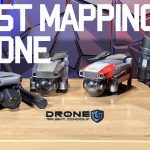
Best Mapping Drone Mavic 3 Enterprise | M30t
Navigate the marketing hype and learn which drone offers better mapping deliverables, the Mavic 3 enterprise or the DJI M30t. Continue reading
0

Best Drone Training Course
Best Drone training courses should be a systematic approach to learn practical approaches of safely flying in different environments.
0

Social Media Drone Jobs | Newest drone deliverable
Newest drone deliverable from drone pilots is portrait style aerial video. These lucrative social media drone jobs pay pilots well for short clips. Continue reading
0
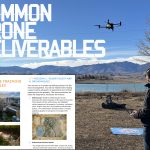
Common Drone Deliverables of Professional Drone Operators
Common drone deliverables of professional drone pilots typically comes down to orthomosaics or photogrammetry, aerial videos and aerial photos. Continue reading
0

-
 Brinc Admits, We Caused the DJI Drone Ban! EXCLUSIVE
-
 Brinc Admits they're behind DJI Ban | Auterion Creates Drone Swarm Brain
-
 Trump Card on the DJI Ban, May be Best drone news of 2025. Will he tiktok DJI?
-
 This Drone Trick Makes Real Estate Videos Awesome!
-
 Exploring Drone Security: Opportunities and Challenges
More on Hot Topics