
Top 6 AI Drones of 2025: A Comprehensive Review
Picture this: An unmanned aircraft is automatically navigating a dense forest, dodging branches, and snapping breathtaking aerial photos.
Does that seem like a scene from a sci-fi movie?
Well, not anymore. This is now a reality with AI drones.
These intelligent machines transform how we explore our world and capture aerial data.
Drones have already changed the way we capture moments, explore new places, and gather data. But in 2025, AI-powered drones took it even further. These autonomous birds offer smarter navigation, better obstacle avoidance, and features that make flying easier than ever.
The AI drone market has rapidly expanded, offering specialized solutions for diverse professional and recreational applications.
With so many choices, how do you pick the right one? That’s where we come in.
Let’s dive in!
What are AI Drones?
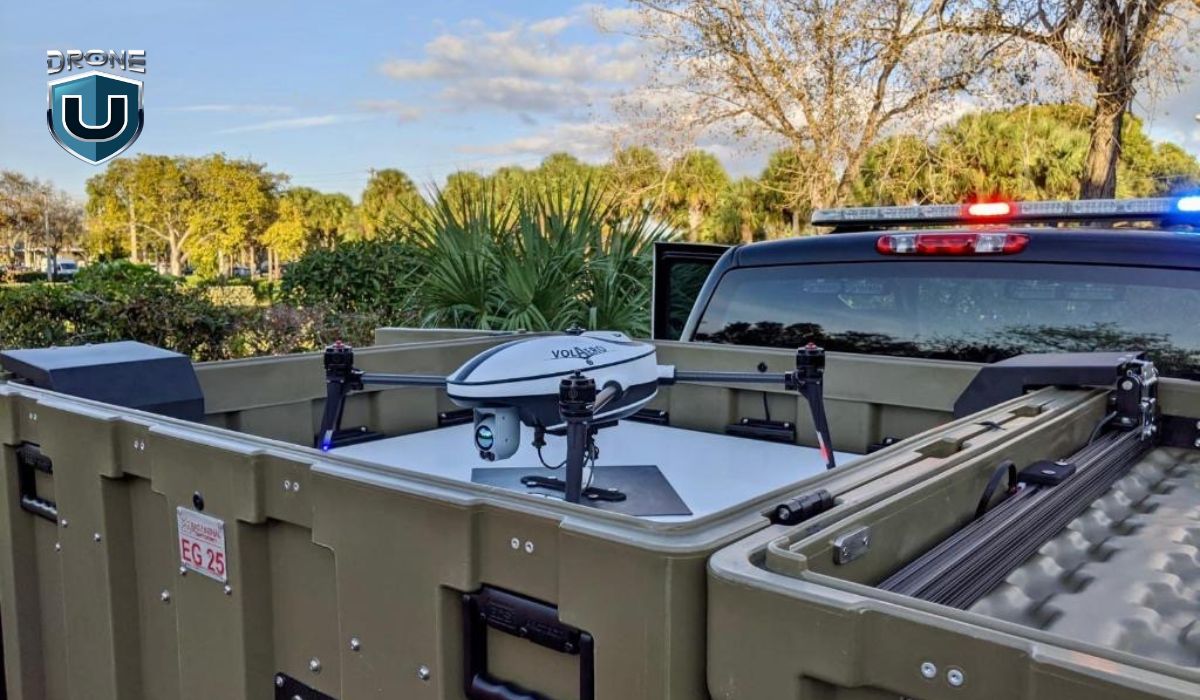
AI drones are unmanned aircraft that use artificial intelligence to fly autonomously and make smart decisions. Unlike traditional drones, which require manual control, AI drones have advanced sensors, cameras, and software that allow them to perceive and navigate their environment.
These drones can detect obstacles, plan their flight paths, and even complete tasks without needing constant input from a pilot. These drones leverage advanced algorithms to process environmental data and make autonomous decisions that enhance flight performance and safety.
Some of the standout features and capabilities of AI drones include:
- Obstacle avoidance and collision prevention
- Autonomous navigation and path planning
- Object detection and recognition
- Intelligent task execution (e.g., surveillance, delivery)
- Adaptive flight control and stabilization
- Machine learning-based decision-making
- Environmental awareness and situational analysis
In short, AI drones make flying easier, safer, and more efficient by using advanced technology to handle tasks that once required a human pilot.
Let’s now understand how can you choose a perfect AI drone for yourself.
Criteria for Choosing an AI Drone
We’ve tested a range of drones, and here’s what we considered to help you make the best choice:
1. Flight Time
AI drones often consume more battery due to their advanced features. It’s important to think about how long you need the drone to stay airborne for your desired task.
2. Camera Quality
AI drones excel at capturing incredible visuals, but camera quality varies. Consider resolution, sensor size, and any specialized features like low-light performance or object tracking.
3. Range
Think about the operational area you envision. If you’re working in vast areas, look for a drone with a longer range. If precision is more important, a drone with a shorter, more controlled range may be a better fit.
4. Ease of Use
AI technology can make flying easier, but some drones are more user-friendly than others. Consider your piloting experience and how much assistance you desire.
5. Safety Features
Look for essential features like obstacle avoidance, return-to-home functionality, and automatic landing in case of signal loss. These features are crucial for a safe and stress-free flight experience.
6. Regulations
Drone operators must comply with Federal Aviation Administration (FAA) regulations, which include specific requirements for drone weight, registration, and operational zones. Familiarize yourself with local drone regulations before making a purchase.
The Best AI Drones in the Market
After carefully considering the above factors, here are the top 6 AI drones that meet these criteria:
1. DJI Mavic Air 2S
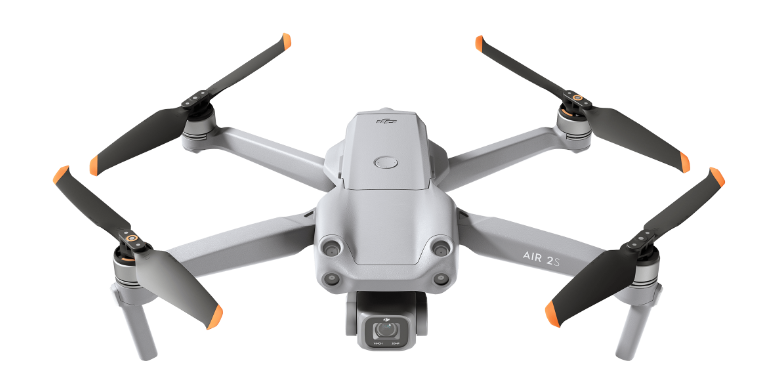 Source: DJI
A creative powerhouse, the Mavic Air 2S features a 1-inch CMOS sensor capable of capturing breathtaking 5.4K video. Omnidirectional obstacle avoidance sensors keep you flying worry-free, allowing you to focus on capturing stunning aerial masterpieces.
Specifications:
- Sensor: 1-inch CMOS
- Video Resolution: 5.4K
- Max Flight Distance: 18.5 km
- Flight Time: 31 minutes
- Obstacle Avoidance: Omnidirectional sensors
Pros:
- Delivers breathtaking visuals due to the large sensor.
- Allows for capturing a wider range of aerial content.
- Omnidirectional sensors provide a safety net for worry-free flight.
- Ideal for travel and content creators.
Cons:
- Compared to some models, the Mavic Air 2S comes at a higher cost.
- Slightly heavier than the DJI Mini 3 Pro, potentially requiring additional licensing depending on regulations.
2. Autel Robotics EVO II Pro 6K Enterprise Bundle V3
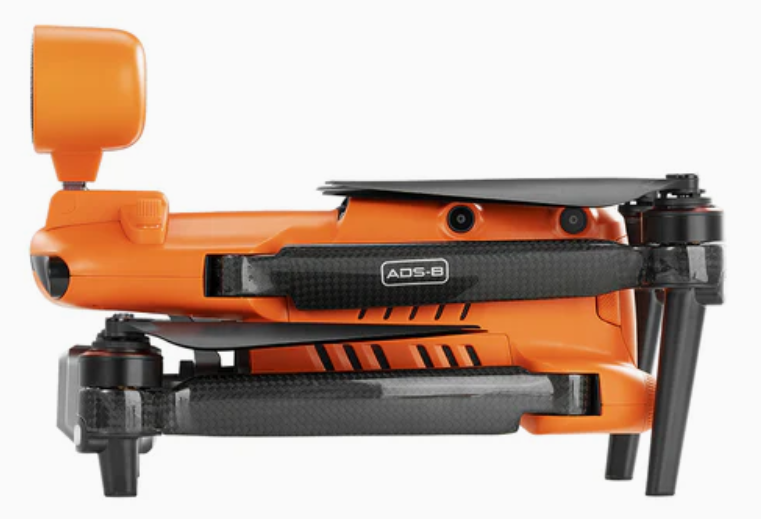 Source: Autel Robotics
This EVO II Pro 6K Enterprise Bundle V3 offers multiple models, each boasting impressive AI features. Track your subject with ease or navigate complex environments with the help of automatic obstacle detection. With an EVO II drone, you’ll have the perfect AI companion for any aerial mission.
Specifications:
- 20MP 1″ CMOS sensor capable of 6k Ultra HD Videos
- 3x Lossless 16x Digital Zoom Capability
- 360° obstacle avoidance with 19 groups of sensors
- 7.9″ Smart Controller V3
- Dynamic Track 2.1
- 42 minutes flight time
Pros:
- Multiple models cater to diverse functionalities and needs.
- Extended flight duration allows for capturing more expansive aerial footage.
Cons:
- The cost depends on the chosen model and its advanced features.
- Some models can be bulkier, impacting portability.
3. PowerVision PowerEye
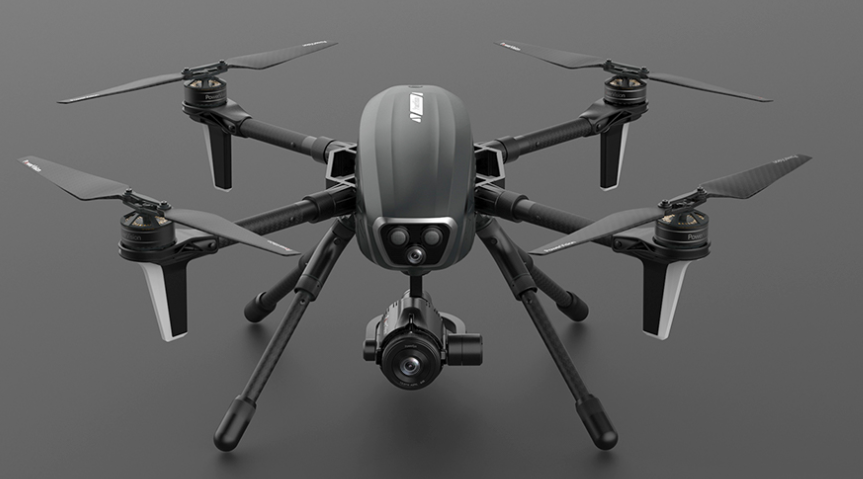 Source: PowerVision
This PowerEye drone stands out for its long flight time and unique tethered flying option, ideal for extended aerial missions and commercial applications.
The PowerEye stands out for its marathon flight times, ideal for extended aerial missions. Add to that the unique tethered flying option, perfect for commercial applications requiring continuous power. The PowerEye is a workhorse in the world of AI drones.
Specifications:
- Sensor: 4/3′ CMOS
- Video Resolution: 4K
- Max Transmission Distance: 5 km
- Flight Time: 29 minutes
- Gimbal: 3-axis
Pros:
- Tethered option enables exceptionally long missions.
- Perfectly suited for tasks requiring continuous power, such as inspections or security.
- Micro Four Thirds sensor delivers solid image capture capabilities.
- Covers vast areas efficiently.
Cons:
- Tethered flight restricts movement in certain scenarios.
- Less portable compared to some options.
4. Skydio X10
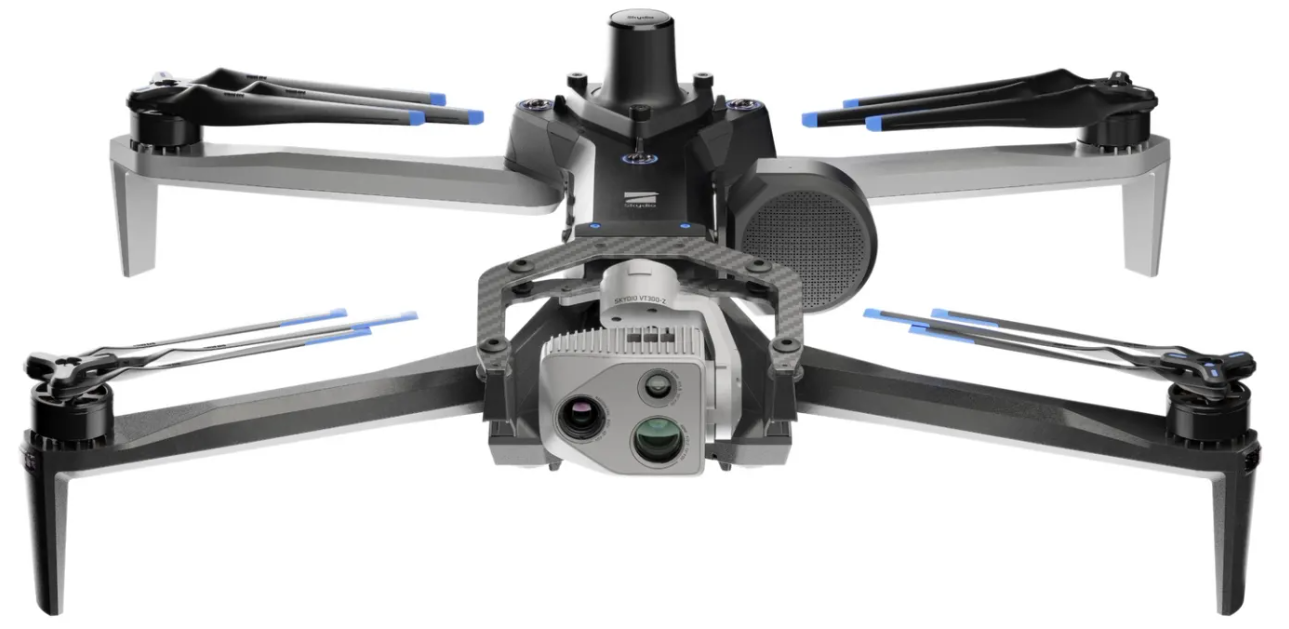 Source: Skydio
Known for its ease of use and autonomous flight modes, the Skydio X10 is a great choice for industrial applications or those seeking a user-friendly AI drone experience.
The user-friendly Skydio X10 makes flying a breeze. With intuitive controls and a variety of autonomous flight modes, the Skydio X10 allows you to experience the power of AI without a steep learning curve.
Specifications:
- Sensor: 1/2″ 48MP CMOS
- Video Resolution: 4K
- Range: 5km
- Flight Time: 40 minutes
- Obstacle Avoidance: 360-degree
Pros:
- User-friendly controls and autonomous flight modes make flying effortless.
- Six-rotor design offers a confidence boost for beginners.
- Provides ample time for capturing desired aerial footage.
Cons:
- Sensor size translates to a lower resolution compared to high-end models.
- May not be ideal for covering larger areas.
5. Ryze Tello EDU
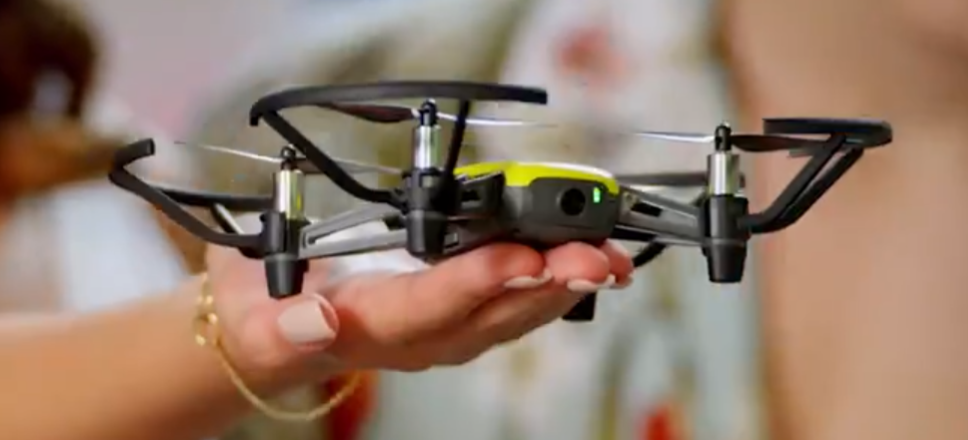 Source: RyzeRobotics
A fantastic option for educators and hobbyists, this budget-friendly drone offers a programmable platform for learning about AI and drone technology.
The Ryze Tello EDU provides an affordable, hands-on platform for STEM education, allowing students and enthusiasts to explore drone programming and AI technologies. This programmable platform allows you to experiment, learn, and unleash your creativity in the sky.
Specifications:
- Camera: 5MP
- Video Resolution: 720p
- Range: 80 meters
- Flight Time: 13 minutes
- Special Feature: Programmable platform
Pros:
- Enables exploration of AI and drone technology at an affordable cost.
- Programmable platform fosters learning and experimentation.
- Compact design allows for easy transport and use.
Cons:
- Primarily suited for learning purposes, not professional photography.
- Not ideal for capturing extensive aerial content.
6. DJI Mini 3 Pro
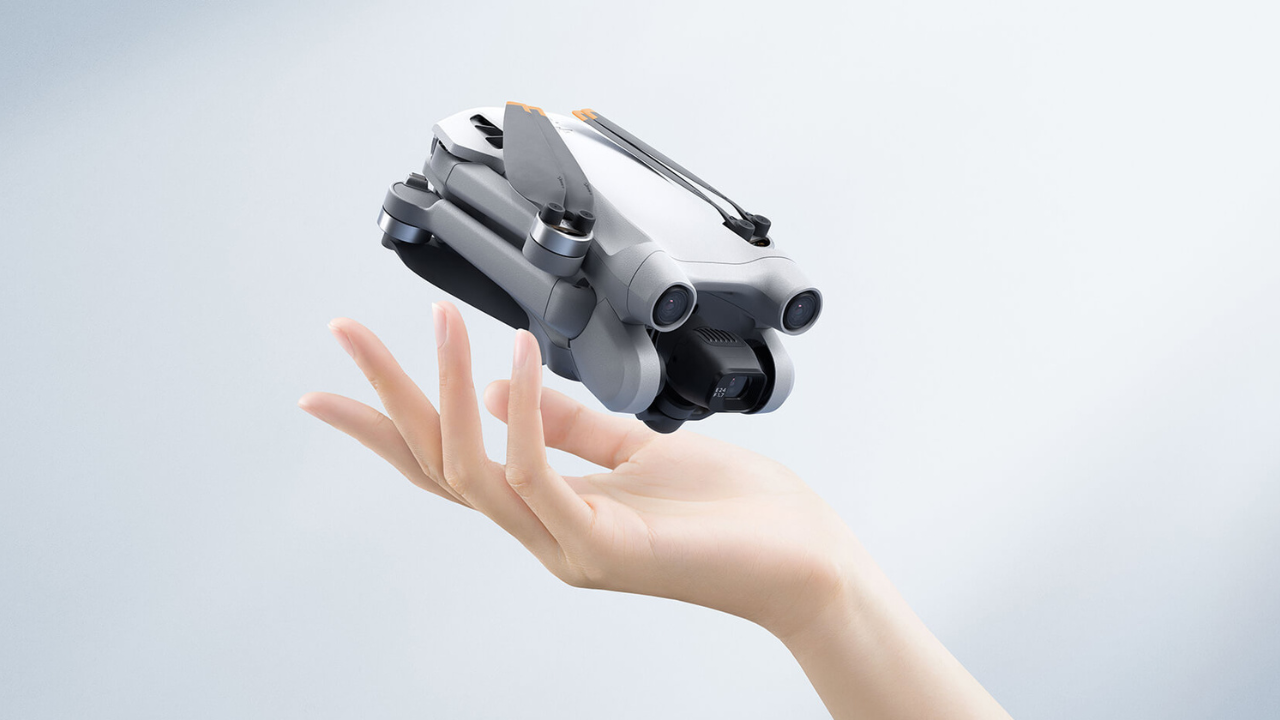 Source: DJI
This lightweight and portable drone packs a punch with its intelligent flight modes, object tracking, and excellent image quality, making it perfect for capturing travel footage or everyday adventures.
Lightweight and portable, the DJI Mini 3 Pro packs a powerful punch. Intelligent flight modes, object tracking, and excellent image quality make it the perfect travel companion for capturing stunning aerial footage of your adventures.
Specifications:
- Sensor: 1/3-inch CMOS
- Video Resolution: 4K
- Range: 18km
- Flight Time: 34 minutes
- Weight: Under 249 grams
Pros:
- Ultra-lightweight design makes it perfect for travel and everyday adventures.
- Captures extensive aerial footage within a compact frame.
- Covers a surprising distance for its size.
- Falls under the 249-gram weight
Cons:
- Image quality may not match higher-end models with larger sensors.
- Due to its lightweight design, strong winds can impact flight stability.
Summary
AI drones aren’t just about the tech. They are about what you can do with it!
The list has explored six compelling AI-powered drones, each with its strengths:
- For a versatile and user-friendly option, the DJI Mavic Air 2S and DJI Mini 3 Pro are excellent choices.
- If you prioritize image quality, the Autel Robotics EVO II Pro 6K stands out.
- For industrial applications or obstacle-heavy environments, the Powervision PowerEye and Skydio X10 excel with their advanced autonomy.
- For those looking to teach or learn about AI drone tech, the Ryze Tello EDU AI is a perfect choice.
Ultimately, the “best” AI drone depends on your specific needs and budget. So, consider what features matter most to you and pick a drone that matches your goals and budget.
Frequently Asked Questions
1. In which industry AI drones are being used?
AI-powered drones are transforming industries by providing advanced data collection, monitoring, and inspection capabilities across agriculture, construction, emergency services, and more. They’re also being explored for delivery services, security, filmmaking, and more.
AI drones are taking off across various industries:
- Agriculture: Monitoring crop health and growth.
- Construction: Inspecting structures and progress.
- Search and Rescue: Locating survivors in disaster zones.
- Delivery Services: Exploring autonomous package delivery.
- Security: Providing aerial surveillance and monitoring.
- Filmmaking: Capturing stunning aerial footage with ease.
2. Which company is making the highest no. of AI drones?
Industry reports often focus on market share by revenue rather than unit volume.
While DJI leads the global drone market, the landscape of AI-enabled drone technology continues to evolve with increasing competition from innovative American and international manufacturers.
Other companies like Autel Robotics, PowerVision, and Skydio are also prominent players in the field.
3. How do AI drones work?
AI drones are essentially regular drones with an extra dose of intelligence. Here’s the gist:
- Sensors: They gather tons of data about their surroundings (cameras, LiDAR).
- AI Processing: This data is analyzed by AI algorithms, allowing the drone to “see” and understand its environment.
- Smarter Decisions: Based on this understanding, the drone can make intelligent choices, like avoiding obstacles or following a subject.
- Easier Flying: AI features can simplify controls and provide real-time data analysis, making flying more intuitive and informative.
AI technologies enable drones to process complex environmental data, make autonomous decisions, and adapt to changing flight conditions with precision.
4. Can AI fly a drone?
AI can also enable drones to perform specific tasks autonomously, like capturing photos or videos, delivering packages, or inspecting infrastructure, based on pre-set parameters.
 1
1
The Best Professional Drones With Camera For High-Quality Shoot in 2025
Just a few years ago, professional drones were considered high-tech novelties. Today these versatile machines have literally transformed our skies, thanks to their game-changing capabilities.
Professional drones are not your run-of-the-mill, toy-like gadgets of yesteryear.
What started as tools for capturing stunning aerial footage or mapping sprawling landscapes has become an indispensable technology. Its applications span from filmmaking to industrial inspections.
When it comes to drones, we’ve come a long way from those toy-like gadgets that used to fill our skies. Today, professional drones are more than just flying cameras—they’re powerhouses of innovation, offering unmatched precision, reliability, and adaptability.
In this guide, we’ll help you navigate the world of professional drones with a sprinkle of wit and a dash of seasoned wisdom.
Let’s first understand what professional drones are.
Understanding Professional Drones
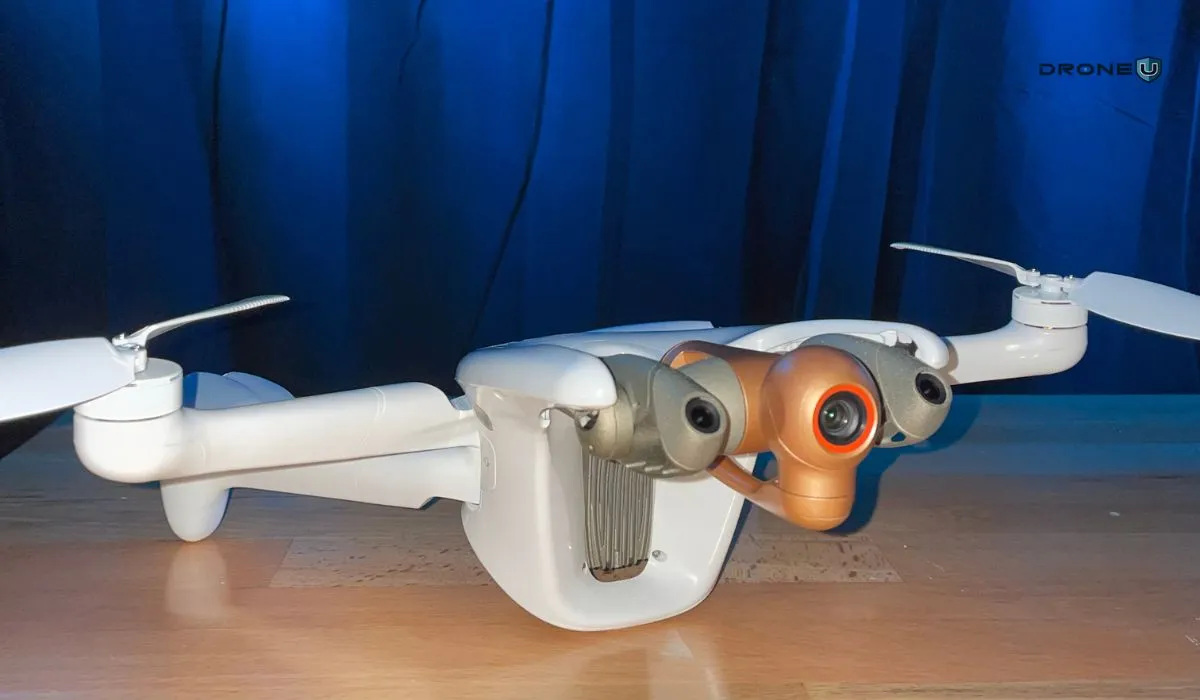 Parrot Anafi Ai
Professional drones are more than just flying cameras. These drones are designed to tackle the toughest tasks with precision, reliability, and top-tier performance.
Often referred to as enterprise drones, these aerial workhorses aren’t the toys you might find under the Christmas tree. These are the tools of the trade for experts.
What sets this line of drones apart from consumer models? Let’s find out.
Professional Drones vs. Regular Drones
| Aspect | Regular Drones | Professional Drones |
| Features | Regular drones are typically equipped with basic sensors, standard cameras, and limited payload options. They feature basic GPS systems and have short-range connectivity, with simple autonomous flight capabilities. | Professional drones come with advanced sensors, high-quality cameras, and specialized payload options (such as thermal or LiDAR). They feature enhanced GPS systems, long-range connectivity, and advanced autonomous flight capabilities, making them suitable for complex tasks. |
| Quality | Regular drones are often made from lightweight materials that prioritize ease of use over durability. They are designed mainly for recreational use and may lack advanced stabilizers, resulting in less stable flight and lower camera quality. | Professional drones are built from durable, strong materials designed to withstand demanding environments. They feature advanced stabilizers for smooth flight, superior imaging quality, and enhanced stability, making them ideal for commercial applications. |
| Price | Regular drones are more affordable, catering to hobbyists and casual users. Their lower price reflects their simpler features and technology. | Professional drones are significantly more expensive, reflecting the advanced technology, enhanced reliability, and performance required for commercial and industrial applications. |
We’ll divide professional drones into two categories: foreign and domestic drones, each with its own unique set of advantages.
First, we’re taking off with foreign options.
Foreign Stars: DJI Enterprise Drones
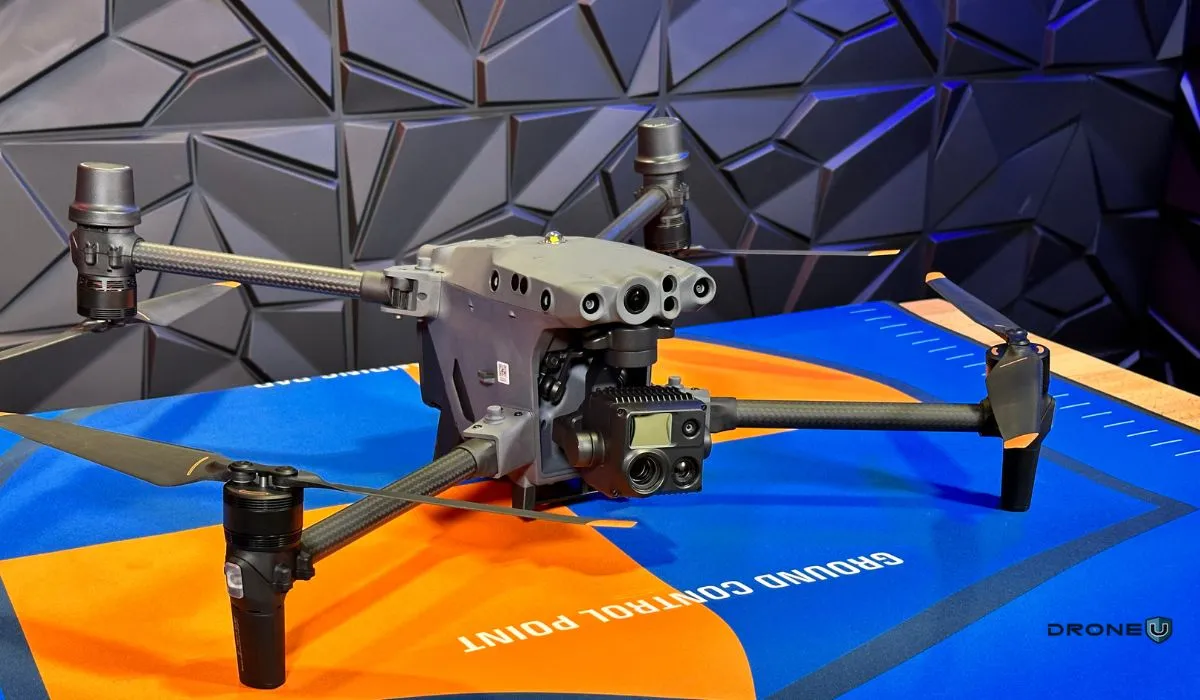 DJI M30
When it comes to foreign professional drones, DJI’s enterprise lineup undeniably takes the crown. Renowned for their innovation and reliability, DJI sets the gold standard in the industry.
These drones are not just about capturing stunning photos and videos—they’re engineered with advanced features that push the boundaries of what drones can achieve.
Equipped with sophisticated software, they can autonomously follow pre-programmed flight paths, creating intricate 2D maps and 3D models with remarkable precision.
Additionally, DJI drones have fewer airspace restrictions, giving you a significant edge when navigating the skies.
One standout feature is the impressive ‘Attitude Mode,’ which ensures steady flight paths and precise control regardless of weather conditions, virtually eliminating the risk of flyaways.
To further enhance their capabilities, you can equip these drones with optional accessories like an RTK antenna for accurate positioning, a speaker for communication, or a flashlight for nighttime operations.
In the DJI enterprise roster, you’ll find a wide array of professional drones designed to meet diverse needs.
Let’s take a closer look at the best DJI drones available and what makes them stand out:
- Matrice 30
- Matrice 30T
- Mavic 3 Enterprise
- Mavic 3 Thermal
- Mavic 3 Multispectral
- Matrice 350
1. Matrice 30
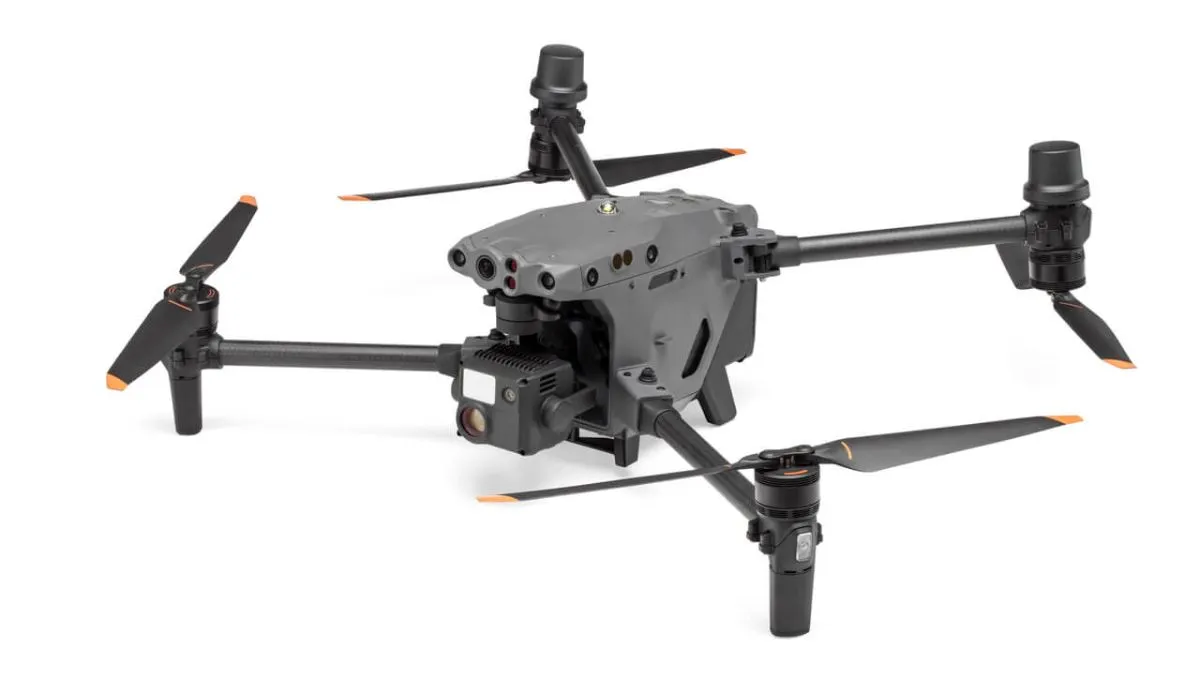 Source: DJI
The Matrice 30 is a high-performance enterprise drone from DJI. It is equipped with a triple-camera gimbal that includes a wide-angle camera, a zoom camera, and a laser rangefinder. This makes it ideal for a wide range of applications, such as inspection, mapping, and search and rescue.
Features of Matrice 30
| Feature | Matrice 30 |
| Camera | 48MP zoom camera, 12MP wide camera |
| Thermal camera | 640x512px resolution, 1280x1040px infrared image super-resolution |
| Laser rangefinder | 1200m |
| Obstacle avoidance | 360-degree omnidirectional obstacle avoidance |
| Flight time | 41 minutes |
| Wind resistance | 15 m/s |
| Service ceiling | 7000 m |
| Maximum speed | 23 m/s |
| Transmission | OcuSync 3 Enterprise, triple channel 1080p transmission |
| Payload attachment area | Yes |
| Dimensions (unfolded, excl. props) | 288 x 217 x 105 mm |
| Weight | 3.7 kg |
2. Matrice 30T
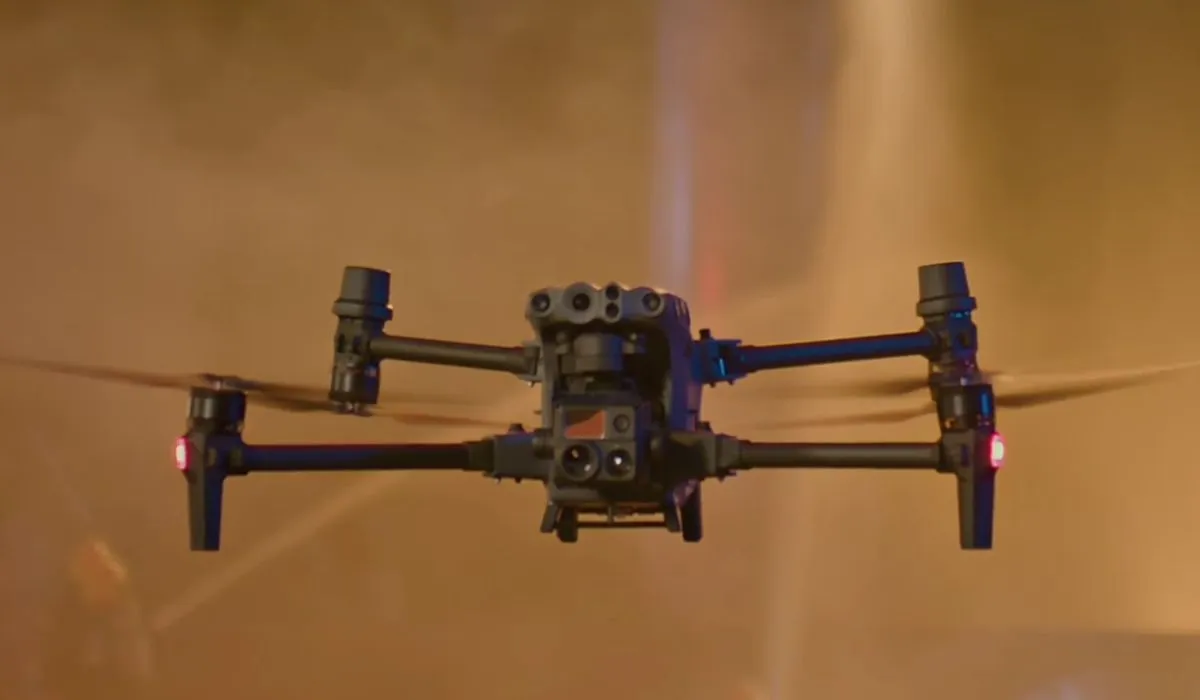 Source: DJI
The Matrice 30T is a variant of the Matrice 30 that includes a thermal imaging camera in addition to the other three cameras. This makes it ideal for applications where thermal imaging is required, such as firefighting, search and rescue, and night operations.
Features of Matrice 30T
| Feature | Matrice 30T |
| Payload | Zenmuse H20T: 12MP wide, 20MP zoom, 640×512 thermal camera with infrared image super-resolution |
| Camera resolution | Wide: 12MP, Zoom: 20MP, Thermal: 640×512 (with infrared image super-resolution: 1280×1040) |
| Video resolution | Wide: 4K/30fps, Zoom: 3.5K/30fps, Thermal: 1080p/30fps |
| Field of view | Wide: 84°, Zoom: 20-200°, Thermal: 120° |
| Flight time | Up to 55 minutes |
| Max speed | 23 m/s (51 mph) |
| Transmission range | 15 km (9.3 miles) |
| Weight | 9.3 kg (20.5 lbs) |
| Dimensions | Folded: 774 x 495 x 472 mm (30.47 x 19.5 x 18.58 in), Unfolded: 1460 x 593 x 815 mm (57.48 x 23.35 x 32.09 in) |
| Operating temperature | -10°C to 50°C (14°F to 122°F) |
3. Mavic 3 Enterprise
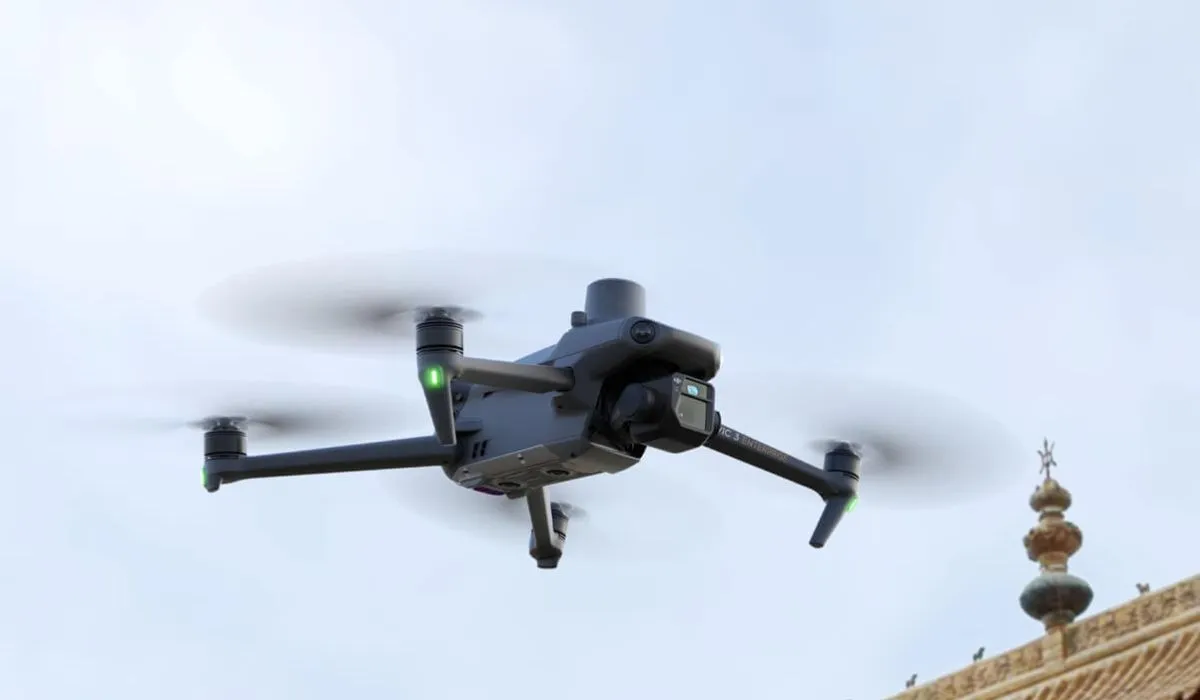 Source: DJI
The Mavic 3 Enterprise is a more compact and portable enterprise drone from DJI. It is equipped with a dual-camera gimbal that includes a wide-angle camera and a zoom camera. It also has many other features that make it ideal for enterprise use, such as a mechanical shutter, an RTK module, and a variety of accessories.
Features of Mavic 3 Enterprise
| Feature | Mavic 3 Enterprise |
| Camera | Dual camera system with 4/3 CMOS wide-angle camera and 12MP telephoto camera with 56x optical zoom |
| Video resolution | Up to 5.1K/30fps |
| Photo resolution | Up to 20MP |
| Mechanical shutter | Yes |
| RTK | Yes (optional) |
| Omnidirectional obstacle avoidance | Yes |
| Advanced RTH | Yes |
| APAS 5.0 | Yes |
| Maximum flight time | Up to 45 minutes |
| Maximum flight speed | Up to 40 mph (64.37 km/h) |
| Operating temperature range | -10° C to 40° C (14° F to 104° F) |
| Wind resistance | Up to 25 mph (40.23 km/h) |
| Weight | 900 grams (without battery) |
4. Mavic 3 Thermal
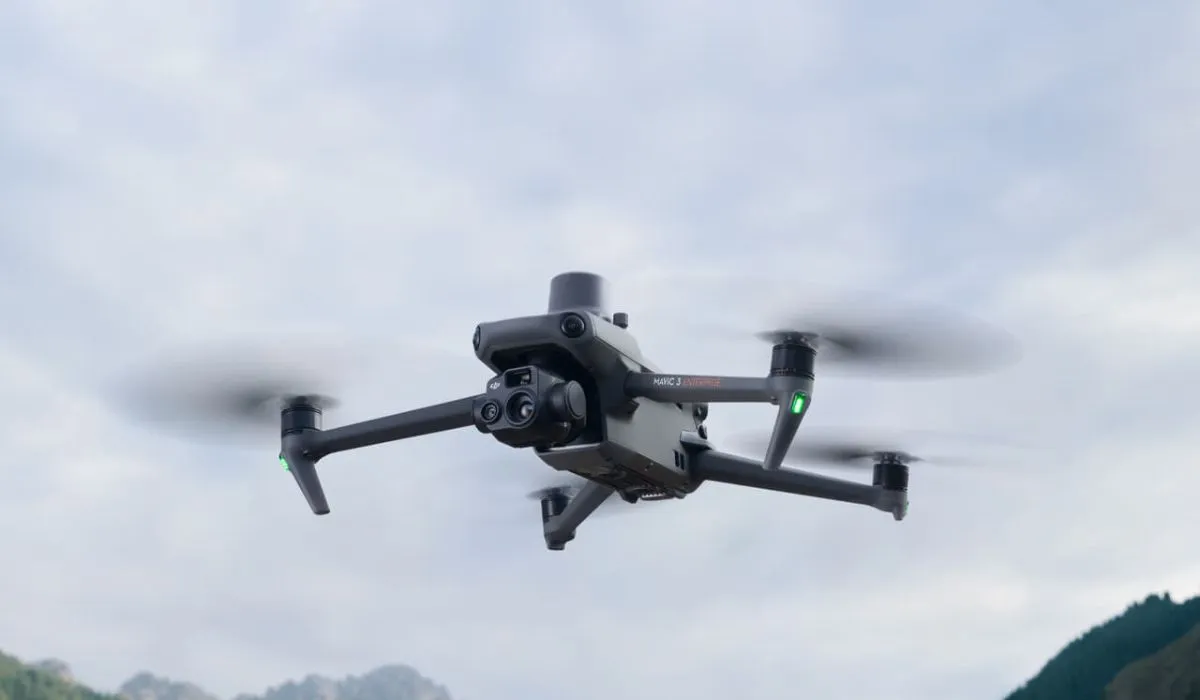 Source: DJI
The Mavic 3 Thermal is a variant of the Mavic 3 Enterprise that includes a thermal imaging camera in addition to the wide-angle camera. This makes it ideal for applications where thermal imaging is required, such as firefighting, search and rescue, and night operations.
Features of Mavic 3 Thermal
| Feature | Mavic 3 Thermal |
| Camera | 48MP wide camera, 12MP tele camera with 56x hybrid zoom, 640×512 thermal camera |
| Sensor | 4/3 CMOS (wide), 1/2-inch CMOS (tele), Uncooled VOx Microbolometer (thermal) |
| Video resolution | 5.1K/30fps (wide), 4K/60fps (tele), 3840 x 2880/30fps (thermal) |
| Flight time | 45 minutes (max) |
| Transmission range | 15 kilometers (O3+ video transmission system) |
| Obstacle avoidance | Omnidirectional obstacle sensing |
| Intelligent flight modes | ActiveTrack 5.0, MasterShots, QuickShots, Advanced RTH, SmartPhoto, etc. |
| Thermal imaging features | Point and area temperature measurement, high temperature alerts, color palettes, isotherms |
5. Mavic 3 Multispectral
 Mavic 3 Multispectral | Source: DJI
The Mavic 3 Multispectral is a variant of the Mavic 3 Enterprise that is equipped with a multispectral camera. This type of camera can capture images in multiple wavelengths of light, which can be used to create detailed maps and other data products.
Features of Mavic 3 Multispectral
| Feature | Mavic 3 Multispectral |
| Camera | Dual-camera system with a 20MP RGB camera and a 4x5MP multispectral camera |
| Multispectral camera bands | Green (560nm ± 16nm), Red (650 nm ± 20 nm), Red edge (730 nm ± 20 nm), Near-infrared (NIR) 860 nm ± 26 nm |
| RGB camera sensor | 4/3 CMOS, 20MP image sensor, mechanical shutter with a maximum speed of 1/2000 |
| RGB camera video resolution | 5.1K/30fps, 4K/60fps, 2.7K/120fps |
| Flight time | Up to 45 minutes |
| Maximum speed | 40 mph (64.4 kph) in Sport mode |
| Maximum wind resistance | 25 mph (40.2 kph) |
| Obstacle avoidance | Omnidirectional obstacle sensing |
| Positioning | GNSS, RTK module (optional) |
| Operating temperature | -10°C to 40°C (14°F to 104°F) |
6. Matrice 350
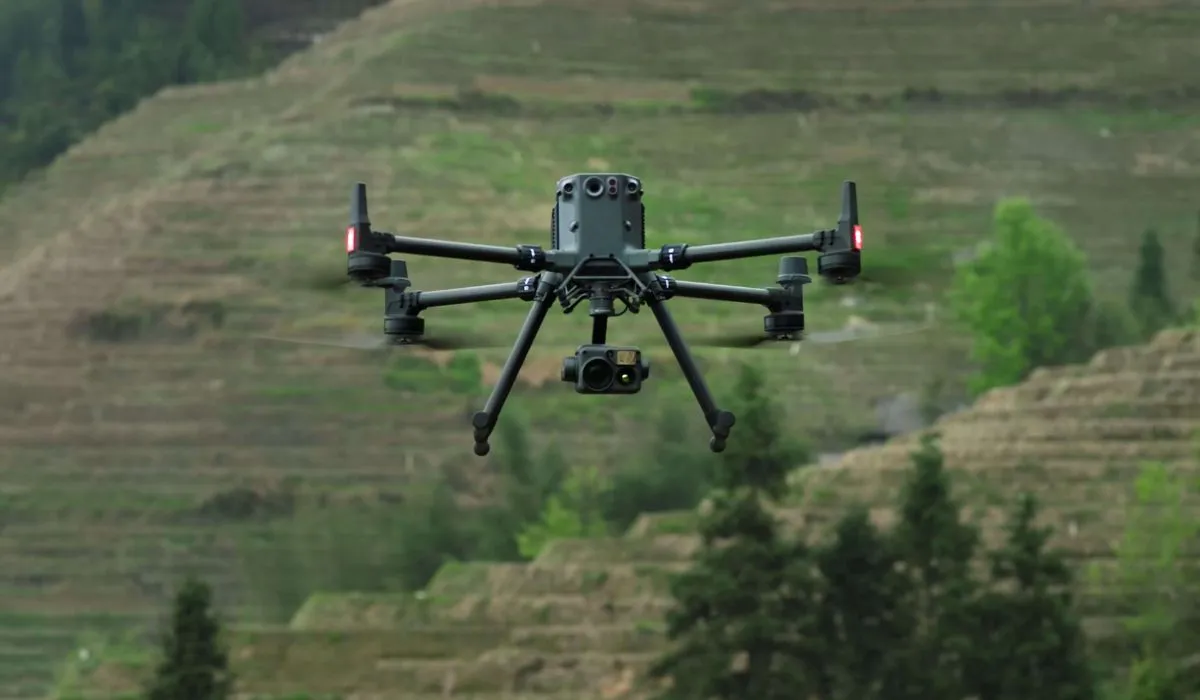 Source: DJI
The Matrice 350 is an older enterprise drone from DJI. It is still a popular choice for many applications, such as inspection, mapping, and search and rescue. It is equipped with a dual-camera gimbal that includes a wide-angle camera and a zoom camera. It also has some other features that make it ideal for enterprise use, such as an RTK module and a variety of accessories.
Features of Matrice 350
| Feature | Matrice 350 |
| Payload capacity | 2.7 kg |
| Flight time | 55 minutes (max) |
| Transmission system | OcuSync 3 Enterprise |
| Operating temperature | -20°C to 50°C |
| Weather resistance | IP55 |
| Camera compatibility | DJI Enterprise payloads (e.g., Zenmuse H20N, Zenmuse P1, Zenmuse L1) |
| Remote control | DJI RC Plus |
| Safety features | Arm locking safety mechanism, FPV camera for low light conditions, ADS-B receiver, airbrake system |
| Other features | Dual downward gimbals, single upward gimbal, E-Port open interface, Waypoint Navigation, Advanced Pilot Assistance Systems (APAS), Smart Inspection |
If you’re looking for the Mac-Daddy of them all, the Matrice 350 is a beast in its own right. But there’s a hidden gem in the collection – the Inspire 3. This versatile drone bridges the gap between enterprise and consumer drones, offering mapping capabilities and an array of video modes, frame rates, and slow-motion options.
However, there’s a caveat with foreign drones. They’re often capped at shooting 4K footage at 30 fps. While that might suffice for your construction projects, it’s not going to make the cut for big-screen productions. That’s where the Inspire 3 truly shines. It offers high frame rates, attitude mode, and a stellar x9 camera, making it a versatile contender for professionals who wear multiple hats.
And if you’re still rooting for the Inspire 2, you’re not alone. It’s a formidable mapping and video machine. Paired with the standard safety features, the Inspire aircraft offers the full suite of DJI’s capabilities.
The Inspire 2’s H-frame design is a boon. Its low center of gravity gives it remarkable wind handling, agility, and stability in a variety of environments. And don’t fret about flying at high altitudes; DJI has you covered with high-altitude props for these airframes.
Now, let’s change course and explore the domestic drone options for professionals.
Domestic Champions: Best NDAA-Approved Professional Drones
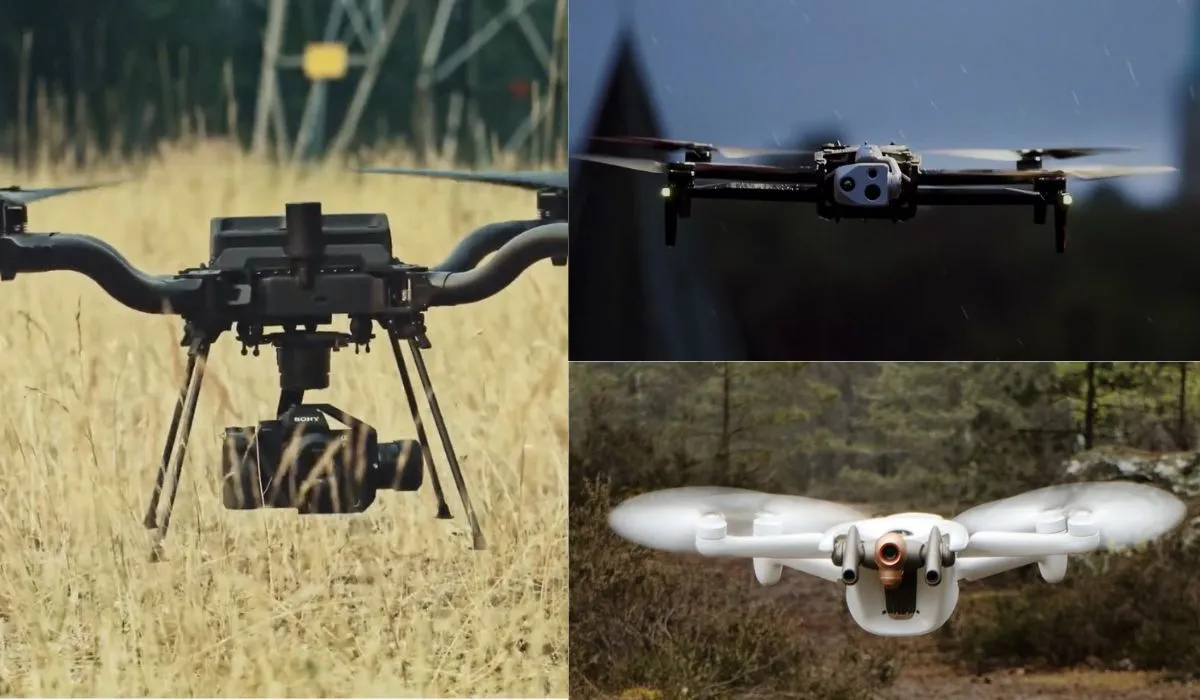
When it comes to American made professional drones, it’s all about meeting NDAA requirements and having the ability to map and capture high-frame-rate video and stunning photos.
After a thorough exploration of the domestic drone landscape, we’ve identified the champions:
- Freefly Astro
- Skydio x10
- Parrot Anafi Ai
1. Freefly Astro
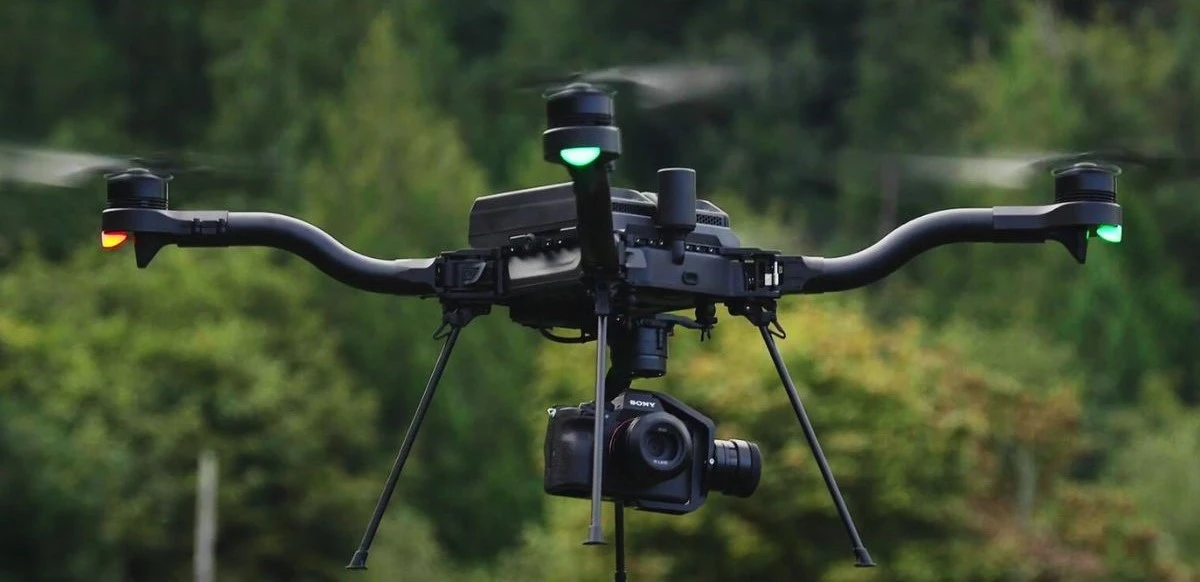 Source: Freefly
Taking the top spot at around $20,000, the Freefly Astro offers impressive flight time, NDAA compliance, and an incredible transmission distance. It comes equipped with a Sony A7r5 camera that’s more than capable of capturing amazing videos and photos.
With various additional payloads available, the Freefly Astro is the Swiss Army Knife of drones, catering to your every need.
Features of Freefly Astro
| Feature | Freefly Astro |
| Dimensions (unfolded) | 917 mm diameter (without props), 1407 mm diameter (including props) |
| Weight | 6,665 g (max takeoff weight) |
| Payload | 1,500 g (max payload) |
| Flight time | Up to 37 minutes (typical flight time with mapping payload is 25-32 minutes) |
| Speed | Up to 20 m/s (max speed in position mode) |
| Flight controller | Freefly custom designed Skynode |
| Flight controller software | Auterion Enterprise PX4 (custom for Astro) |
| Communication link | Herelink RF (2.4 GHz and 5.8 GHz) |
| Video transmission | 1080p60 HD video transmission |
| Battery | 2x Freefly Super Light Batteries (SL8-Air) |
| Motor | Freefly F45 |
2. Skydio x10
 Source: Skydio
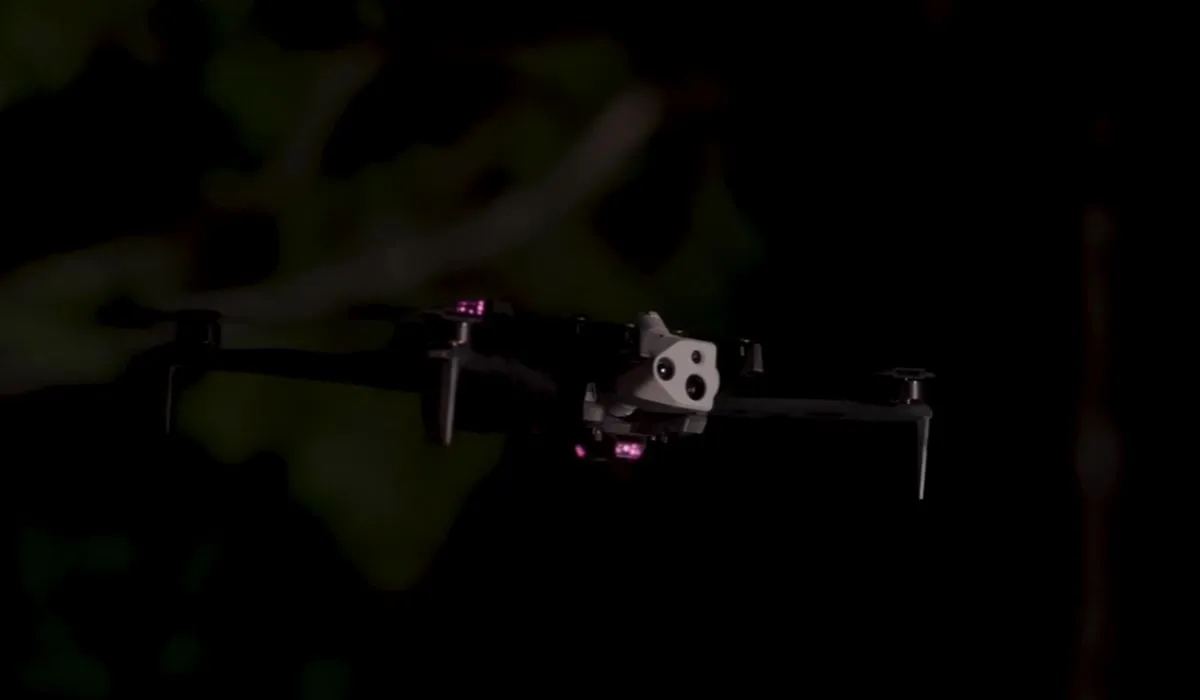
While a bit pricier than the Freefly Astro, the Skydio x10 makes up for it with a substantial 35-minute flight time and the convenience of cellular signal control. Its triple-camera payload delivers results that can rival the DJI M30T from yesteryears.
Features of Skydio x10
| Feature | Skydio X10 |
| Dimensions (unfolded, with propellers) | 31.1 x 25.6 x 5.7 inches |
| Dimensions (folded, without battery) | 13.8 x 6.5 x 4.7 inches |
| Weight (incl. batteries) | Connect SL: 2.11 kg / 4.65 lbs. Connect SL + 5G: 2.14 kg / 4.72 lbs |
| Max Takeoff Weight | 2.49 kg / 5.49 lbs |
| Sensors | 64MP visual camera, 48MP telephoto camera, 50MP wide-angle camera, 640×512 thermal camera |
| Flight time | Up to 36 minutes |
| Top speed | 45 mph (72 km/h) |
| Max wind resistance | 25 mph (40 km/h) |
| Operating temperature range | -10°C to 40°C (14°F to 104°F) |
| Autonomous flight modes | Follow Me, Point-of-Interest Orbit, Cinematic Mode, ActiveTrack, Beacon, 3D Scan |
| Obstacle avoidance | 360-degree, 3D |
| Return-to-Home | Yes |
| Waypoint missions | Yes |
| Live streaming | Yes, up to 4K resolution |
| Recording | Yes, up to 6K resolution at 30fps |
| Software | Skydio 3D Scan, Skydio Remote Flight Deck, Skydio Controller, Skydio App |
3. Parrot Anafi Ai
 Source: Parrot
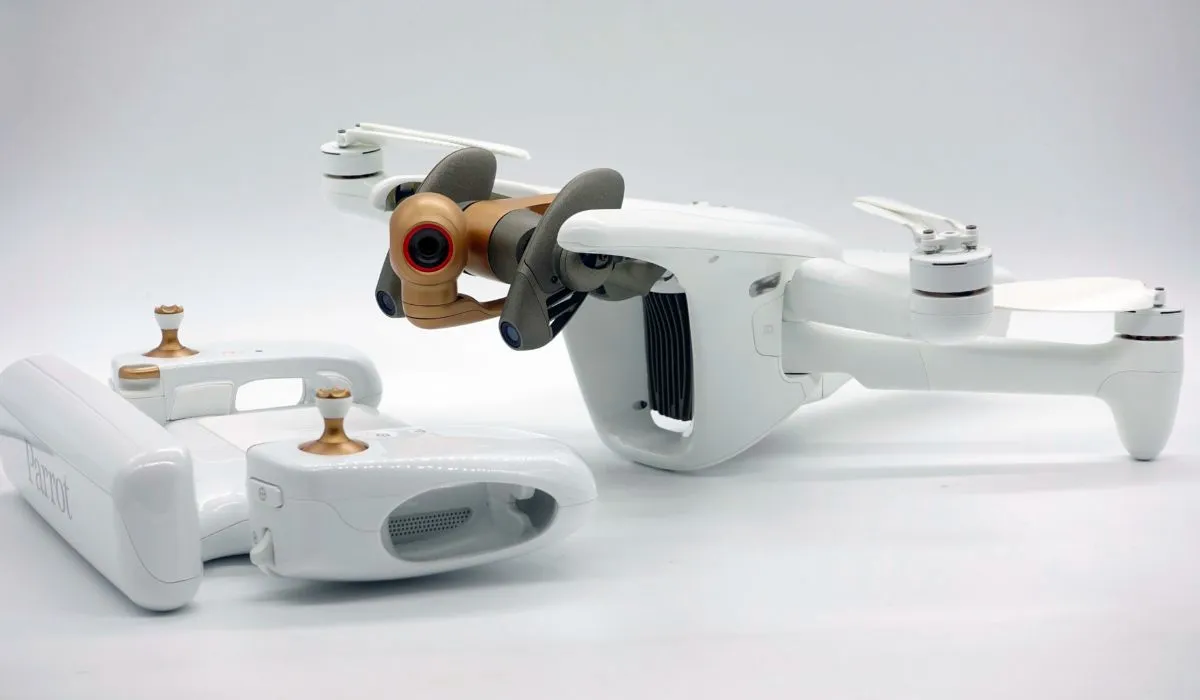
If you’re on a budget, the French-made Parrot Anafi Ai is a fantastic all-in-one solution. It’s domestically approved, offering a 48MP camera, an impressive 43-minute flight time, and portability that’s hard to beat.
Features of Parrot Anafi Ai
| Feature | Specification |
| Camera | 48 MP Sony CMOS sensor, 2.4-48 mm f/2.8-f/5.6 lens, 6x digital zoom |
| Video | 4K HDR (30 fps), 1080p HDR (60 fps) |
| Image stabilization | 5-axis hybrid image stabilization (2 mechanical axes, 3 electronic axes) |
| Camera tilt | 180° |
| Flight time | 32 minutes |
| Max range | 22.5 km (at 14 m/s without wind) |
| Max speed | 17 m/s (forward), 16 m/s (backward and laterally) |
| Wind resistance | 12.7 m/s |
| Max practical ceiling above sea level | 5,000 m |
| Max angular speed | 300°/s on pitch and roll axes, 200°/s on yaw axis |
| Weight | 320 g |
| Dimensions (folded) | 175 x 65 x 65 mm |
| Dimensions (unfolded) | 240 x 240 x 65 mm |
Overall, the Skydio X10 is the most advanced drone on this list, with the best camera, longest flight time, and longest range. However, it is also the most expensive.
The Freefly Astro is a good option for users who want a more open and modular drone, but it is not as easy to use as the Skydio X10.
The Parrot Anafi AI is the most affordable drone on this list, but it has a smaller camera sensor and shorter flight time than the other two drones.
Other honorable mentions in the domestic professional drone arena include Sony’s Airpeak, Vantage Robotics, and Flir Siras.
So, what’s the ultimate choice for professional drone pilots?
If budget constraints are a factor, the M30T takes the crown, closely followed by the Inspire 2. If you’ve got a bit more wiggle room in your budget, the Inspire 3 from the foreign contenders and the Freefly Astro from the domestic offerings are the undisputed kings.
In the ever-evolving world of professional drones, one thing is clear: the sky is not the limit, but just the beginning of a thrilling journey. Whether you opt for foreign or domestic, your perfect drone awaits, ready to capture the beauty of the world from a bird’s-eye view.
Happy flying!
Frequently Asked Questions
1. What are professional drones, and how do they differ from consumer drones?
Professional drones, also known as enterprise drones, are designed for specific work-related tasks, offering precision, reliability, and performance. They differ from consumer drones in their capabilities and features, such as advanced camera systems, longer flight times, and specialized accessories. Consumer drones are typically designed for recreational use, while professional drones are tools for businesses and industries.
2. Can you provide an overview of the key differences between the Matrice 30 and the Mavic 3 Enterprise?
The Matrice 30 is larger and more powerful, equipped with a triple-camera gimbal for a wide range of applications, including inspection, mapping, and search and rescue. In contrast, the Mavic 3 Enterprise is more compact and portable, offering a dual-camera gimbal and other enterprise features like a mechanical shutter and RTK module.
3. What are the benefits of the H-frame design in the Inspire 2, and how does it impact drone performance?
The H-frame design of the Inspire 2 results in a low center of gravity, providing remarkable wind handling, agility, and stability in various environments. This design also allows for reliable high-altitude flight with the use of high-altitude props.
4. Do I need a license to operate a drone professionally?
Of course, in most countries, commercial drone operations require a certification like the FAA Part 107 license in the U.S.
1
Top 27 Best Black Friday Deals in 2024 You Can’t Miss
Black Friday is the ultimate shopping season for tech enthusiasts, and drones are no exception. Every year, Black Friday drone deals unleash a tidal wave of savings.
If you’re searching for the best drone deals this holiday season, you’ve come to the right place.
From budget-friendly options for beginners to advanced models for professionals, this is your chance to upgrade your gear or start a new hobby without overspending.
In this guide, we will walk you through the best drone deals and tips on where to find the best discounts.
Why Black Friday is the Best Time to Buy a Drone
Major players like DJI, Autel, and Holy Stone often slash prices on their top models, while retailers such as Amazon offer bundles that include must-have accessories like extra batteries, cases, or even exclusive add-ons.
The DJI store also comes up with discounts on refurbished models and accessories during Black Friday.
Just to be clear, specific deals vary by year and region.
However, it’s important to plan ahead. Black Friday deals are time-sensitive, and the best offers can sell out quickly. Researching beforehand, setting a budget, and monitoring retailer announcements can help ensure you don’t miss out.
Let’s see the best drone Black Friday deals you can grab this year.
Best Black Friday Drones Deals
Here are the top Black Friday deals on drones:
1. DJI Neo: Best Entry-Level Drone
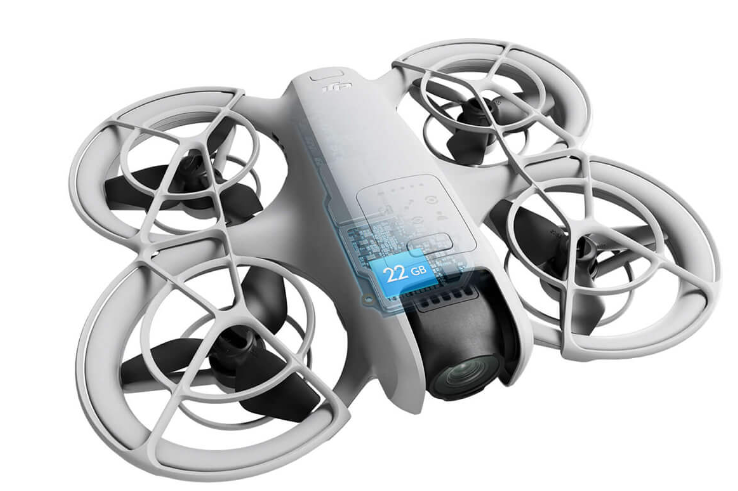
If you’re new to drones and want a versatile yet fun flying experience, the DJI Neo stands out as one of the best entry-level options. Designed with beginner-friendly features, the Neo blends functionality and simplicity, making it ideal for those taking their first steps into the world of drones.
The Neo offers two standout modes: FPV (First-Person View) and Follow Me.
While the Neo is limited in speed and lacks advanced obstacle sensors found in higher-end models, it compensates with its ease of use and entertainment value. It’s perfect for casual flying in open spaces where the risk of collisions is minimal.
Key Features:
- Takeoff Weight: Approx. 135 g
- Max Flight Time: Approx. 18 mins
- Max Flight Distance: 7 km
- Operating Temperature: -10° to 40° C (14° to 104° F)
- Global Navigation Satellite System: GPS + Galileo + BeiDou
- Internal Storage: 22 GB
- Max Image Size: 12 MP Photo
2. DJI Mini 4 Pro: Best for Photography/Videography
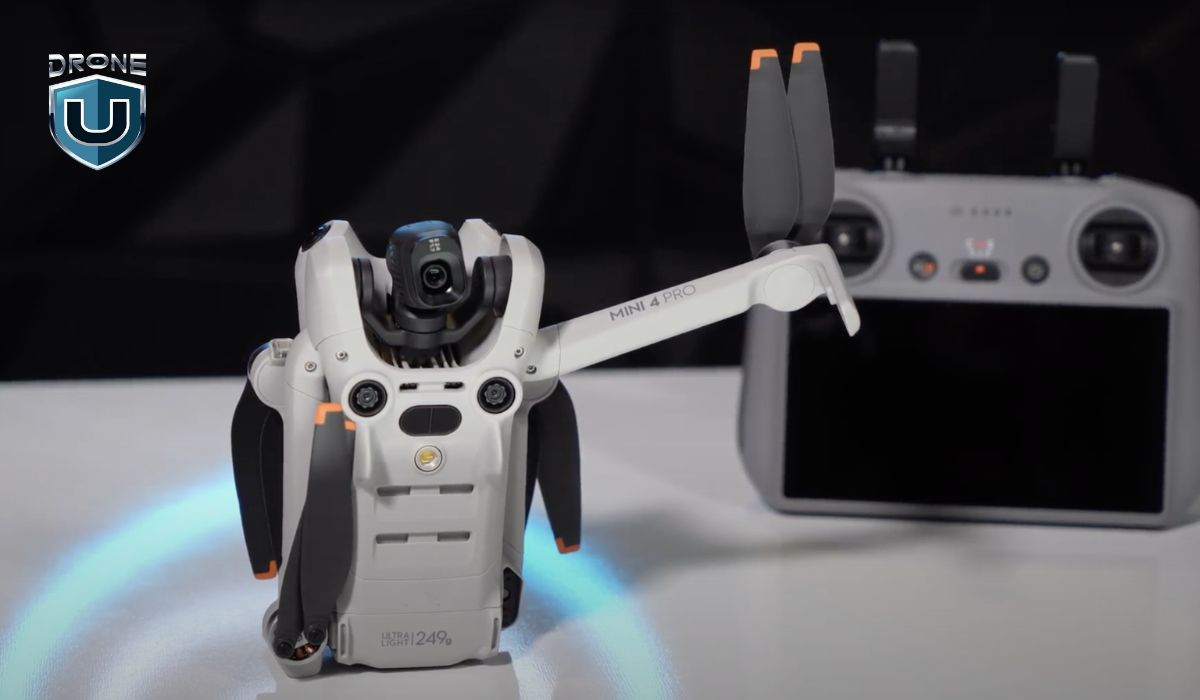
The DJI Mini 4 Pro with Smart Controller is a powerful combination for aerial photography and videography.
Compact and lightweight, the Mini 4 Pro is equipped with an advanced camera system that captures stunning, high-resolution images and smooth 4K HDR video.
Paired with the Smart Controller, it offers an exceptional flying and filming experience with clear, real-time visuals on a bright, easy-to-read display, even in direct sunlight.
Click Here To Buy DJI Mini 4 Pro
Key Features:
- Takeoff Weight: less than 249 g
- Max Flight Time: 34 minutes
- Max Flight Distance: 18 km
- Operating Temperature: -10° to 40° C (14° to 104° F)
- Global Navigation Satellite System: GPS + Galileo + BeiDou
- Internal Storage: 2 GB
- Image Sensor: 1/1.3-inch CMOS, Effective Pixels: 48 MP
3. DJI Avata 2: Best FPV Drone
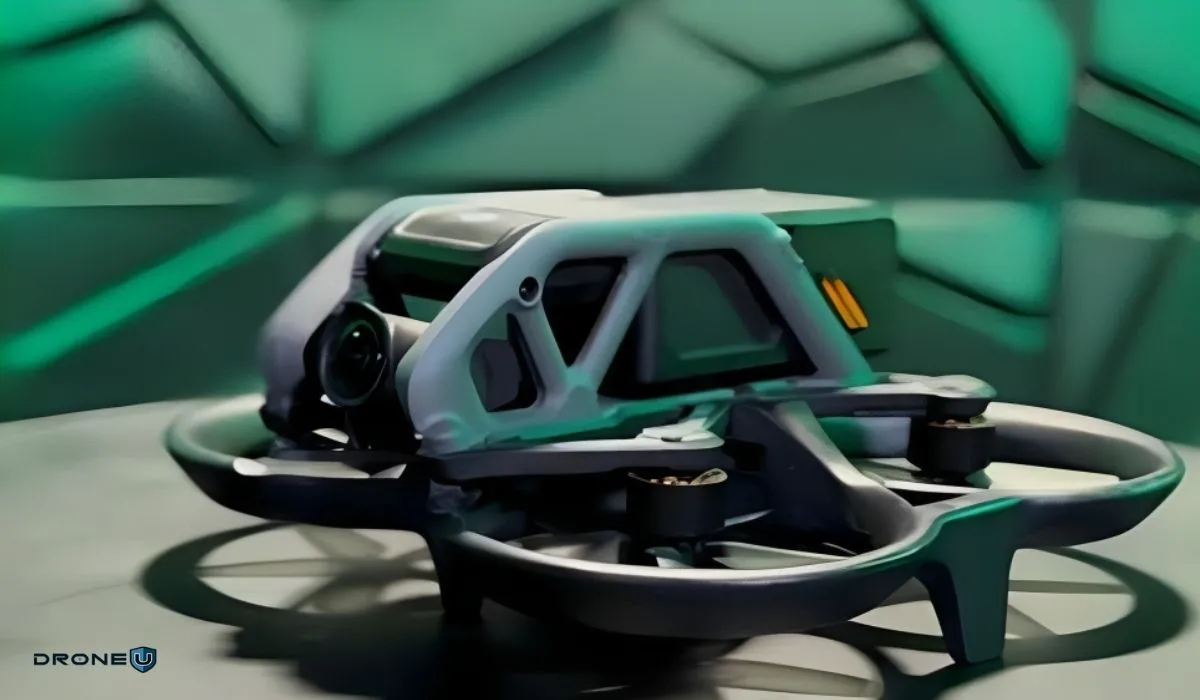
The DJI Avata 2 is a thrilling choice for experienced pilots looking to elevate their drone flying with an extra dose of excitement. Designed with a powerful FPV experience, the Avata 2 combines speed, agility, and immersive visuals to deliver an exhilarating flight that feels like you’re in the cockpit.
Built for adventure, the Avata 2 offers precise control and responsive handling, ideal for pilots who enjoy dynamic maneuvers and high-speed chases. Its advanced camera system captures stunning 4K video, allowing you to film breathtaking footage with cinematic quality.
For those willing to invest a bit more, the DJI Avata 2 promises unmatched performance, excitement, and pro-level video quality, setting it apart as the ultimate drone for passionate, skilled pilots.
Key Features:
- Takeoff Weight: Approx. 377 g
- Max Flight Time: Approx. 23 mins
- Max Flight Distance: 13.0 km
- Operating Temperature: -10° to 40° C (14° to 104° F)
- Global Navigation Satellite System: GPS + Galileo + BeiDou
- Internal Storage: 46 GB
- Image Sensor: 1/1.3-inch image sensor, Effective Pixels: 12 MP
4. DJI Air 3 Fly More Combo: Best for Intermediate-Level
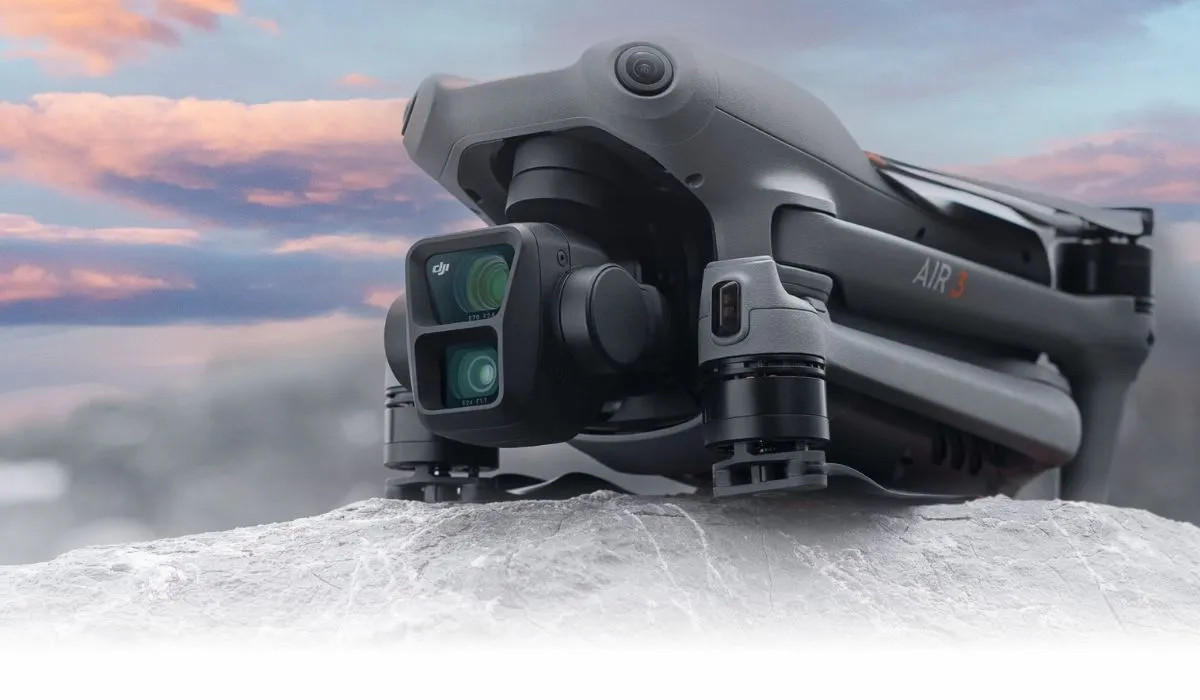
The DJI Air 3 Fly More Combo is a perfect choice for intermediate drone enthusiasts who want advanced features without the complexity of professional-grade equipment. It strikes a balance between performance and usability, making it ideal for consumers who are ready to elevate their drone experience.
The DJI Air 3 Fly More Combo is a well-rounded option for those seeking a drone that combines excellent camera capabilities, extended flight time, and intelligent features. It’s perfect for capturing creative shots while offering an accessible step-up for intermediate pilots.
Click Here To Buy DJI Air 3 Fly More Combo
Key Features:
- Takeoff Weight: 720 g
- Max Flight Time: 46 minutes
- Max Flight Distance: 32 km
- Operating Temperature: -10° to 40° C (14° to 104° F)
- Global Navigation Satellite System: GPS + Galileo + BeiDou
- Internal Storage: 8 GB
- Image Sensor: 1/1.3-inch CMOS, Effective Pixels: 48 MP
Best Black Friday Deals on Drone Accessories
Following are the best drone accessories to buy on the Black Friday sale:
1. DJI RC-N3 Remote Controller
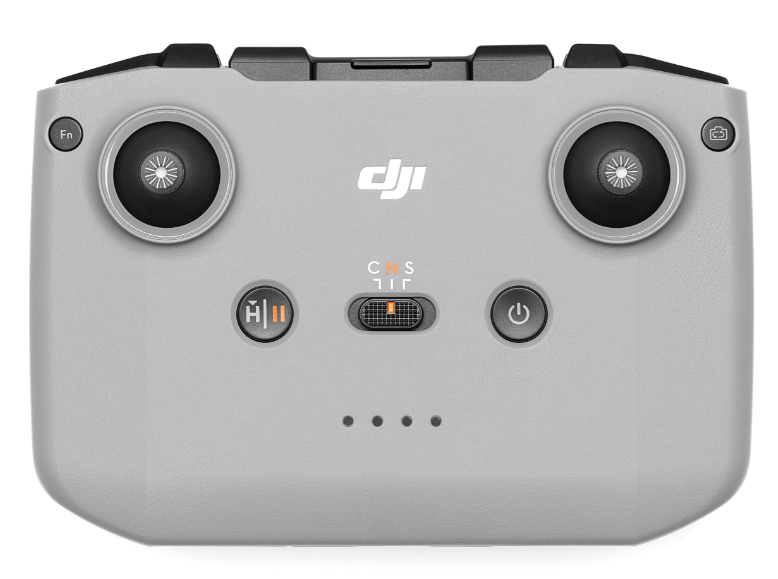
Designed for enhanced control and ease of use, the DJI RC-N3 provides a seamless and intuitive flying experience. With a comfortable grip and precise response, this remote allows for improved maneuverability and range, making it perfect for capturing smooth and dynamic footage.
Features of the DJI RC-N3 Remote Controller
- Low-Latency Transmission
- OcuSync 3.0 Technology
- HD Live Feed Support
- Works seamlessly with ActiveTrack, Follow Me, Waypoints
2. DJI RC-N2 Remote Controller
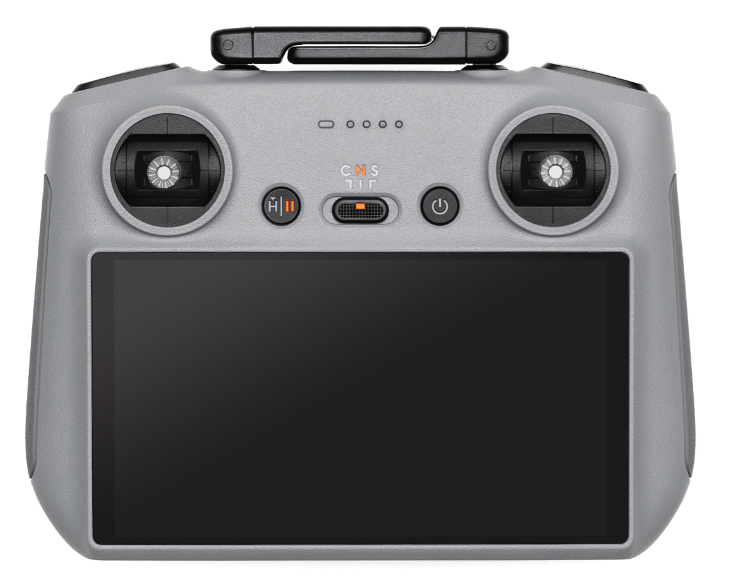
The DJI RC-N2 Remote Controller is designed to offer a seamless and responsive control experience for drone enthusiasts. Built for both beginners and intermediate pilots, the RC-N2 ensures precision, reliability, and ease of use. Whether you’re capturing stunning aerial footage or simply enjoying the thrill of flying, this controller complements your drone perfectly.
Key Features of DJI RC-N2 Remote Controller
- Enhanced Signal Strength
- Smooth joysticks and responsive buttons for accurate navigation and adjustments.
- Comes with an adjustable clamp to securely hold your smartphone for a better FPV (First Person View) experience.
- Long Battery Life
- Compact and travel-friendly
3. DJI Goggles N3
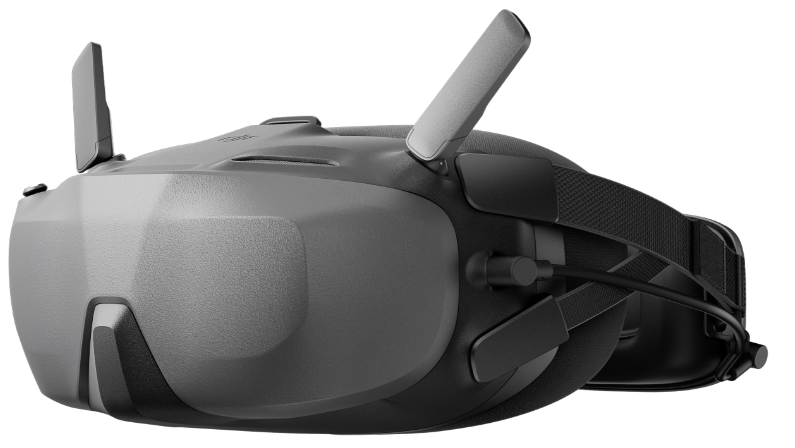
The Goggles N3 are more budget-friendly compared to the Goggles 3, making them a great starting point for those new to FPV.
They work seamlessly with DJI drones like the Neo and Avata 2, providing a convenient and integrated experience.
While not as high-resolution as the Goggles 3, the Goggles N3 still offers a decent 1080p display with a wide field of view for immersive flying.
They are designed to be comfortable to wear for long periods, with adjustable straps and a lightweight design.
4. ND Filters
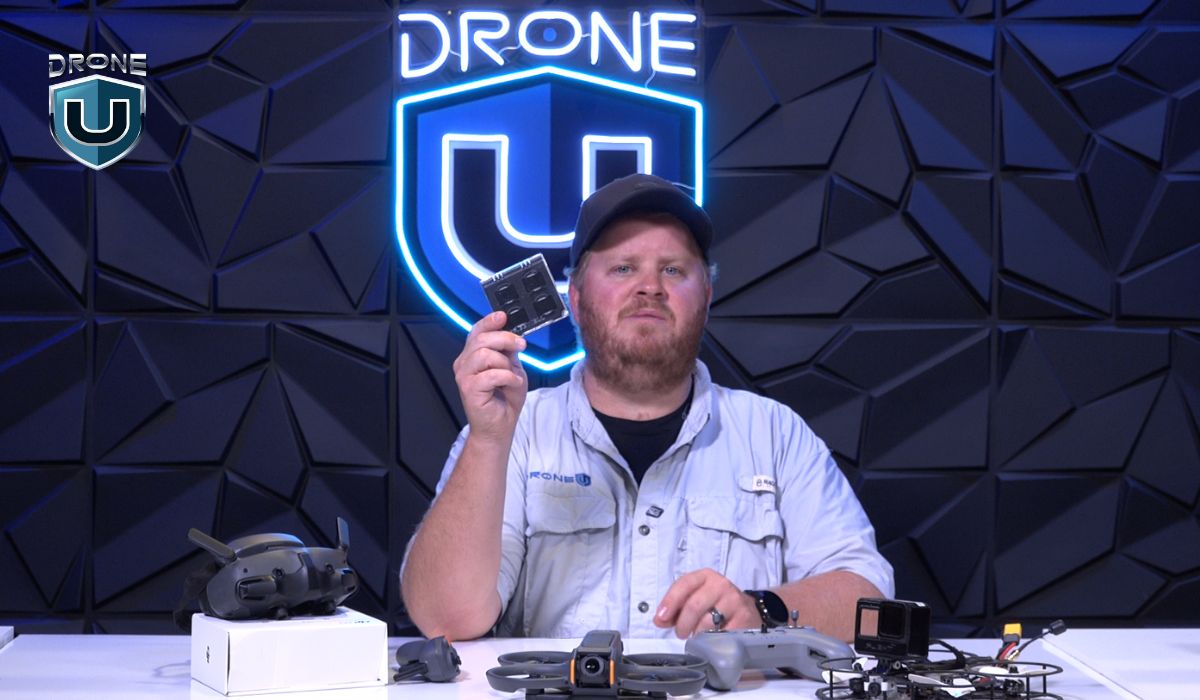
Neutral Density (ND) filters are essential for capturing high-quality video footage in bright conditions. Black Friday deals often include drone ND filter bundles, giving you the chance to upgrade your drone’s camera capabilities at a discounted price.
5. Lowepro Eco-Friendly Backpack
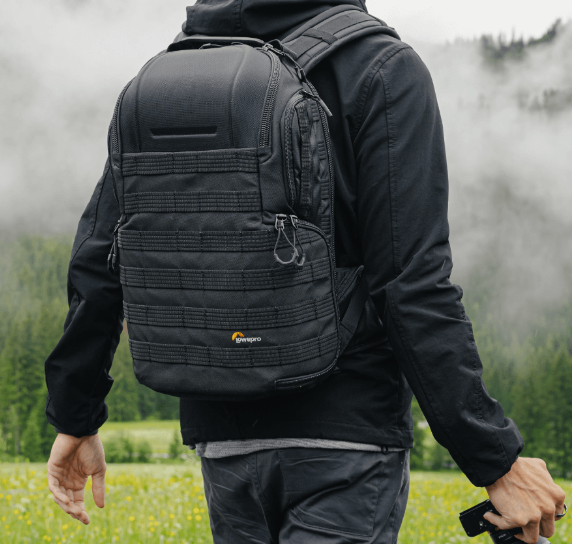
A reliable companion for professionals, this backpack combines practicality with eco-friendly innovation, making it a top choice for photographers on the move.
Click Here To Buy Lowepro Eco-Friendly Backpack
Key Features:
- Made with 63% sustainable materials, including 37% recycled fabrics and 26% solution-dyed fabrics
- Customizable interior compartments and external attachment points
- Features a 4-point access system for quick gear retrieval
- SlipLock loops and tabs allow you to attach pouches for water bottles
- Ergonomic ActivZone back panel provides support and ventilation for all-day comfort
6. VSGO Camera and Drone Backpack
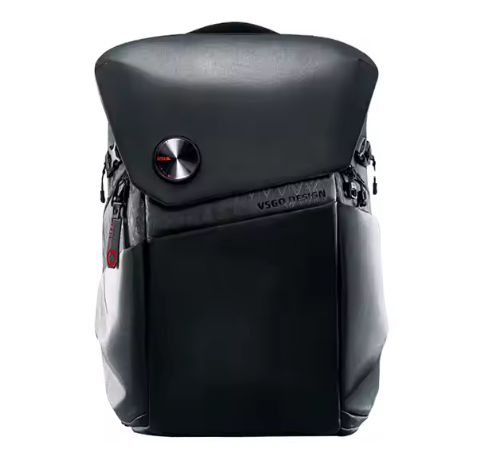
The VSGO Camera and Drone Backpack offers ample storage, durable materials, and ergonomic features designed for photographers and drone operators who value versatility and protection. Its multifunctional design adapts to your needs, making it ideal for both day trips and extended shoots.
Click Here To Buy VSGO Camera and Drone Backpack
Key Features:
- Fits 1 camera body, 3 lenses, a 15.6-inch tablet, a tripod, DJI RSC2 stabilizer, and other essentials
- Includes a detachable chest buckle to reduce shoulder strain
- Made with thick composite fabric and TPU-coated canvas, offering excellent shock resistance and durability
- EVA-padded back panel with air channels promotes airflow
7. DJI Osmo Pocket 3
The DJI Osmo Pocket 3 features a 1-inch sensor, a notable improvement compared to the smaller sensors typically used in most smartphones. This enhanced sensor lets the camera gather more light, delivering superior image quality.
The DJI Osmo Pocket 3 excels at capturing high-energy activities like tubing, mountain biking, kayaking, and more, making it the perfect choice for filming your most exciting adventures.
Click Here To Buy DJI Osmo Pocket 3
We put the DJI Osmo Pocket 3 on our list even though it’s not yet on sale because we love it so much, but we recognized it’s quite expensive. If you’re not quite ready to drop that much money on a gimbaled camera, we suggest the Osmo Mobile 6, which IS on sale.
8. DJI Osmo Mobile 6
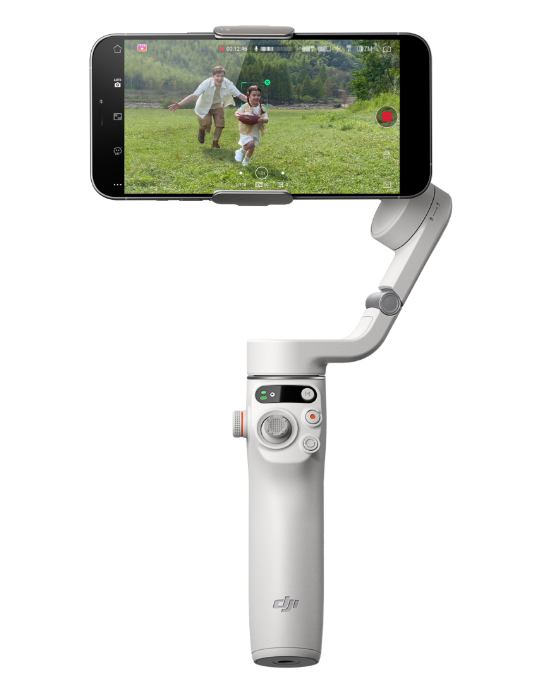
For those seeking professional-level stabilization without breaking the bank, the DJI Osmo Mobile 6 is a great alternative.
This versatile smartphone gimbal is perfect for shooting smooth, cinematic footage on the go. Its compact, foldable design makes it easy to carry, while advanced features like ActiveTrack 6.0 and intuitive controls give you the flexibility to create stunning videos effortlessly.
The DJI Mimo app facilitates efficient shooting, editing, and sharing, allowing you to catch every unforgettable moment and bring your creative vision to life.
9. SD Cards and Storage
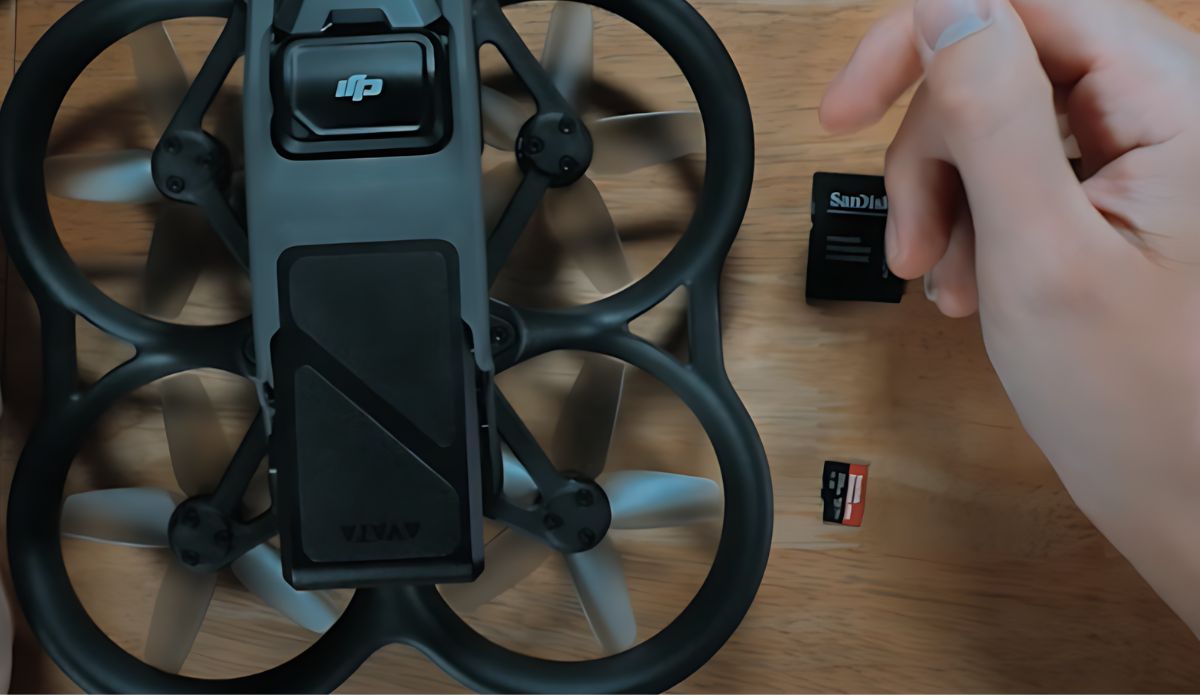
SSDs and storage cards often see their biggest price drops during Black Friday, making it the perfect time to upgrade or expand your storage capacity without breaking the bank.
Black Friday deals often include a variety of SSD types (e.g., SATA, NVMe) and storage cards (e.g., microSD, SDXC) that cater to different devices, from laptops to cameras, drones, and gaming consoles.
Here are the best ones for you:
- SD card holder – Click Here To Buy
- SSD – SanDisk 2TB – Click Here To Buy
- Extreme Pro Micro SD Cards (max 256gig) – Click Here To Buy
10. Ronin RS4
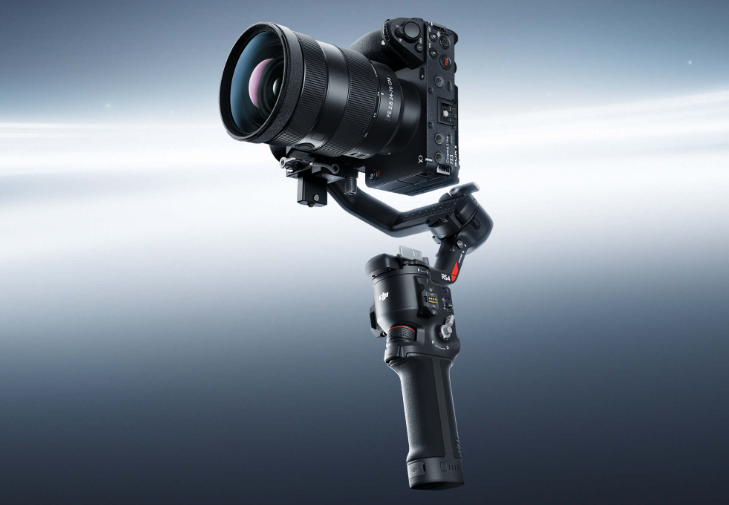
The DJI RS 4 is a lightweight stabilizer designed for commercial use, offering advanced native vertical shooting capabilities for greater operational efficiency.
With improved stabilization, enhanced performance, and a refined accessory system, it provides solo filmmakers with a professional-grade toolset for crafting compelling visual narratives with ease and precision.
11. GoPro HERO12
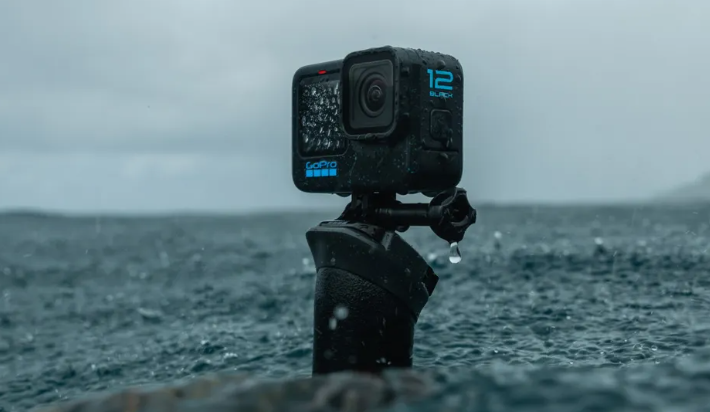
The HERO12 Black takes GoPro’s legendary performance to new heights with stunning HDR video in 5.3K and 4K, next-level HyperSmooth 6.0 stabilization, and an ultra-wide 177° field of view with the Max Lens Mod 2.0. Its redesigned power system improves thermal performance and doubles the runtime, so you can shoot longer without interruptions.
For professionals, it offers advanced features like wireless timecode sync across multiple HERO12 cameras and precision color controls, giving you the tools to create like a pro.
Click Here To Buy GoPro Hero12
Best Black Friday Deals on Electronics
Here are the top electronics deals you’ll want to jump on before they’re gone:
1. Anker Prime Power Bank
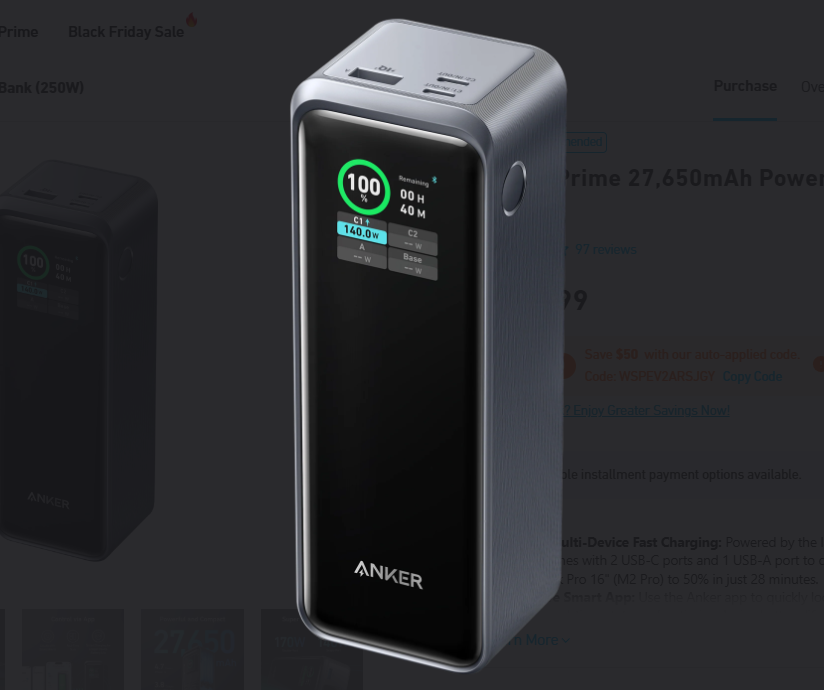
The Anker Prime Power Bank delivers lightning-fast charging and enough juice to keep all your devices running through long flights, road trips, or busy workdays. With a sleek design, rapid charging capability, and enough capacity to power multiple devices simultaneously, this power bank is a lifesaver.
Click Here To Buy Anker Prime Power Bank
2. Anker Power Bank
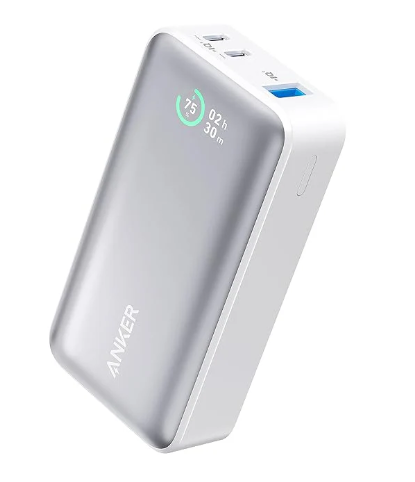
For those looking for a budget-friendly yet efficient power solution, the Anker Power Bank is a solid choice. The Anker Power Bank is compact, reliable, and perfect for everyday use. It is perfect for slipping into your bag or pocket.
Click Here To Buy Anker Power Bank
3. Ultimate Ears Wonderboom 4
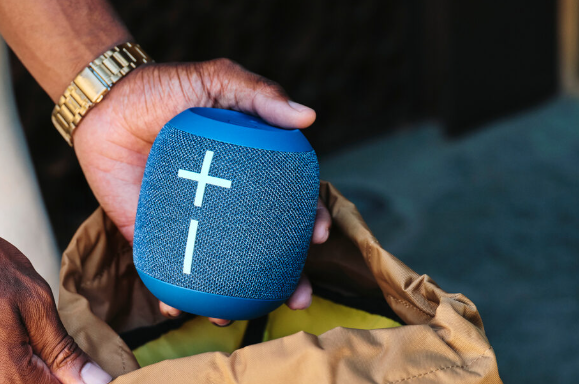
The Ultimate Ears Wonderboom 4 punches way above its weight class, delivering crisp, 360-degree sound and bass that makes your playlist pop. It’s waterproof, drop-proof, and comes with enough battery life to last your adventures. It is perfect for music lovers who want quality sound anywhere.
Click Here To Buy Wonderboom 4
4. Apple AirPods 2
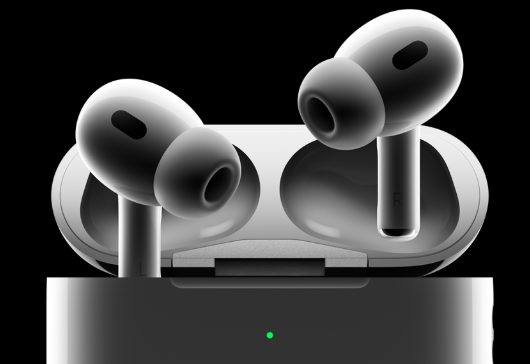
If you’ve been eyeing AirPods, now’s the time to act. The Apple AirPods 2 are a fan favorite for a reason—they’re easy to use, sound fantastic, and pair effortlessly with all your Apple devices. From work calls to weekend playlists, these AirPods make life much easier.
5. Mac Mini
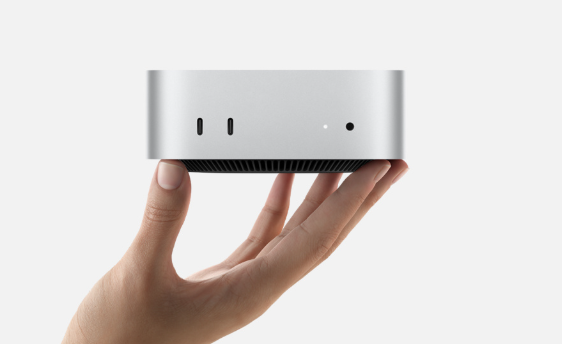
The Mac Mini delivers pro-level performance in a small, sleek package. It’s ideal for anyone who needs a computer that’s fast, efficient, and capable of handling everything from work projects to creative hobbies.
6. MacBook Pro (M4)
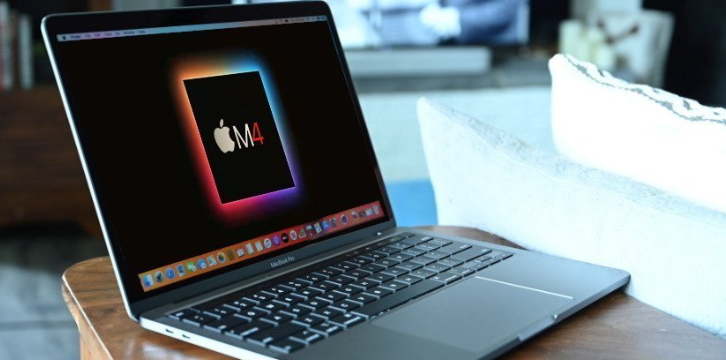
This one’s for the serious multitaskers. The MacBook Pro (M4) combines cutting-edge performance with the portability you need for life on the move. It is excellent for editing videos, designing graphics, or simply handling your daily tasks.
Click Here To Buy MacBook Pro (M4)
7. MSI Raider Gaming Laptop
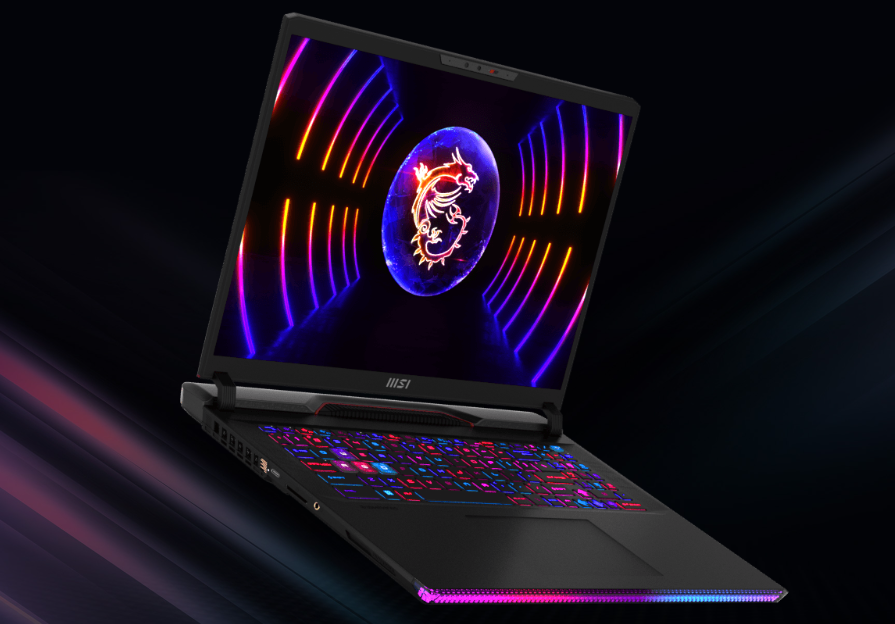
The MSI Raider GE76 isn’t just a gaming laptop—it’s a beast built to dominate. With its stunning 17.3″ Full HD display and ultra-smooth 144Hz refresh rate, every detail of your favorite games comes alive. It delivers lightning-fast performance for gaming, streaming, or multitasking without a hitch.
Top Black Friday Discounts on Other Items
Here are some miscellaneous items that are worth buying:
1. Apple AirTag 4 Pack
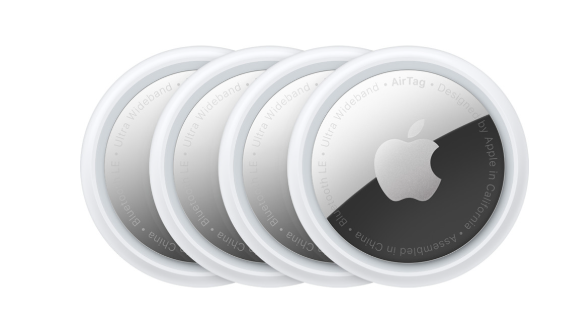
Never lose track of your belongings again with the Apple AirTag 4 Pack. This simple yet powerful tool helps you keep an eye on your keys, bag, wallet, or anything else you hold dear, all through the Find My app on your iPhone or iPad.
If you misplace something nearby, you can play a sound directly from the AirTag’s built-in speaker to help you find it. If your AirTag is farther away, you can rely on the vast Find My network of Apple devices to help you locate it.
In Lost Mode, you’ll be notified when it’s detected by another device in the network.
The Apple AirTag 4 Pack is the ideal way to keep your valuables secure and always within reach.
Click Here To Buy Apple AirTag 4 Pack
2. Tile Mate Tracker
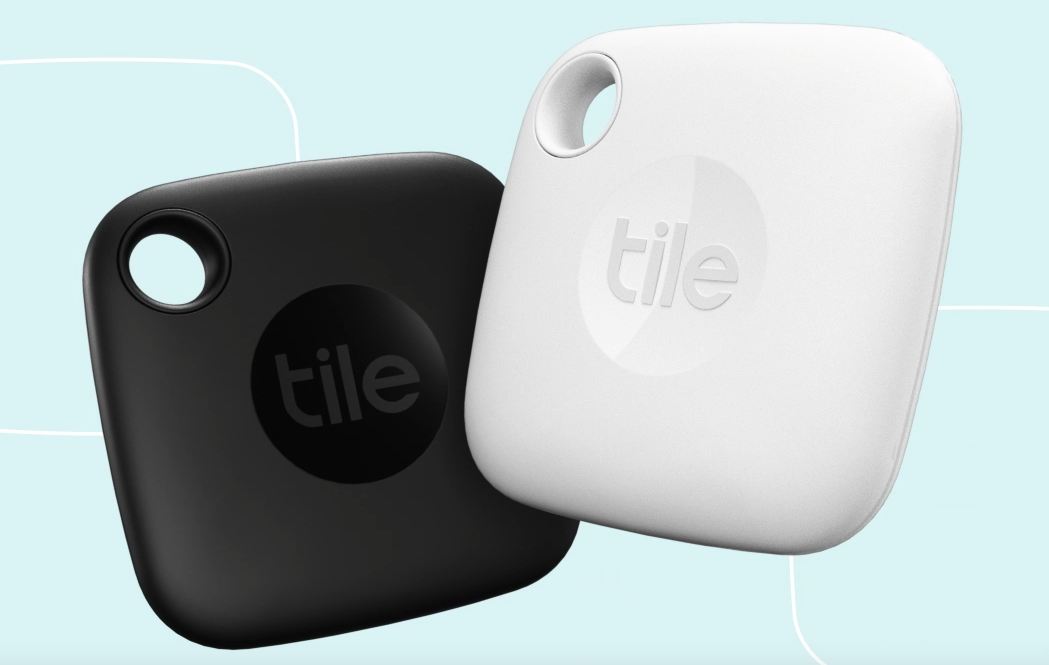
The Tile Mate tracker is a game-changer when it comes to keeping tabs on your things. It’s easy to attach to everyday items like your keys or wallet, and the free Tile app helps you find them in a snap.
If your Tile is nearby, just use the app to make it ring. It’s compatible with iOS, Android, and smart home devices, making it a versatile solution for anyone.
The app shows you the last known location, and the Tile network adds extra help, ensuring you’re never left looking for your lost items. You can even make your phone ring by double-pressing the Tile button, even if your phone is on silent.
Click Here To Buy Tile Mate Tracker
3. NEEWER Photography Lighting Kit
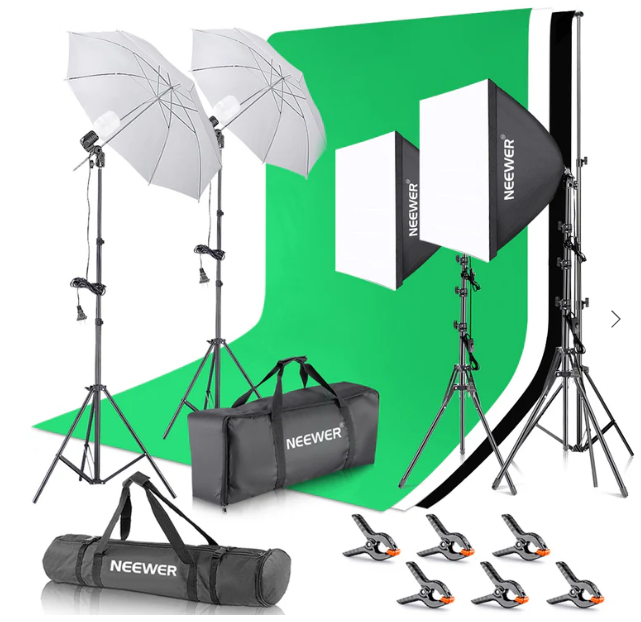
Take your photography game to the next level with the NEEWER Photography Lighting Kit. It includes everything you need, from light stands to softboxes, to create professional-quality lighting at home or in a studio.
The 7ft light stands are sturdy enough for any setup, and the softboxes and umbrellas diffuse light beautifully for even illumination. The included 24W LED bulbs match the brightness of regular 200W incandescent bulbs, providing clear, crisp lighting perfect for photography.
The kit comes with backdrops in black, white, and green, allowing you to easily change up your backgrounds for any shoot.
Click Here To Buy NEEWER Photography Lighting Kit
4. VICTIV 74” Camera Tripod
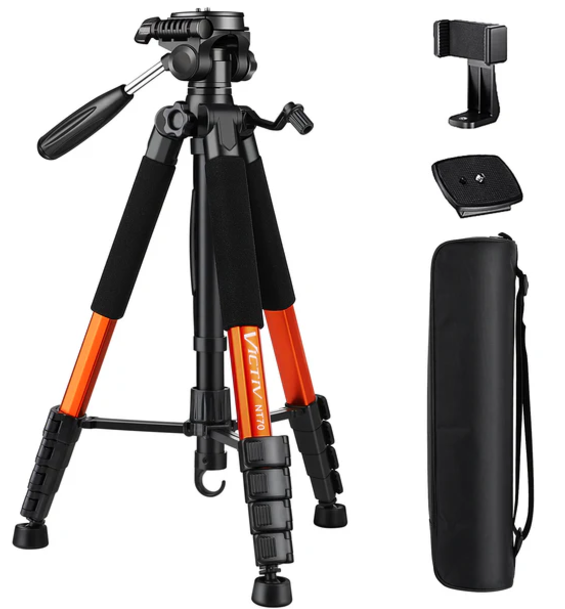
The VICTIV 74” Camera Tripod is built to handle all your shooting needs. With adjustable heights ranging from 19 to 74 inches, it’s perfect for everything from indoor photography to outdoor landscapes.
The 3-way pan head allows smooth, versatile movement, making it ideal for panoramic shots or vertical portraits. It works with all cameras, including DSLRs, SLRs, and smartphones, so you can get stable shots no matter your gear.
Click Here To Buy VICTIV 74” Camera Tripod
5. Heavy Duty Camera Tripod
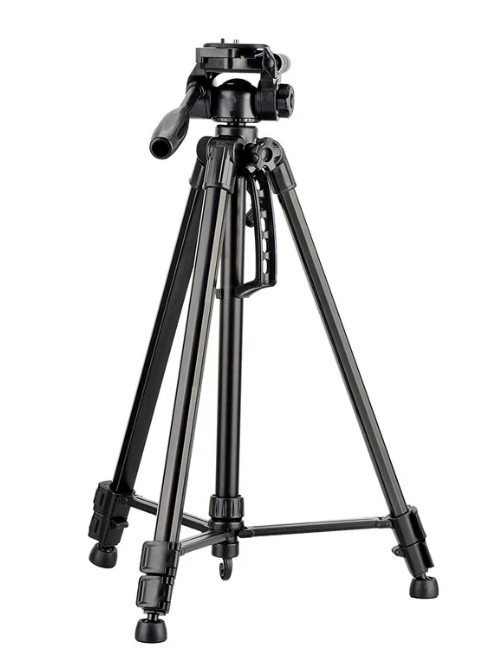
This Heavy Duty Camera Tripod is the ideal choice for professional photographers. Its 360° panoramic head allows you to effortlessly capture a wide range of angles, while the ball lock mechanism gives you full control over your camera’s position.
The tripod’s sturdy aluminum construction and anti-slip rubber feet provide stability, keeping your equipment safe.
With an adjustable height that reaches up to 80 inches, you can easily find the perfect shooting angle. It can be converted into a monopod, offering even more flexibility for different shooting situations.
Click Here To Buy Heavy Duty Camera Tripod
6. Lipo Safe Bag
The Lipo Safe Bag is designed to give you peace of mind when charging your Lipo batteries. Made with fireproof fiberglass and a flame-retardant layer, it can handle high temperatures, keeping your batteries safe. The bag includes adjustable dividers, so you can store multiple batteries separately to reduce any risks.
This bag is also versatile enough to store other items like important documents or valuables that need heat or fire protection. With plenty of room and a mesh pocket for accessories like plugs and cables, it’s both practical and reliable.
Click Here To Buy Lipo Safe Bag
Final Thoughts
This Black Friday, take advantage of incredible deals to upgrade your collection at unbeatable prices.
With drone technology advancing fast, Black Friday is an excellent opportunity to invest in the latest models and accessories that will enhance your flying experience.
Watch for price drops, compare offers, and don’t miss out on bundles and extra perks to maximize your value.
Happy flying!
Frequently Asked Questions
1. Are drones significantly cheaper on Black Friday?
Yes, many drones see discounts of 20-40% on Black Friday, with some brands offering bundles for added value.
2. What is the top choice for professional drone pilots on Black Friday?
The DJI Mini 4 Pro is ideal for professionals, with its high-quality camera and long flight time, making it a top Black Friday pick.
3. Can I find FPV drones on sale for Black Friday?
Absolutely. The DJI Avata 2 and similar FPV models often see discounts, especially in bundles that include FPV goggles.
4. What accessories should I buy with a drone?
Extra batteries, storage cases, and propeller guards are essential. Many retailers offer Black Friday bundles that include these add-ons at a discounted rate.
1
Class D Airspace: A Comprehensive Guide for Drone Pilots
Drone flying offers an exhilarating sense of freedom, but the world’s airspace is a complex network of three-dimensional segments, each of which is further divided into seven airspace classes known as Class A, B, C, D, E, F, and G.
Class D or Delta airspace, in particular, is an essential category as this airspace is designed to facilitate organized traffic flow in and out of the airport with controlled towers.
This means that you must understand the rules and regulations before flying into Class D airspace, ensuring safety and regulatory compliance.
In this comprehensive guide, we will help you understand what is Class D airspace, and the basic legal requirements you need to get well-versed with to fly in it.
Let’s get started.
What is Class D Airspace?
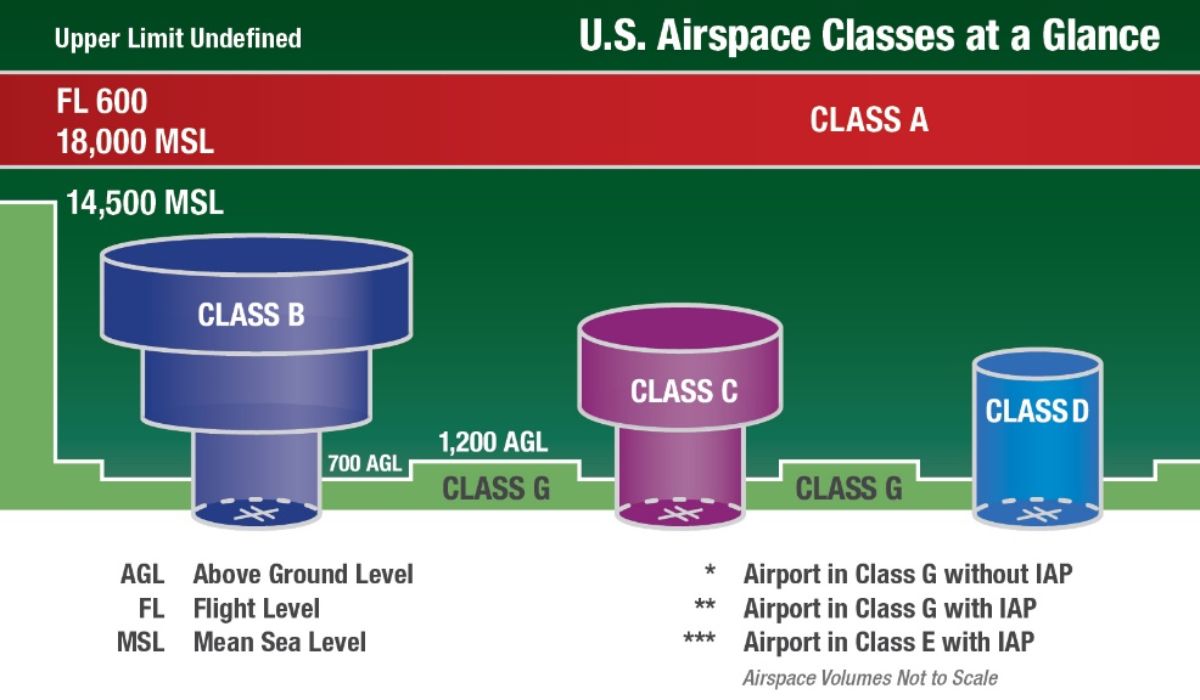
Class D airspace consists of Air Traffic Control (ATC) towers to conduct airport operations safely and efficiently.
Class D airspace includes almost any kind of air traffic, from airlines and corporate traffic to cargo operators and weekend fliers—everyone shares this airspace at many Class D airports.
Its key characteristics include the following:
- Vertical Limits: Think of it as a cylindrical cake layer in the sky, usually extending from the surface up to 2,500 feet above ground level (AGL). However, its dimensions may vary based on local air traffic patterns and terrain.
- Horizontal Boundaries: About 4 to 5 nautical miles from the airport’s center.
- Operating hours: Often operates full-time (24 hours) or part-time.
- Weather Minimums: According to Visual Flight Rules (VFR), visibility must be at least three statute miles, and cloud clearance must be at least 500 feet below, 1,000 feet above, and 2,000 feet horizontally.
- Speed limit: Class D airspace speed limit must stick to a maximum of 200 knots, when at or below 2,500 feet AGL, within 4 nautical miles of the primary airport.
But why is it important? Let’s find out.
Why is Class D Airspace Important for Drone Pilots?
Well, most accidents in controlled airspace occur due to a lack of knowledge and understanding of airspace rather than intentional violations.
Class D airspace represents such a highly controlled airspace; that’s why you cannot fly within this zone without prior authorization from the FAA.
Drones can operate in this airspace only with proper ATC authorization that has jurisdiction over that airspace.
Now the question arises, how can you check for Class D airspace? That’s what is covered in the next section.
Where is Class D Airspace Located?
Class D airspace, commonly found around smaller airports, presents a unique challenge for pilots. Shaped as a cylinder around the airfield with highly controlled operational towers and extending 2,500 feet above the airport elevation, it can be tricky to navigate within this controlled airspace.
How to Identify Class D Airspace?
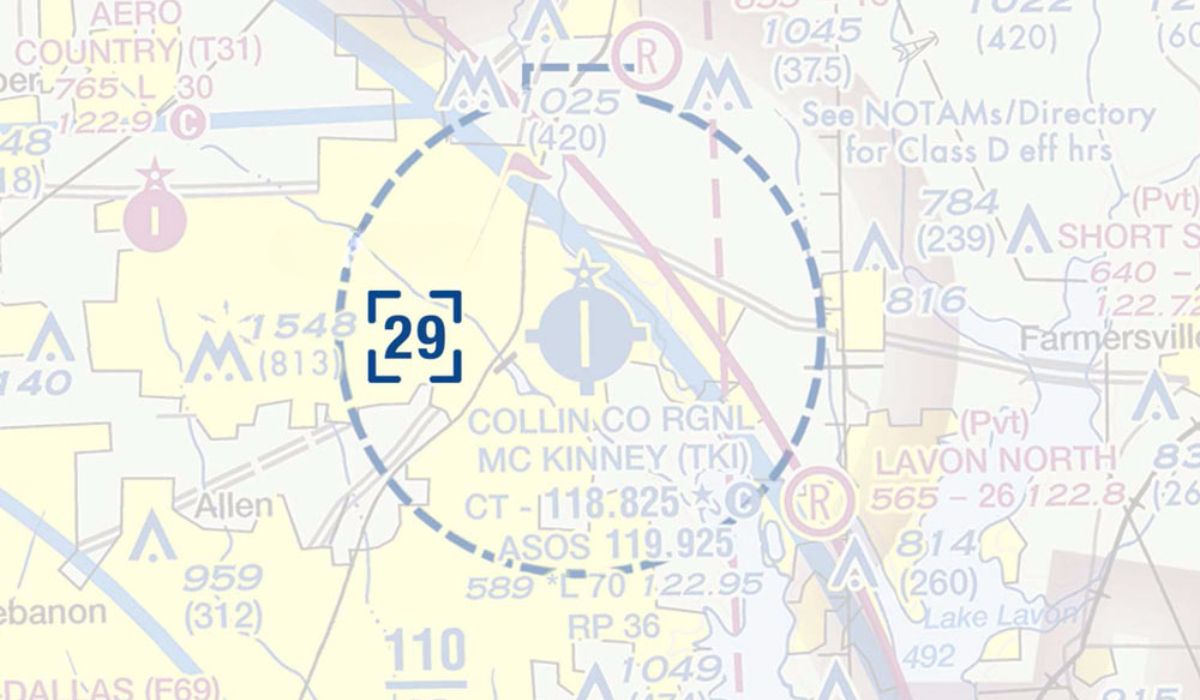
The most accurate identification of Class D airspace is necessary for safe and efficient flight operations. The best way to achieve this is by using aeronautical charts like AirMap or any other flight planning apps that provide precise airspace locations.
A blue dashed circle on aeronautical maps symbolizes the airport, serving as a visual indicator. Around that, Class D airspace is depicted with a two-digit number surrounded by square enclosed brackets.
Having understood the basics, let’s discuss whether you can fly a drone in Class D.
Requirements for Flying Drones in Class D Airspace
There are the following requirements you need to take into account before operating your drone in Class Delta areas:
1. Permission to Fly in Class D Airspace
To fly a drone, you’ll need to get prior approval through airspace authorization by the FAA.
This approval allows you to request permission from ATC to operate flying in controlled airspace. Authorization can be obtained for a single location or area governed by a single ATC.
You can easily obtain FAA authorization through the LAANC (Low-Altitude Authorization and Notification Capability) system.
It’s a partnership between some private drone companies (like DJI, Skyward, and Kittyhawk) and the FAA that allows you to apply for instant airspace authorization using a mobile or web application.
If LAANC is not available at your desired location, you can fill out the FAA’s online airspace authorization form and wait for it to be processed. Depending on the complexity of your request, this may take at least 90 days or even longer to process.
2. Drone Pilot Qualifications and Part 107
To fly drones in controlled airspaces, you must comply with the FAA’s Part 107 rules. These rules outline the qualifications needed for a commercial drone pilot, including remote pilot certification issued by the FAA.
This ensures that you are well-versed in the different airspace classes. Understanding these classifications will prepare you to operate in controlled airspaces with altitude restrictions and line-of-sight requirements.
3. Equipment and Safety Considerations
Although there are no specific transponder requirements for most drones flying in Class D, it’s still essential to follow these basic equipment safety rules:
- Use reliable GPS systems.
- Follow Class D weather minimums.
- Stay alert and have a clear understanding of your surroundings.
- Adhere to visual flight rules (VFR) visibility requirements, this includes maintaining at least three statute miles of visibility and staying clear of clouds (500 feet below, 1,000 feet above, and 2,000 feet horizontally).
- Pre-plan emergency landing spots in case of an emergency.
Radio Procedures and Communication
Flying a drone in controlled airspaces often requires a high level of communication to ensure safe flying surroundings for manned aircraft.
So, here are some drone flying communication best practices you must follow in controlled airspaces:
1. Stay in Touch with ATC (Air Traffic Control)
While you don’t always need to interact with ATC, still there are some specific communication procedures in Class D airspace to follow:
- In case you are flying close to manned aircraft routes, always establish two-way communication with ATC.
- When a tower reaches you while flying, follow the right communication protocols and understand what they want to communicate.
- Always maintain a safe distance from manned aircraft.
2. Follow Class D Airspace Communication Requirements
If your drone is near manned traffic, or if ATC specifically shares any requests, then you have to use the two-way radio communication system.
In such situations, you must have an understanding of basic Class D airspace communication requirements like:
- Acknowledgment: Reply to the instructions given by ATC to confirm understanding.
- Urgent Request Handling: Intentions or requests (e.g. landing or transitioning through).
- Altitude: Confirm & maintain a specified altitude (usually below 400 feet AGL for drones).
- Hold Position: Stop movement if instructed by ATC.
3. Have an Understanding of Step-by-Step Radio Procedures
Use these basic radio procedure steps to maintain clear communication and a safe flight:
- Initial Contact: Before beginning drone operation, call the control towers to request clearances for drone operations.
- State Intentions: Briefly describe the purpose of your flight, location, and altitude.
- Listen for ATC: Wait for ATC to grant clearance, provide information, or request further details.
- Acknowledge ATC: Confirm ATC’s instructions by repeating them back.
- Report Changes and Exist: If you have any changes in your flying operations or you’ve completed your flight, notify ATC.
Conclusion
Flying in regulated areas like Class D Airspace can be challenging at first. However, with the correct understanding of different airspace classes, rules, and regulations, you can ensure not only safe but also successful drone operations, providing a sense of security and reassurance.
Drone U’s drone pilot training program resources are specially designed to support you in foundation building, ensuring you can navigate your path with confidence, preparedness, and competence.
Check out our group training and one-on-one training programs, here.
Frequently Asked Questions
1. Can I fly a drone in Class D airspace?
Yes, you can fly drones in Class D airspace, but it’s crucial to remember that this requires pre-authorization from the FAA. This step is of utmost importance as Class D airspace is a high-traffic area due to its proximity to airports. Additionally, you’ll need permission from ATC.
It’s essential to stick to these strict regulations related to flying altitude, weather minimus, speed limits, and visibility standards, as these ensure the safety of all flying operations in Class D airspace.
2. How do I get approval to operate a drone in Class D airspace?
To get approval to operate a drone in Class D airspace, you can use these two different processes:
1) Use the LAANC System: for instant approval for operations, by following these steps:
- Download an approved LAANC provider mobile app or use their web portal.
- Enter your flying location, time, and altitude details.
- Submit the request. If LAANC covers the location and the operation meets FAA requirements, approval is often granted instantly.
2) Submit a Request through FAA DroneZone: LAANC does not work 100% of the time for every location, in such case follow these steps:
- Create an account on the FAA’s DroneZone website (dronezone.faa.gov).
- Submit a request for airspace authorization, including details like your flight location, date, time, and purpose of flying.
- Await FAA approval, which can take up to 30-90 days or even more, depending on the request’s complexity.
3. What happens in the Class D Airspace when the tower is closed?
In Class D airspace when a tower is closed, the airspace changes. Depending on the airport, this typically reverts to either Class E or Class G airspace.
1. Class E Airspace
ATC usually controls Class E but may have fewer restrictions than Class D airspace.
However, you still need to follow the same rules of visibility and cloud clearance in Class E, but there is no need to maintain two-way communication with ATC.
2. Class G Airspace
Class G is not controlled, meaning you need to operate without any communication with ATC, but still need to follow Visual flight rules (VFR) and maintain visibility with cloud clearance standards.
Remember, when flying in Class E or Class G airspace without ATC guidance, you need to be even more careful and alert.
So, consider using a visual observer to help spot other aircraft in complex airspace around airports.
4. What is the maximum altitude for drone flights in Class D airspace?
The maximum altitude for drone flights in class D airspace is 400 feet above ground level (AGL).
In case you want to exceed this 400-feet limit, then you can seek specific authorization from the FAA, which may require additional approvals from ATC.
However, keep in mind that such permissions are granted only under special circumstances and must comply with necessary safety measures.
5. What is the VFR minimum for Class D?
In Class D airspace, Visual Flight Rules (VFR) minimums for drones are closely set to manned aircraft. Here are the requirements:
Flight visibility: Three statute miles.
Cloud Clearance: The drone must remain at least
- 500 feet below
- 1,000 feet above
- 2,000 feet horizontal
As per FAA, for any drone operation in Class D airspace, maintaining these VFR minimums is essential to keep flying altitude under 400 feet AGL.
1
How to Finance a Drone: Explore Top Drone Financing Options
Does looking at that $5000 price tag on your dream drone feel unreachable?
You know the revolutionary potential this purchase can have on your work, but that steep upfront cost seems like a steep climb.
Whether you’re a business owner eyeing a high-end drone or a hobbyist ready to upgrade your aerial videography game, here’s the good news: you’ve got financing options for drones!
With new technologies constantly evolving, the excitement surrounding drone technology is acceptable.
In this guide, we’ll explore some of the top drone financing options currently available in the market. So you can turn flying your dream drone a reality and of course, get those amazing drone jobs done.
Why Financing a Drone Purchase Makes Sense?
Drones can cost from a few hundred to thousands of dollars based on their tech specifications and features. When you’re eyeing those high-end models, the price tag can be overwhelming.
That’s when drone financing options come in.
Financing allows you to invest in advanced technology while saving money for other important expenses.
Reasons you need to consider financing:
- Manageable payment: Financing allows you to spread out the cost into monthly manageable installments.
- Allows to capitalize on new market opportunities: Once you access the latest high-end drone technology, you can explore new possibilities, which can lead you towards generating higher income.
Common Financing Options for Drones
Here are some of the best ways to finance a drone purchase available to fit your specific needs and financial conditions:
1. Personal drone loans
Got no cash to pay upfront? Ain’t no worries—financing a drone via a personal loan can be a practical solution for you.
Consider approaching a bank, credit union, or online lender to apply for a loan. These loan providers usually look for a credit score of at least 600 to 700.
Depending on your creditworthiness and financial history, loan duration could range from 24 to 60 months, with loan amounts ranging between $3,000 to $20,000.
Pros:
- You can purchase any drone without being restricted to a limited budget.
- You can get personal loans easily, that too on low interest rates based on your credit card score.
Cons:
- To get a loan you must have good to excellent credit to qualify for the best rates.
- If you already have loans to pay off, then excessive borrowing might result in increased monthly payments and even lead to financial hardship.
2. Store-based financing
Store-based financing or point-of-sale financing (PoS) allows you to buy gadgets from store retailers and pay later.
These store retailers often partner with financing companies to offer manageable monthly payment plans. Common examples of such financing companies are UCFS and Abunda.
Pros:
- If you don’t have access to high credit limits on your credit cards, you can easily make a purchase using store financing, as it doesn’t impact your credit utilization.
- Majority of store financing options approve loans quickly, allowing you to complete your purchase fast.
Cons:
- Store financing usually has higher interest rates as compared to traditional loans, which can increase the overall cost, and make the purchase more expensive in the long run.
- In some cases, store financing may also include additional fees like origination fees, prepayment fees, and late payment fees—adding up to the cost.
3. Credit Cards
Do you have a credit card with 0% APR (Annual Percentage Rate)?
Well, it could also be your ticket to bringing home that drone you have been eyeing for so long.
Pros:
- Credit cards offering 0% APR can allow you to finance your drone purchase interest-free if paid off within the promotional timeframe (usually 6 to 18 months)—making it a cost-effective financing option.
- In addition, using a rewards credit card can offer you cash back points, or other perks on your purchases.
Cons:
- Once the APR period ends, the interest rates can significantly increase from 15% to 25%, which further increases the cost of purchase dramatically.
- Missed a payment? You may lose that sweet 0% interest rate, further complicating your repayment and adding to the cost.
Drone Payment Plans For High-End Drone Purchases

Ready to finance your next premium drone purchase?
Besides the traditional store retailers and loan providers, online retailers are offering “buy now and pay later” installment schemes—especially for big drone purchases.
These online retailers allow you to split the cost of your drone into monthly installments, often with little to zero interest rate (if paid in a set period of time).
Here are some widely used options to consider:
1. BNC Finance
BNC Finance specializes in offering high-end financing and leasing to businesses and individuals on equipment purchases.
Their drone installment plans are designed to cater to both small businesses and individual buyers, making it easier to finance costly tech equipment. Plus, they offer customized financing plans for a range of industries.
Their financing solutions start from $500 up to $350,000, with terms extending from 12 to 84 months.
It’s ideal for any small to midsize business owner and experienced drone pros.
2. Stearns Bank
If you are looking for specific equipment financing solutions for your business, then Stearns Bank can be a good option.
Stearns Bank is a well-known equipment finance and leasing service provider that focuses mostly on commercial applications. They serve small and medium-sized businesses with short or long-term equipment financing options based on specific needs.
Stearns Bank’s application process is streamlined, allowing you to secure funding quickly and effectively. They offer benefits like—low down payments, flexible repayments, and competitive interest rates.
3. Affirm
Affirm is one of the most popular pay-over-time drone financing solutions for both casual buyers and business owners.
Affirm partners with many major online retailers, allowing you to select suitable financing offers during checkout at 0% interest (for qualified buyers). Their application and qualification process is quick, where customers can choose their repayment plans, typically ranging from 3-12 months.
This way, you can get your new high-end drone delivered in no time and manage cash flow effectively.
4. Klarna
Klarna works with many online drone retailers, where they offer “Buy Now, Pay Later” financing services.
You can simply select Klarna during checkout as your payment option and then choose among several options, including their popular “Pay in 4” option—this allows you to split the payment into four interest-free installments over 6 weeks.
Klarna’s key benefits include a 0% interest rate on a short-term plan and instant approval. Plus, the Klarna app allows for easy management of re-payments.
How to Choose the Right Drone Financing Option
Watch the video to learn what to check before buying a used drone
Whether for business or personal, making an informed final decision on drone financing options involves a detailed evaluation.
Here are three key points you need to ask yourself while making the final call:
1. Understand your goals, needs and requirements
- What will the drone be used for?
- How frequently will the drone be used?
- What features and specifications are non-negotiable for you?
- How frequently will you need to upgrade?
2. Assess your current financial situation
- What is your budget?
- What is your current credit score?
- What interest rate can you qualify for?
- How much lump sum or down payment can you afford?
- How long can you commit to the installment payment plan?
3. Compare and review your best financing options
- What different finance plans are available based on your needs?
- What are the repayment terms of each plan?
- What are the terms and conditions of payment plan flexibility?
- What additional benefits do financing plans include?
Let’s compare all the best financing options for drones in the next section.
Comparing the Best Drone Financing Options for Businesses and Hobbyists
| Financing Option | Suitable For | Pros | Cons |
| 1. Personal Loans | Individual hobbyists | Flexible terms, potentially lower interest rates | Requires good credit, may involve additional fees |
| 2. Store-Based Financing | Individual hobbyists | Convenient, quick approval | Higher interest rates, limited options |
| 3. Credit Cards | Individual hobbyists | Great potential for 0% APR, rewards | High interest rates after promotional period, risk of overspending |
| 4. BNC Finance | Businesses, Individual hobbyists | Customized plans, high loan amounts | May require collateral |
| 5. Sterns Bank | Businesses | Specialized equipment financing, competitive rates | May require more documentation and have a longer approval process |
| 6. Affirm | Businesses, Individual hobbyists | 0% APR options, quick approval | May have higher interest rates for those with lower credit scores |
| 7. Klarna | Businesses, Individual hobbyists | Flexible payment options, 0% APR | Limited loan amounts |
Conclusion
Choosing the best possible financing option isn’t just a financial decision anymore—it’s a strategic investment in your future goals.
So remember, the key is to always weigh your options mindfully and make the right decision based on your current requirements and financial standing.
Don’t let financial constraints hold you back. Explore the possibilities, and take advantage of the financing options.
Focus on what’s the ultimate goal with this purchase, what outcome you want to achieve, and how you can make the most out of your drone investment.
Want to maximize your investment? Check out our drone training program here.
Because having a drone is just the beginning—and knowing how to fly like a pro will set you apart and help you achieve your goal.
Frequently Asked Questions
1. Can I finance a drone purchase as a business?
Yes! You can finance drones as a business using gadget loans, credit cards, and leasing programs.
These financing options can help you spread the cost, preserve your cash flow, and sometimes even get benefits from tax advantages associated with the gadget loans.
Among all the options, leasing is popular—as it allows businesses to upgrade their equipment easily as the technology evolves.
2. What are the best financing options for high-end drones?
For high-end drones, considering options like Affirm Financing can be viable as they have a buy now, pay later option, and they offer instant loan approval for online purchases.
Affirm doesn’t depend on just your credit score; they also consider other data points while making loan approvals. Their checkout process is simple, safe, secure, and has no hidden fees.
3. How does leasing a drone compare to buying?
Leasing a drone or buying one outright both have their own pros and cons—making the choice dependent on your current needs and circumstances. It typically involves little to no down payment or small monthly installments, which is quite affordable compared to buying one.
Leasing is usually ideal for businesses that frequently want to upgrade their equipment as this reduces the risk of obsolescence associated with rapidly evolving technology.
So, if you are looking for more flexibility in your operational needs and want to work with only the latest technology, then you can consider leasing as a good option.
However, the disadvantage here is that you never become the owner of the equipment. This means you’ll miss out on long-term asset value.
4. Can I finance a drone with bad credit?
Yes, you can finance a drone with a bad credit score, although your options can get limited with this.
Some financing options by Affirm, Klarna, and Sterns Bank allow you to get drones with lenient credit score requirements.
However, keep in mind that you may face higher interest rates or limited financing terms. In some cases, saving for the drone may be a better long-term option if financing isn’t favorable.
1
Best Indoor Drones with Cameras [2024]
Flying drones indoors can be a lot more challenging than outdoor flights.
Simply because when you’re flying indoors, you are dealing with many elements like furniture, narrow doorways, and potential interference from household appliances.
To avoid crashes flying indoors, you need a drone that provides a lot more stability, precise control
When choosing a drone for indoor flying, it’s not just about camera quality, it’s also about how well the drone can handle confined spaces while ensuring the safety of both the drone and its surroundings.
In this article, you will find some of the best indoor drones with cameras for a smooth and safe flight.
Let’s first understand what to look for when buying an indoor drone.
Key Features to Look for in an Indoor Drone
When flying indoors, prioritize drones that are stable, easy to control, and equipped with a reliable camera.
Here are some of the key features to consider when buying these agile birds:
- Stability and Control: Look for drones with advanced stabilization systems to prevent crashes and ensure precise control.
- Camera Quality: A 1080P camera is generally sufficient for indoor shots. While high-end features are nice, stability is more important in confined spaces.
- Obstacle Avoidance: Be mindful of false readings in smaller areas. Know when to turn off sensors to avoid unexpected behavior.
- Durability: Indoor flying can be more accident-prone. Choose a drone that can withstand minor bumps without major damage.
- Noise and Battery: Opt for quieter models to avoid disturbing indoor environments. Keep an eye on battery life as indoor flights can be more demanding.
With that, let us uncover the top drones we’ve picked up to elevate your indoor flying experience.
Best 6 Indoor Drones with Camera
1. DJI Mini 2
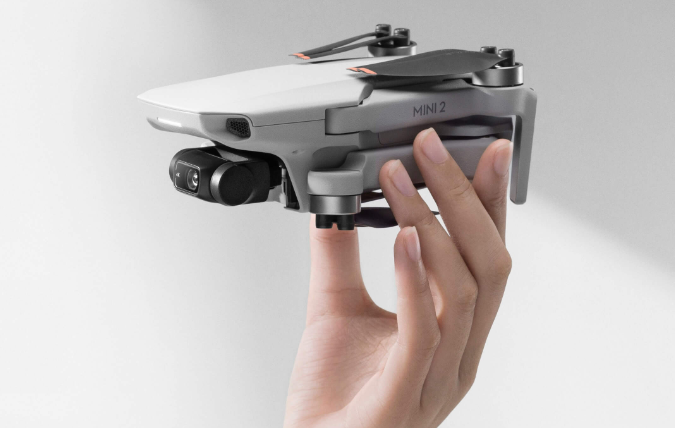
The DJI Mini 2 is celebrated for its compact and lightweight design. It is extremely maneuverable indoors. It comes with a 4K camera paired with 3-axis stabilization, delivering smooth and high-resolution footage. It also offers intelligent flight modes like QuickShots, enhancing creativity.
Pros:
- Excellent camera quality (4K) for detailed indoor shots.
- Lightweight and foldable for easy storage and transport.
- 3-axis gimbal ensures stable footage.
Cons:
- No obstacle avoidance, which can be tricky for beginners in tight spaces.
- Slightly pricier compared to other indoor drones.
Best For:
Cinematic indoor shots and aerial photography enthusiasts.
|
Feature |
Specification |
|---|---|
| Camera | 4K with 3-axis gimbal |
| Flight Time | Up to 31 minutes |
| Max Range | 10 km |
| Weight | 249g |
| Max Speed | 57.6 km/h |
| Flight Modes | QuickShots, Return-to-Home |
2. DJI Mini 2 SE
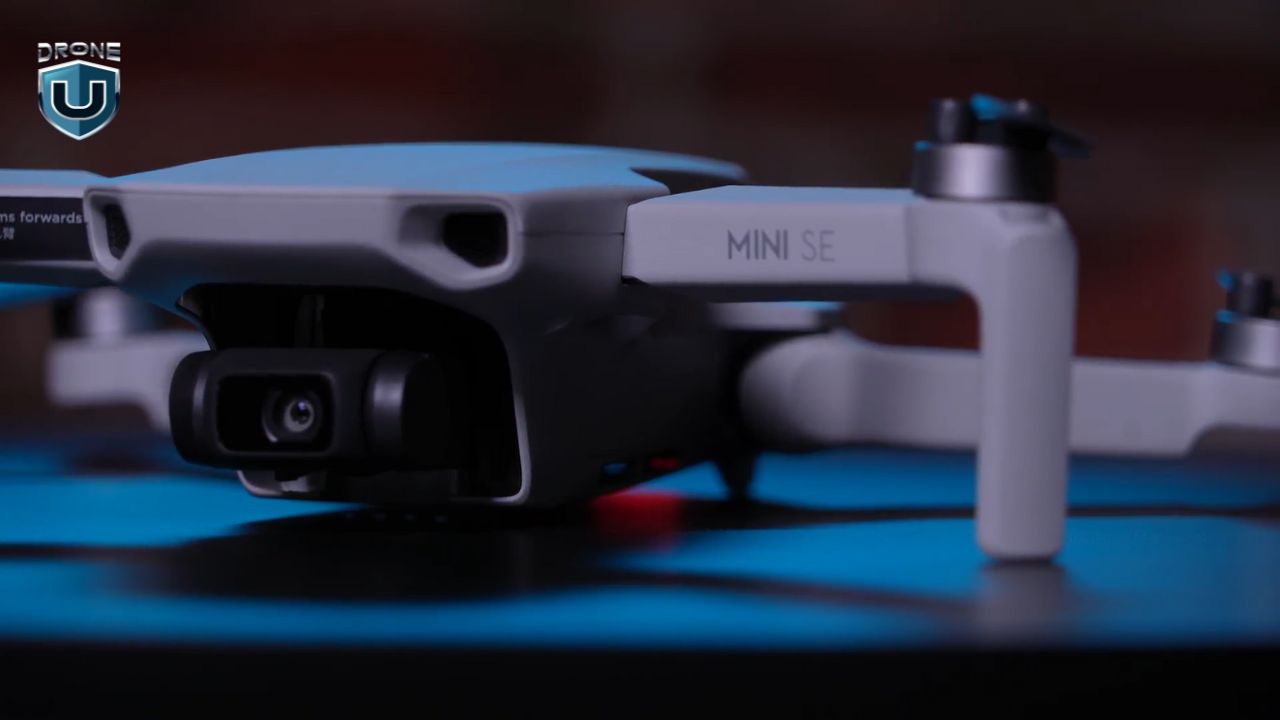
A compact and lightweight drone with impressive camera quality for its size. It features 2.7K video resolution with stable performance.
Pros:
- Extremely lightweight and easy to control indoors.
- Excellent stabilization for high-quality footage.
Cons:
- Requires GPS mode to be disabled for smoother indoor flights.
Best For:
Indoor videographers looking for a portable, high-quality drone.
|
Feature |
Specification |
|---|---|
| Camera | 2.7K with 3-axis gimbal |
| Flight Time | Up to 31 minutes |
| Max Range | 10 km |
| Weight | 246g |
Check out this guide for a detailed review of DJI Mini 2 vs Mini 2 SE
3. Autel Robotics EVO Nano
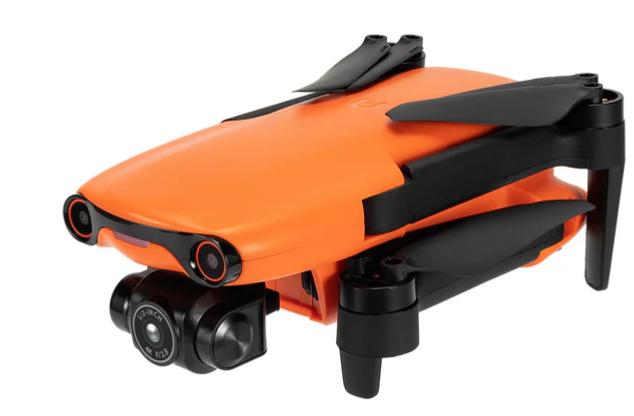
This Autel Robotics drone features a 4K camera with a 3-axis gimbal for clear, stable footage. It also comes with obstacle avoidance sensors, making it safer to fly indoors, especially for less experienced pilots.
Pros:
- Obstacle avoidance makes indoor flying safer.
- Long flight time and high-speed capability.
- Supports advanced features like 8K hyperlapse and HDR video.
Cons:
- Higher price point compared to other indoor drones.
- Might feel overpowered for simple indoor use.
Best For:
Indoor filming projects that require precise control and advanced safety features.
|
Feature |
Specification |
|---|---|
| Camera | 4K with 3-axis gimbal |
| Flight Time | Up to 35 minutes |
| Max Speed | 40 mph (64.3 km/h) |
| Max Range | 10 km |
| Weight | 249g |
| Flight Modes | 8K Hyperlapse, HDR |
3. Parrot Anafi
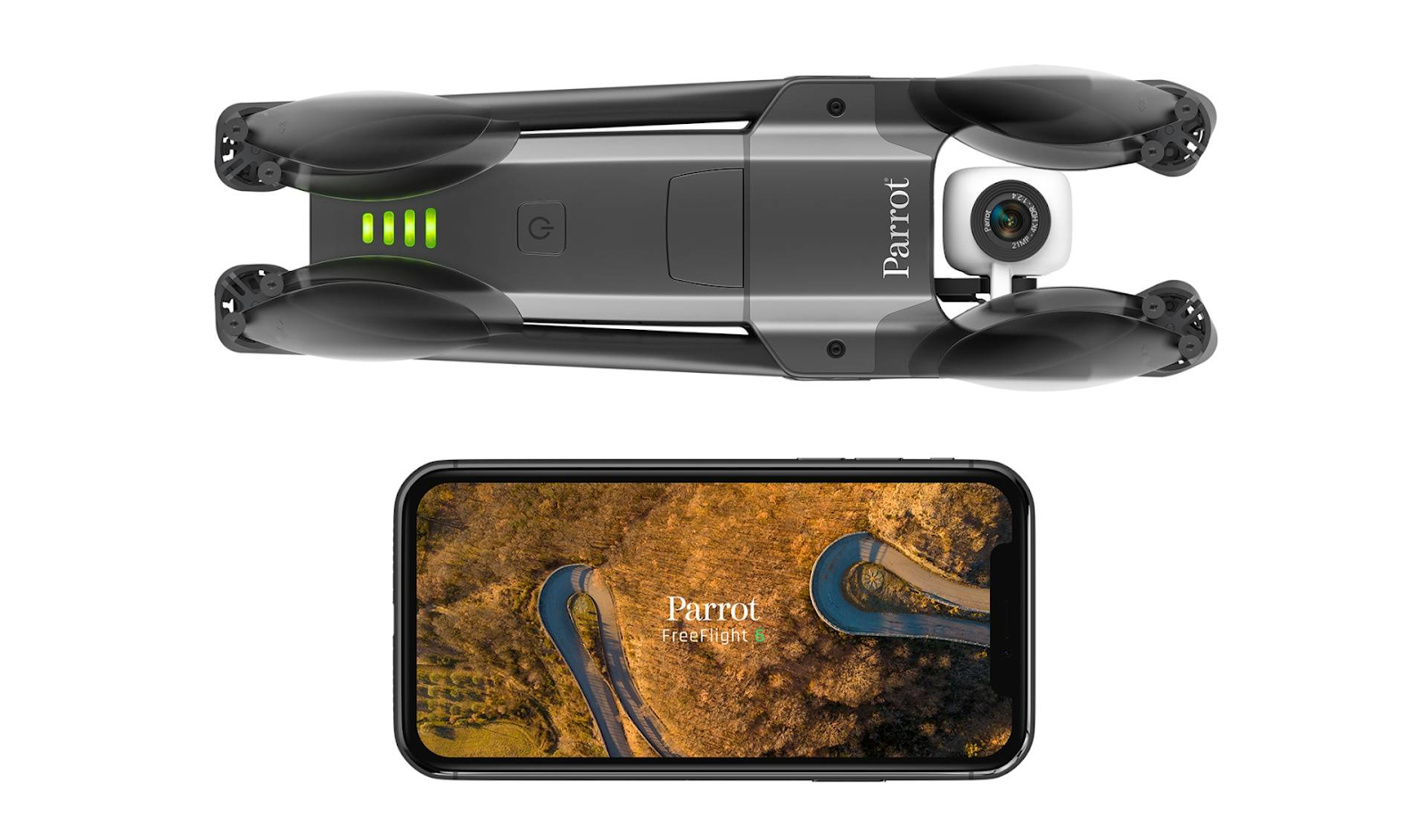
The Parrot Anafi offers a 4K HDR camera in a compact foldable design, making it an ideal choice for indoor flying. It comes with an FPV headset for a more immersive flying experience.
Pros:
- Compact and foldable for easy portability.
- 4K HDR camera delivers high-quality video.
- FPV headset provides immersive flying.
Cons:
- Shorter flight time compared to others in this range.
- Limited obstacle avoidance features.
Best For:
Indoor pilots looking for immersive FPV flying experiences and portability.
|
Feature |
Specification |
|---|---|
| Camera | 4K HDR with FPV support |
| Flight Time | Up to 25 minutes |
| Max Range | 4 km |
| Weight | 320g |
| Flight Modes | Slow-motion, Hyper-lapse |
4. Holy Stone HS720E
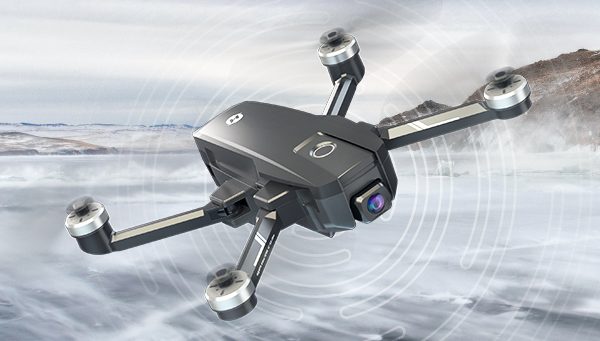
The Holy Stone HS720E features a 4K UHD camera with a 90-degree adjustable angle, making it great for versatile indoor shots. Its GPS-assisted intelligent flight modes provide enhanced control, ideal for indoor projects.
Pros:
- Long flight time.
- GPS-assisted flight modes improve control.
- High-quality camera with adjustable angles.
Cons:
- Slightly larger in size, which may make it harder to navigate in smaller spaces.
- Limited range compared to more advanced models.
Best For:
Indoor projects require long flight times and versatile camera angles.
|
Feature |
Specification |
|---|---|
| Camera | 4K UHD, 90° adjustable |
| Flight Time | Up to 46 minutes |
| Max Range | 1 km |
| Weight | 495g |
| Flight Modes | GPS Return-to-Home, Follow Me |
5. Ryze Tello
The Ryze Tello is a highly affordable drone ideal for beginners. It features an HD camera and reliable flight control for smaller indoor spaces.
Pros:
- Affordable and easy to fly for beginners.
- Stable flight performance indoors.
Cons:
- Limited camera features and range.
- Basic design with few advanced features.
Best For:
Beginners looking for an affordable indoor drone for basic shots.
|
Feature |
Specification |
|---|---|
| Camera | 720p HD |
| Flight Time | Up to 13 minutes |
| Max Range | 100 m |
| Weight | 80g |
6. Holy Stone HS110D
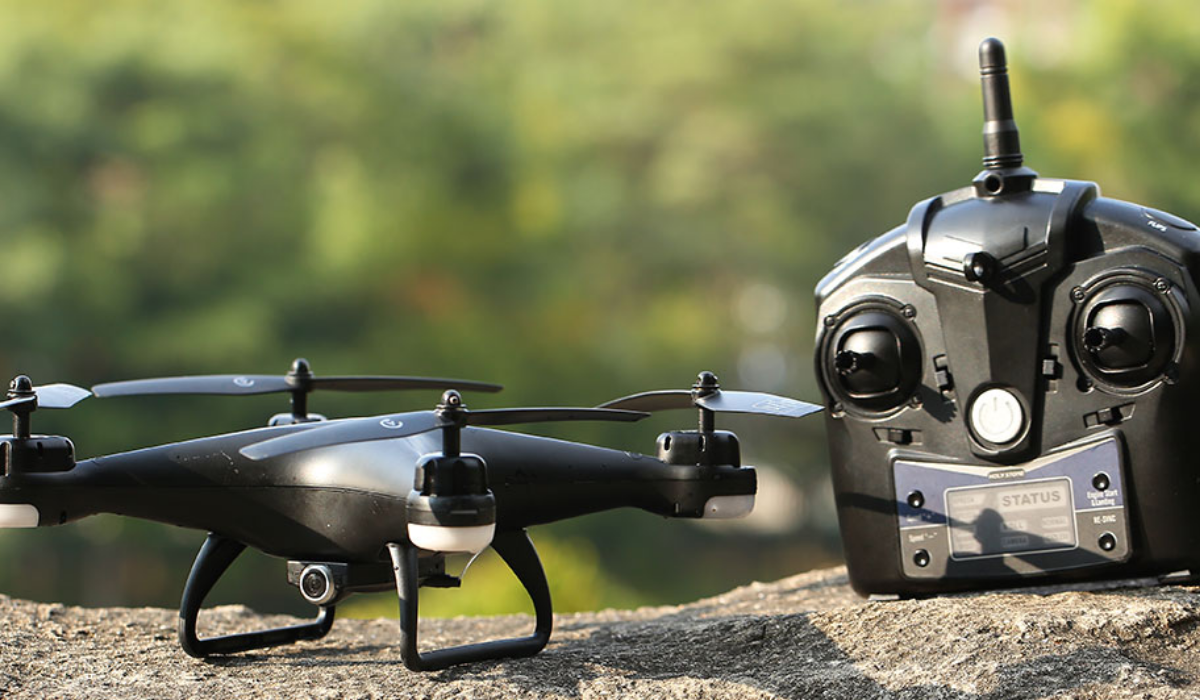
This Holy Stone drone offers a 1080p camera and is great for beginners looking to enhance their indoor flying skills. It also has decent obstacle-avoidance features.
Pros:
- Good camera quality for its price.
- Stable flight with obstacle avoidance.
Cons:
- Bulkier design makes it less suited for tight indoor spaces.
Best For:
Beginners looking for an affordable indoor drone with a good camera.
|
Feature |
Specification |
|---|---|
| Camera | 1080p |
| Flight Time | Up to 10 minutes |
| Max Range | 100 m |
| Weight | 149g |
Conclusion
When selecting the best indoor drone with a camera in 2024, it’s essential to consider your specific filming needs and preferences. Whether you value a compact design, advanced autonomous features, or longer flight times, there’s a drone on this list that fits your requirements.
Flying drones indoors can be challenging, but with the right drone, it can also open up exciting possibilities. Choosing a drone specifically designed for indoor use will help you navigate the tight spaces of homes, factories, and other interiors with ease.
The drones we’ve reviewed offer the control, stability, and camera quality needed to capture stunning footage.
Happy flying and let me know which one are you planning to buy in the comments section.
1
Understanding BVLOS (Beyond Visual Line of Sight) in the Drone Industry
Remember when drone pilots had to keep a constant eye on their flying machines? That changed with BVLOS (Beyond Visual Line of Sight). BVLOS lets drones fly farther, faster, and do more on their own.
BVLOS is like a superhero cape for drones. It helps them do bigger and more complicated jobs, like mapping huge areas, delivering packages, and helping in emergencies.
A recent research indicates that the Autonomous BVLOS Drones market is projected to reach approximately USD 3.03 billion by 2029, with a strong compound annual growth rate (CAGR) of 23.26% over the forecast period.
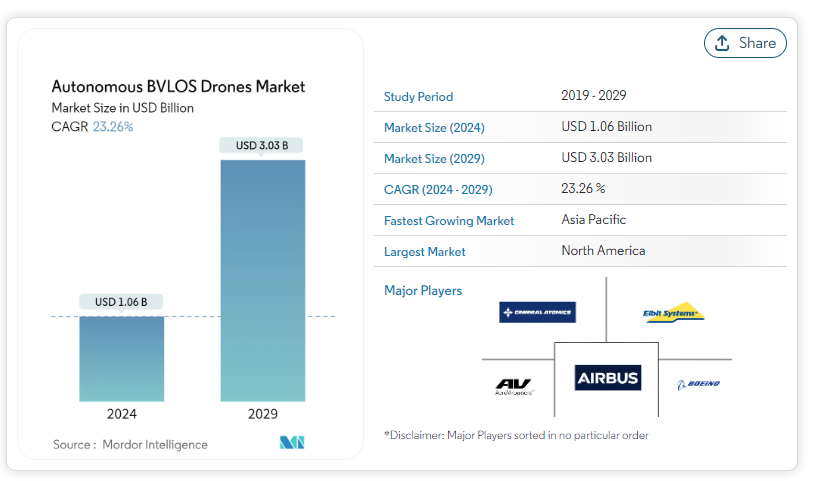 Mordor Intelligence BVLOS Report
This technology has opened up new possibilities for industries like farming, building, and search and rescue. It’s a big technological change happening right now.
In this article, we’ll dive into everything about Beyond Visual Line of Sight: how it works, why it’s great, and how it’s changing different industries.
Let’s get started.
What is BVLOS?
The concept of BVLOS (Beyond Visual Line of Sight) isn’t new, but recent advancements in technology and regulatory support have rapidly accelerated its development. Traditionally, drone operations were limited to Visual Line of Sight (VLOS), where pilots had to maintain direct visual contact with the aircraft.
However, as the demand for drones to cover greater distances and perform more complex tasks grew, technologies like detect-and-avoid systems and real-time communication networks were developed.
BVLOS simply means flying your drone beyond where you can see it with the naked eye. While this was traditionally against regulations, times are changing.
Most drone operations in the US still fall under VLOS rules, requiring operators to keep drones within eyesight, but BVLOS is starting to push those boundaries—opening up new possibilities for drone technology and its applications.
Key Elements of BVLOS
- Autonomous Flight: BVLOS relies on advanced automation, allowing drones to follow pre-programmed routes or respond to real-time commands without the need for constant human oversight.
- Enhanced Communication Systems: Strong communication technologies, such as satellite links, cellular networks, and high-frequency radio signals, are essential for maintaining control of drones during BVLOS operations.
- Sense and Avoid Systems: To ensure safety, BVLOS drones are equipped with advanced sensors and AI-powered systems that detect and avoid obstacles autonomously.
Real-World BVLOS Applications: Where You Could Be Working
Let’s look at some exciting ways BVLOS is being used right now, and how you could be part of these innovative projects:
1. Package Delivery
Companies like Amazon and UPS are testing BVLOS drones for last-mile delivery. In 2019, UPS received the first FAA certification for a drone airline, allowing BVLOS operations. Imagine being at the forefront of revolutionizing the delivery industry.
2. Infrastructure Inspection
American Tower Corporation uses BVLOS drones to inspect cell towers across remote areas, reducing risks to human climbers and improving efficiency. Your skills could be crucial in maintaining critical infrastructure.
3. Disaster Response
After Hurricane Harvey in 2017, BVLOS drones were used to assess damage and assist in search and rescue operations, covering large areas quickly. Your expertise could literally save lives in emergency situations.
4. Agriculture
Drone company Rantizo received BVLOS approval in 2024 for agricultural spraying operations, allowing farmers to treat larger areas more efficiently. You could be part of transforming the agriculture industry, improving crop yields, and reducing resource use.
5. Wildlife Conservation
In Africa, BVLOS drones are being used to monitor wildlife populations and detect poaching activities across vast wilderness areas. Your skills could contribute to protecting endangered species and preserving our planet’s biodiversity.
6. Urban Air Mobility
Companies like Joby Aviation and Lilium are developing electric vertical takeoff and landing (eVTOL) aircraft for urban air taxi services. While not exactly drones, these aircraft will rely on many of the same BVLOS principles and technologies. Your experience could be valuable in this emerging field.
Regulatory Landscape of BVLOS Operations
The primary barrier to the widespread adoption of Beyond Visual Line of Sight (BVLOS) drone operations is regulatory. Aviation authorities worldwide have implemented strict guidelines to ensure the safety of manned aircraft and prevent mid-air collisions.
Two key regulatory bodies are:
- The Federal Aviation Administration (FAA) in the United States
- The European Union Aviation Safety Agency (EASA) in Europe
These organizations play a crucial role in shaping the rules for drone operations, including BVLOS flights.
For drone operators looking to conduct BVLOS flights, the process often involves:
1. Applying for specific waivers or certifications
2. Demonstrating that their drone systems are equipped with sufficient technology for safe operation without human visual monitoring
This process can be complex and time-consuming, but it’s essential for ensuring safety in shared airspace.
Moreover, Aviation authorities are working to create frameworks that balance safety concerns with the growing demand for BVLOS operations. Some notable initiatives include:
1. FAA Pathfinder Initiative
The FAA’s Pathfinder Initiative aims to:
- Gather data on BVLOS operations
- Develop a regulatory framework for safe and scalable BVLOS flights
- Inform future policy decisions regarding drone integration into national airspace
2. EASA’s Specific Operations Risk Assessment (SORA)
The SORA model introduces a risk-based approach to BVLOS permissions:
- Each operation is analyzed based on its specific risk profile
- This allows for more flexible and tailored approvals
- It encourages innovation while maintaining high safety standards
These developments signal a shift towards more accommodating regulations for BVLOS operations, paving the way for broader adoption of this transformative technology.
Challenges in BVLOS Technology
While Beyond Visual Line of Sight (BVLOS) drone operations offer exciting possibilities, they come with a unique set of challenges. Let’s explore these key considerations and the technologies that address them:
1. Safety: Ensuring the safety of BVLOS operations is paramount. This includes collision avoidance, reliable command and control links, and contingency management. You need to be well-versed in these aspects to operate safely Beyond Visual Line of Sight (BVLOS).
2. Privacy: With drones flying beyond visual range, addressing privacy concerns becomes even more critical. You need to be aware of privacy laws and best practices to operate ethically and legally.
3. Airspace Integration: BVLOS drones need to safely coexist with manned aircraft and other airspace users. Understanding airspace regulations and coordination procedures is crucial.
4. Technology: Reliable long-range communication, sense-and-avoid systems, and autonomous flight capabilities are crucial for safe BVLOS operations. Familiarize yourself with these advanced technologies.
5. Training and Certification: BVLOS operations require additional skills and knowledge. You likely need specialized training and potentially new certifications. Drone U can help you get those specialized training – check out this page for more information.
6. Data Management: BVLOS operations often generate large amounts of data. Understanding data analysis and management will become an important skill set.
7. Insurance and Liability: BVLOS operations may require different insurance coverage. Understanding the liability implications will be important for protecting yourself and your business.
The Future of BVLOS in the Drone Industry
Looking ahead, the potential of BVLOS technology is incredibly promising. Here are some predictions that could shape your career:
1. AI-Powered Operations: Advanced AI may soon enable fully autonomous BVLOS missions, with human pilots transitioning into roles as mission managers, focusing on planning, oversight, and problem-solving rather than direct control.
2. Drone-in-a-Box Solutions: Self-deploying drones could handle routine BVLOS inspections or surveillance without human involvement, placing you in a position to manage and oversee a network of autonomous systems.
3. Urban Air Mobility: BVLOS operations are paving the way for urban air mobility concepts, such as flying taxis. Your experience in BVLOS could prepare you for opportunities in this rapidly developing field.
4. Specialized BVLOS Careers: We may see the rise of niche roles, including BVLOS network designers, long-range drone mission specialists, and BVLOS airspace integration experts.
Industry experts predict that within the next decade, BVLOS will become the standard for most commercial drone operations. This shift will allow for more complex missions, including long-range deliveries, large-scale environmental monitoring, and high-risk industrial inspections.
Conclusion
BVLOS technology is transforming the drone industry, unlocking opportunities that go beyond what was previously possible.
From long-range deliveries to complex environmental monitoring, BVLOS allows industries to operate drones at a scale that was unimaginable just a few years ago. As regulatory frameworks continue to evolve and technology advances, it’s becoming clear that Beyond Visual Line of Sight is the future of drone operations.
For businesses and professionals, embracing BVLOS is no longer optional—it’s critical for staying competitive. Industries like agriculture, infrastructure, and defense are already seeing the benefits of adopting this technology. As a drone pilot, technician, or business leader, positioning yourself at the forefront of this change is key.
To thrive in this evolving landscape, staying informed and continually upgrading your skills is essential. Whether it’s gaining expertise in new BVLOS technologies, understanding regulatory changes, or mastering the safety protocols for beyond-visual operations, continuous learning will help you stay ahead.
So, what’s next?
Take action. Start preparing now for the BVLOS future by:
- Expanding Your Skills: Get training on BVLOS technologies, regulations, and safety protocols.
- Exploring New Opportunities: Identify industries and sectors that are beginning to implement BVLOS and consider how your expertise can add value.
- Networking and Collaboration: Engage with industry experts, join BVLOS forums, and participate in industry events to stay at the cutting edge.
- Staying Adaptable: As BVLOS Technology continues to develop, new challenges and opportunities will arise—be ready to pivot and evolve as the technology does.
With BVLOS, the potential for growth in your career or business is enormous. By embracing these advancements, you’ll be in a prime position to take advantage of the new opportunities it creates.
The future of drones is about going beyond—beyond the line of sight, beyond current limitations, and beyond traditional career paths. It’s an exciting time to be in the drone industry, and Beyond Visual Line of Sight is just the beginning. Are you ready to be part of it?
Quiz: Are You Prepared for the BVLOS Revolution?
1. What does BVLOS stand for?
a) Better Visual Line of Sight
b) Beyond Visual Line of Sight
c) Basic Vertical Launch Operations System
2. What percentage of commercial drone operators had BVLOS waivers as of 2019?
a) 1%
b) 5%
c) 10%
3. Which of these is NOT a key challenge in Beyond Visual Line of Sight operations?
a) Safety
b) Privacy
c) Drone color schemes
4. What is a crucial stepping stone toward routine BVLOS operations?
a) Remote ID
b) Drone racing
c) Social media marketing
5. By what percentage is the median salary for drone pilots with BVLOS experience higher than those without?
a) 10%
b) 20%
c) 30%
(Answers: 1-b, 2-a, 3-c, 4-a, 5-b)
5
Comprehensive Drone Modeling Guide: 3D Mapping and Modeling Explained
Have you ever imagined capturing the world from above with remarkable precision and detail? Drone 3D modeling makes this a reality, converting stunning aerial views into intricate, explorable 3D models.
With advanced photogrammetry software, you can stitch aerial data into an accurate 3D representation, allowing you to explore everything from vast landscapes to hard-to-reach areas.
Drone Modeling technology is revolutionizing industries like construction, urban planning, and agriculture by making data collection faster, safer, and more accurate. But creating high-quality 3D models that are detailed from every angle isn’t just about having a good drone—there’s more to the process.
According to Markets and Markets, the 3D Mapping and Modeling Market is projected to grow from USD 5.4 billion in 2023 to USD 11.8 billion by 2028, at a CAGR of 17.2%.
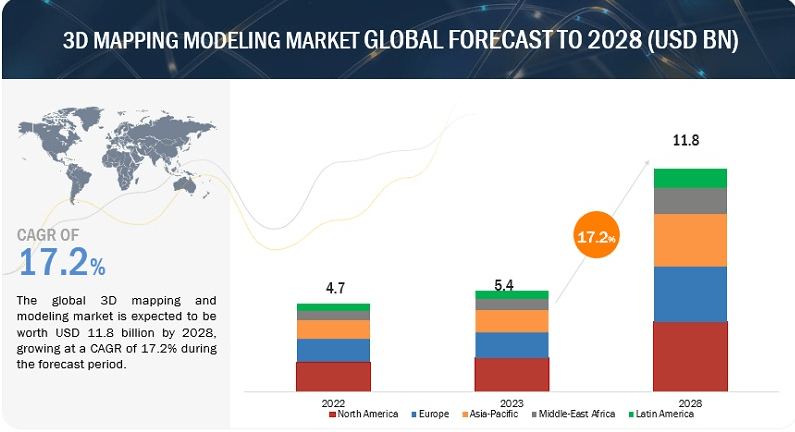 Credit: Markets and Markets
This guide explores the intricacies of drone modeling, covering everything from basic 3D modeling concepts to advanced 3D mapping and modeling techniques. We’ll cover everything about drone 3D modeling, from understanding what a drone 3D model is to choosing the best drone for 3D mapping and learning how to create a model from drone images.
Let’s get started!
What are Drone Modeling and 3D Mapping?
Drone Modelling is using a drone to capture data and imagery of an object or area. The common ways to capture the data include:
| Photogrammetry | LiDAR (Light Detection and Ranging) |
| This involves taking lots of pictures of the same thing from different angles. These pictures are then put together to create detailed models. These models can be used for many things like mapping, surveying, monitoring, analysis, and visualization. | This method uses lasers to measure the distance between objects. The drone equipped with LiDAR flies over the area, and the laser pulses bounce off the ground and objects, creating a highly accurate 3D point cloud that can be used to generate a 3D model. |
Drone Modeling helps us measure land accurately, plan where to build things, and respond quickly to emergencies like disasters.
Now that we know what drone modeling is, let’s learn why it’s important.
Significance of 3D Drone Modeling
3D modeling with drones has revolutionized how we capture and analyze spatial data. It has resulted in a more efficient, safe, and informed decision-making process. Here’s why drone modeling matters:
1. Enhanced Precision and Detail
Drones are like having a super-powered camera that can fly. With drones, you can capture crystal-clear pictures and turn them into cool 3D models, giving you a super detailed view of anything from buildings and landscapes to even small objects.
And the best part? These 3D models are super accurate, down to the centimeter.
This level of precision is a game-changer for things like construction, engineering, and land surveying, where every tiny detail can make a big difference.
2. Cost Efficiency
With drones, you can cover vast areas in a flash, significantly reducing the time and manpower needed for data collection. This translates to substantial cost savings for your projects.
3. Accessibility and Safety
Drones go where humans can’t: steep terrains, disaster zones, hazardous environments. They can capture information and create models from these difficult-to-reach areas. This eliminates the risk of exposing yourself or your team to potential dangers, making drone modeling a valuable tool for enhancing safety on the job.
4. Time Efficiency
With drones, you can cover vast areas in a fraction of the time, drastically improving turnaround times for project planning and execution. This translates to faster completion and increased efficiency, allowing you to get things done quicker.
5. Comprehensive Data Analysis
Drones are a game-changer for data collection. They allow you to gather a massive amount of information in a fraction of the time compared to traditional methods. You can use the collected drone data for volume calculations, change detection over time, and environmental monitoring.
6. Innovative Applications
Drones aren’t just data collection powerhouses, they’re also bringing the world to life in immersive experiences through VR and AR applications.
You can explore historical sites in virtual reality or train on complex procedures with augmented reality overlays.
Speaking of history, drones are also helping preserve the past by creating detailed models of historical sites and artifacts. This allows for digital archiving and study, ensuring these treasures are accessible to future generations.
After significance, let’s explore how drone modeling works.
How 3D Drone Modeling Works
The process of drone modeling involves several distinct steps, ranging from planning the drone flight to processing the captured images.
Here’s a step-by-step breakdown of how drone modeling works:
Step 1: Project Planning and Preparation
Start by identifying the goals of your drone modeling project, specifying the area to be mapped or the level of detail you require. Then, choose the types of equipment and sensor(s) that best suit your project. This might include high-resolution cameras, LiDAR, or multispectral sensors, depending on the data you need.
Step 2: Data Acquisition
The next step is to gather multiple images following your data collection strategy. Equip the drone with a high-resolution camera that suits your needs. Make sure the camera is calibrated correctly and set to capture images regularly.
Alternatively, manually control the capture process to ensure proper overlap. Remember to capture a series of overlapping images or sensor readings from different angles.
Step 3: Data Processing
Import your collected images into the software of your choice. Choose photogrammetry software that can process your images into a 3D model. This software identifies common points between overlapping images during processing. Popular options for this include Pix4D, Agisoft Metashape, and DroneDeploy.
However, can you use a Macbook for 3D Drone Modeling? Check out this video to find the answer:
If you use LiDAR sensors on your drone, the drone emits laser pulses toward the ground, measuring the time it takes for each pulse to return. Then, this data is used to create highly accurate digital surface models (DSMs) or digital terrain models (DTMs).
Step 4: Model Refinement
Once the raw data undergoes processing in specialized software, it stitches together the collected data points to form a detailed 3D model. You can then utilize software tools to eliminate any anomalies, unnecessary objects, or errors from the model, ensuring it accurately represents the target area.
Further refinement of the model involves additional processing to add textures, colors, and other details, enhancing its realism and usefulness.
Step 5: Analysis and Application
The software will then analyze the images for common points and align them to start constructing the 3D model. Once the 3D model is finalized, you can perform various analyses based on your project goals. This model can be integrated into GIS systems, shared with stakeholders, or utilized in simulations.
To understand drone modeling fully, let’s explore both its benefits and drawbacks.
Advantages & Disadvantages of Drone Modeling
|
Advantages |
Disadvantages |
| More cost-effective compared to traditional methods. | Limited payload capacity, restricting the types and number of sensors that can be carried. |
| Large areas can be covered quickly, allowing for rapid data collection and analysis. | Operations are weather-dependent, and adverse weather conditions such as strong winds, rain, or fog can impede flights. |
| Access remote or hazardous areas that are difficult or dangerous for humans to reach. | Drone modeling requires technical expertise in drone piloting, data processing, and software operation. |
| Capability to collect and process data in real-time. | Susceptible to hacking and cybersecurity threats, posing risks to data integrity and security. |
Let’s delve into the usage of drone modeling across different industries.
Applications of Drone Modeling
3D modeling and mapping have found applications across various industries, from construction to agriculture. Its versatility and efficiency render it invaluable for professionals aiming to analyze data.
With drone modeling, you can monitor and plan projects with a level of accuracy that was previously challenging or costly to attain.
Here are some key applications of drone modeling.
1. Construction and Infrastructure Development
Drone modeling assists in planning construction projects by providing accurate land surveys. It also retrieves topographic data to ensure efficiency. Drones are also used to monitor the project progress and track resources, helping manage assets on-site and keep projects on schedule.
Moreover, drones can inspect structures for wear, tear, or damage, allowing you to conduct regular maintenance checks for bridges, roads, and buildings. This streamlined process eliminates the need for scaffolding or human climbers, making inspections easier and safer for you.
2. Agriculture and Forestry
Drones provide you with detailed models of farmland, helping you understand crop health. By identifying variations in the field, you can track growth and optimize water usage and fertilization.
Drones also play a crucial role in safeguarding the forests by collecting data to assess tree health and monitor deforestation rates. This information helps in implementing conservation practices and ensuring sustainable management of forest resources.
3. Environmental Monitoring and Conservation
3D models created through drones provide a non-intrusive way to study ecosystems, helping researchers track changes in vegetation, wildlife habitats, and water bodies. Drones act as friendly flying spies for nature, enabling researchers to monitor plant health, animal behavior, and changes in rivers and lakes.
It’s an excellent method to observe nature and understand how it changes over time.
Additionally, drones rapidly map affected areas during natural disasters such as floods, wildfires, or hurricanes. This helps in damage assessment, planning relief efforts, and rebuilding strategies.
4. Urban Planning and Real Estate
Urban planners use drone modeling to visualize proposed developments within existing cityscapes, measuring the impact of new projects and planning infrastructure upgrades accordingly. You can also provide high-quality 3D drone models to potential buyers with immersive tours of properties, showcasing features and layouts more engagingly and comprehensively.
5. Mining and Geology
In mining operations, drones map and model excavation sites, enabling tracking of volume extraction, monitoring environmental compliance, and efficient asset management.
Drones collect data in geologically interesting areas for mineral identification, making the study of geological formations easier and providing valuable insights into potential hazards.
6. Archaeology and Cultural Heritage

Drones produce detailed 3D models of archaeological sites, enabling researchers to explore and document historical sites without causing disturbance.
These detailed models of historical structures and sites aid in preservation efforts, serving as invaluable digital records for future generations.
7. Energy and Utilities
Drones are valuable for inspecting solar farms, wind turbines, and power lines, allowing you to assess maintenance needs or damage from a safe distance, reducing downtime and operational risks.
Drone 3D models assist in site selection and layout planning for new energy projects, ensuring optimal placement of facilities such as solar panels and wind turbines.
Let’s delve into the top drones available in the market for drone modeling.
Best Drones for Drone Modeling
Having covered the essential aspects of drone modeling, let’s explore the top drones that can assist you in your modeling projects.
Here are the best 3 drones for drone modeling:
1. DJI Phantom 4 RTK
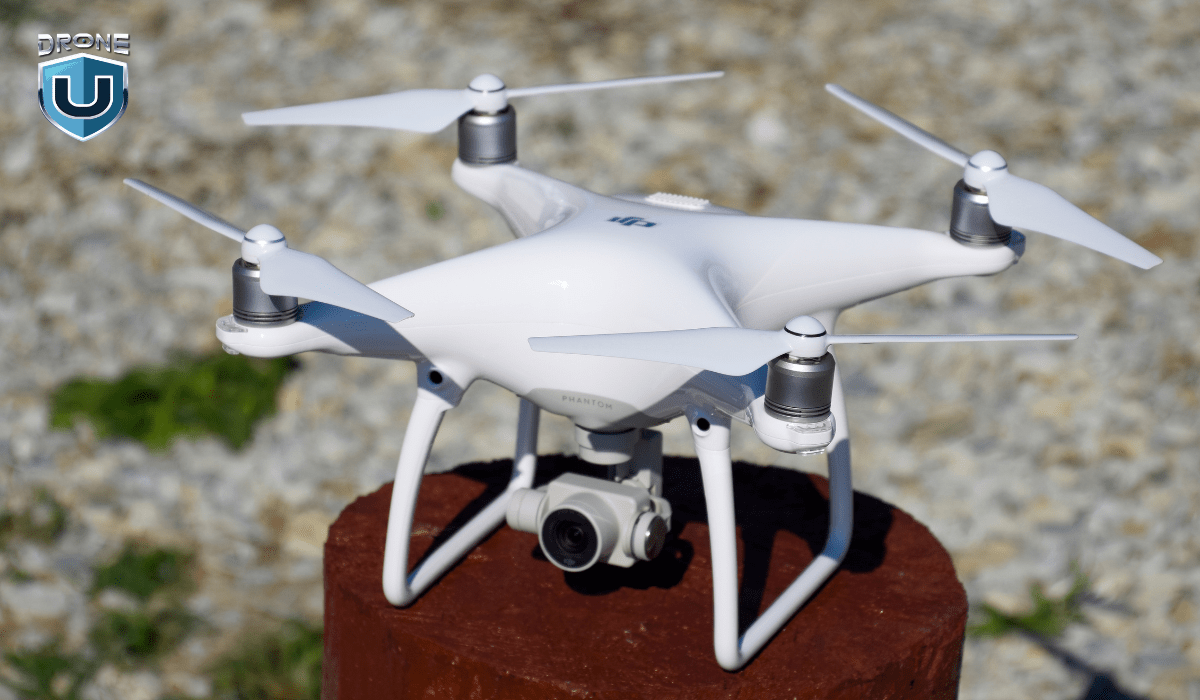
The DJI Phantom 4 RTK is designed for precision aerial mapping, equipped with a high-accuracy GNSS module. It supports RTK (Real-Time Kinematic) positioning capabilities, making it ideal for surveying, construction, and agriculture.
| Features | DJI Phantom 4 RTK |
| Takeoff Weight | 1391 g |
| Sensor | 1″ CMOS; 20 MP |
| Max Flight Time | Approx. 30 minutes |
| Mapping Accuracy | As per ASPRS Accuracy Standards for Digital Orthophotos Class III |
| Ground Sample Distance(GSD) | (H/36.5) cm/pixel |
| Operating Temperature Range | 32° to 104° F 0° to 40? |
| Photo Format | JPEG |
| Video Format | MOV |
2. DJI Mavic 2 Pro
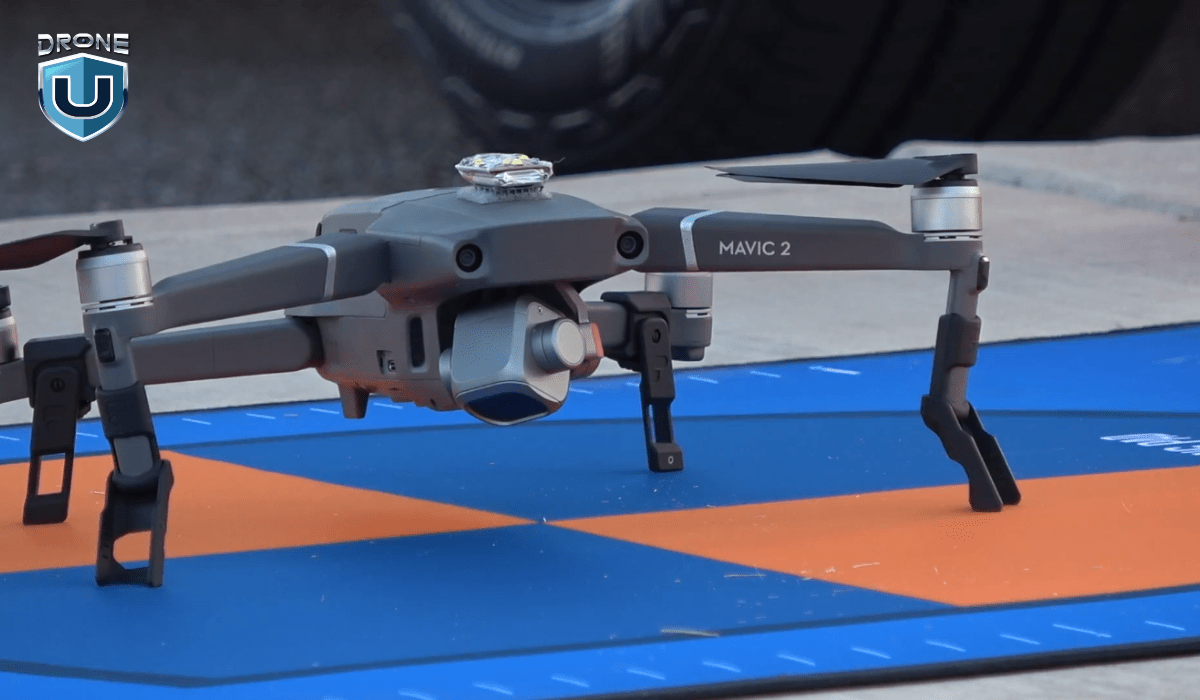
The DJI Mavic 2 Pro features a Hasselblad camera with a 1-inch CMOS sensor. It offers excellent image quality and powerful performance in a compact size. Thus, suitable for professional photography, videography, and aerial mapping.
| Features | DJI Mavic 2 Pro |
| Takeoff Weight | 907 g |
| Sensor | 1″ CMOS; 20 MP |
| Max Flight Time | 31 minutes (at a consistent 25 kph) |
| Operating Temperature Range | -10°C to 40°C |
| Photo Format | JPEG / DNG (RAW) |
| Video Format | MP4 / MOV (MPEG-4 AVC/H.264, HEVC/H.265) |
3. Autel Robotics EVO II Pro
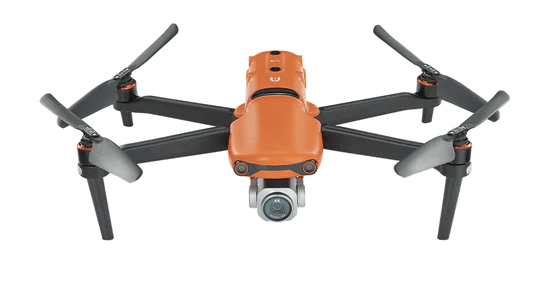
The Autel Robotics EVO II Pro is a popular drone model that offers impressive features such as 6K video capabilities, high-resolution imaging, and adjustable aperture. It’s designed to perform exceptionally well in various lighting conditions, allowing you to capture detailed aerial photographs and map areas with ease. Furthermore, the EVO II Pro is a great option for night photography, making it a versatile choice for any aerial photography enthusiast.
| Features | Autel Robotics EVO II Pro |
| Takeoff Weight | 1187 g |
| Sensor | 1″ CMOS; 20 MP |
| Max Flight Time | 40 minutes |
| Operating Temperature Range | -10°C to 40°C |
| Photo Format | JPEG / DNG (RAW) |
| Video Format | MP4 / MOV (MPEG-4 AVC/H.264, HEVC/H.265) |
Without appropriate drone modeling software, you cannot get the desired results. Let’s explore the top 3 of them.
Best Software for Drone Modeling
To effectively process data captured by drones into precise, detailed models, you need top-notch drone software solutions. Below are the top 3 suggestions:
1. Pix4Dmapper
 Credit: Pix4D
Pix4Dmapper is a leading photogrammetry software for drone mapping. It offers end-to-end solutions for creating professional-grade 3D models from drone-captured images. It’s designed for a wide range of applications, from surveying and construction to agriculture and public safety.
2. DroneDeploy
 Credit: DroneDeploy
DroneDeploy is a cloud-based software platform that simplifies drone mapping. It offers an all-in-one workflow. That enables users to plan flights, capture high-quality imagery, and analyze data across devices.
3. Bentley ContextCapture
 Credit: Bentley
Bentley ContextCapture is a powerful solution for creating high-resolution 3D models from digital photographs. It can be used to generate detailed models of urban environments, industrial plants, and historical sites.
Let us understand what the future holds for drone modeling.
Future of Drone Modeling
The future of drone 3D models promises significant growth and innovation across various industries. Let’s explore key developments expected to shape their future:
- AI and ML advancements will enhance the processing and analysis of drone-captured data, enabling more sophisticated 3D models to automatically identify features and classify objects, predicting changes over time.
- Advancements in sensor technology will enhance the resolution, accuracy, and detail of drone 3D models, facilitating more precise measurements and realistic representations of the physical world.
- Drone 3D models will play a crucial role in monitoring environmental changes, aiding in assessing the impact of climate change, and supporting conservation efforts.
- The future will witness the rise of more drones capable of autonomous operation, enabling data collection without human intervention. Coupled with real-time data processing, this will enable immediate insights and decision-making.
- Research and development in drone swarms will enable coordinated flights of multiple drones, allowing data capture from different angles and scales simultaneously. This will enhance the efficiency and comprehensiveness of 3D modeling efforts.
Conclusion
Drone modeling is a fantastic technology that helps us gather detailed information and create cool 3D models. Drones are like flying helpers that can make our jobs easier in farming, construction, and even protecting the environment. As drone technology advances, the possibilities for 3D modeling and mapping continue to expand, offering unprecedented insights across industries.
Frequently Asked Questions
Q1. Can drone modeling be affected by weather?
Yes, adverse weather conditions such as high winds, rain, or fog can affect drone flight. To ensure stability and image quality, check the weather conditions beforehand.
Q2. How long does it take to create a 3D model with drone images?
The time required can vary widely based on the size of the area being modeled – the number of images captured, and the processing power of your computer system. Simple projects might be completed in a few hours, while more complex models could take several days.
Q3. What types of data can drones capture for modeling purposes?
Drones can capture aerial imagery, LiDAR data, thermal imaging, and multispectral data for modeling purposes.
1
Which is the Best Drone to Learn FPV and Why?
The world of drone flying has seen rapid advancements, with FPV (First-Person View) drones becoming increasingly popular among enthusiasts.
FPV flying offers an immersive experience, allowing pilots to feel as though they’re sitting in the cockpit of the drone, racing through the skies.
However, for beginners, the transition from traditional drone flying to FPV can be daunting. The key to a successful and enjoyable learning experience lies in choosing the right drone.
The DJI Avata 2 emerges as the best option for anyone looking to start their FPV journey, offering a perfect blend of ease, control, and innovative features.
In this article, we’ll explore why the DJI Avata 2 is considered the best drone for learning FPV. We’ll also cover important considerations for aspiring FPV pilots, including safety, and necessary equipment.
Let me break it down for you and explain why this bird is the ultimate choice for FPV newbies.
What is FPV?
FPV, or First-Person View, is a type of drone flying where the pilot controls the drone from a perspective that feels like they are on board the drone itself. This is achieved through a camera mounted on the drone that transmits live video to a headset worn by the pilot.
FPV drone flying differs significantly from traditional drone piloting:
1. Immersive Experience: Pilots see real-time video feed from the drone’s perspective.
2. Manual Control: FPV typically requires more hands-on control than automated consumer drones.
3. Skill Intensive: Mastering FPV flying often involves a steeper learning curve.
4. Versatility: FPV is popular in racing, freestyle flying, and cinematography.
Learning to fly an FPV drone is a challenging task. Unlike traditional drones with automated features like altitude hold and GPS stability, FPV drones require manual control, making them less forgiving for novices.
So What’s the Choice?
The answer is DJI Avata 2.
DJI Avata 2 – Best Drone to Learn FPV
DJI Avata 2 gives you the same user experience as a regular consumer drone. It’s like the perfect bridge between your typical drone and the wild world of FPV.
If you’ve been flying those regular consumer drones, the ones where you let go of the sticks and they just hover in place like magic? Well, the DJI Avata 2 gives you that same user experience. It’s like the perfect bridge between your typical drone and the wild world of FPV.
One of the standout features of the DJI Avata 2 is its ability to offer a seamless transition from traditional drone flying to FPV. When you’re used to flying consumer drones, your remote has two sticks that center themselves when you let go. It’s all nice and predictable. But with FPV, you’re the one in control of that altitude, baby. And that’s where the Avata 2 shines.
This familiarity makes it much easier for beginners to start exploring FPV without feeling overwhelmed.
Key Features That Make the DJI Avata 2 Ideal for FPV Beginners
1. Stability and Ease of Use
The DJI Avata 2 is designed with stability in mind, offering a flight experience that is similar to what most traditional drone users are accustomed to. When you release the control sticks, the drone will stop in place and hold its altitude, a feature that is incredibly useful for beginners. This stability allows new pilots to focus on learning the basics of FPV flying without worrying about losing control of the drone.
2. Manual/Acro Mode
One of the most exciting features of the DJI Avata 2 is its manual mode, also known as Acro mode. This mode allows you to take full control of the drone’s movements, including its altitude. For beginners, this might sound intimidating, but the DJI Avata 2 makes it easier by allowing you to switch between different flight modes. You can start with the more forgiving normal or sports modes and gradually transition into manual mode as your skills improve. This flexibility is crucial for learning FPV flying at your own pace.
3. Customizable Remote
The remote control of the DJI Avata 2 is another feature that sets it apart from other drones. The back panel of the remote can be removed, allowing you to adjust the spring tension in the control sticks. This customization is particularly useful when flying in manual mode, as it allows you to keep the altitude at a more precise position. With the right adjustments, you can fine-tune the remote to suit your flying style, making the learning process more intuitive and less frustrating.
4. Battery Life and Consistency
Battery life is a critical factor for any drone, and the DJI Avata 2 does not disappoint. The standard manufacturer-based batteries provide a consistent flight time, typically around 18 to 20 minutes. This consistency is vital for beginners who are still learning to manage their flight time and battery usage.
Why the DJI Avata 2 Stands Out
So, why is the DJI Avata 2 the absolute best drone to learn FPV? Let’s summarize:
- Smooth Transition: It bridges the gap between traditional drones and FPV flying seamlessly.
- Versatile Flight Modes: From beginner-friendly to pro-level manual control, all in one package.
- Customizable Remote: The modifiable stick tensions give you precise control when you need it most.
- Consistent Performance: Standard batteries mean predictable flight times and performance, crucial for learning.
- Growth Potential: It’s a drone that grows with you, from beginner to expert.
- Therapeutic Experience: There’s a joy to flying this drone that goes beyond just piloting.
- Cinematic Capabilities: Once mastered, it can capture professional-grade footage.
Potential Drawbacks of the DJI Avata 2
While the DJI Avata 2 excels in many areas, it’s important to consider some potential drawbacks:
- Cost: It’s more expensive than many entry-level FPV drones, which might be a barrier for some beginners.
- Size and Weight: Heavier than typical FPV drones, it may feel less agile for experienced pilots.
- Repairability: DJI products can be more challenging to repair yourself compared to some open-source alternatives.
- Ecosystem Lock-in: You’re largely confined to DJI’s ecosystem of products and software.
Safety Considerations for New FPV Pilots
Safety should be a top priority for all drone pilots, especially those new to FPV flying:
1. Know the laws: Familiarize yourself with local drone regulations and obtain the necessary certifications.
2. Start slow: Practice in open areas away from people, animals, and obstacles.
3. Use a simulator: FPV simulators can help you gain skills without risking your drone.
4. Wear proper equipment: Always use FPV goggles designed for drone use.
5. Maintain line of sight: Have a spotter to keep an eye on your drone when you’re wearing FPV goggles.
6. Check your equipment: Always inspect your drone and controllers before flying.
7. Be aware of your surroundings: Watch for changes in weather, other aircraft, and potential hazards.
Additional Equipment Needed
To get started with the DJI Avata 2, you’ll need more than just the drone:
1. FPV Goggles: DJI Goggles 2 or DJI FPV Goggles V2 are compatible options.
2. Controller: DJI FPV Remote Controller 2 or DJI Motion Controller.
3. Extra batteries: For extended flying sessions.
4. Propeller guards: Recommended for beginners to protect the drone during crashes.
5. Micro SD card: For recording high-quality footage.
6. Carrying case: To safely transport your drone and accessories.
7. Simulator software: For risk-free practice (optional but recommended).
Final Thoughts
The DJI Avata 2 stands out as an excellent choice for those looking to enter the world of FPV drone flying.
Its blend of user-friendly features, stability, and advanced capabilities make it a versatile option that can grow with you as your skills improve. However, it’s important to consider your budget, goals, and the commitment required to master FPV flying.
If you’re serious about getting into FPV flying, the DJI Avata 2 is hands down the best place to start. It’s got everything you need to learn, grow, and eventually master the art of FPV drone piloting.
Whether you choose the Avata 2 or another beginner-friendly FPV drone, remember that patience, practice, and safety are key to your success.
With time and dedication, you’ll be experiencing the thrill of FPV flight and capturing breathtaking aerial footage.
The sky’s the limit in your FPV journey!
1
Drone Buying Guide: Choose the Best Drone for Your Needs
The world of consumer drones has experienced a remarkable surge in popularity since the release of the Parrot AR and DJI Phantom drones in 2010 and 2013, respectively.
These unmanned aerial vehicles (UAVs) are now within reach of anyone eager to use them for various purposes, whether recreational or professional.
While the excitement of flying a drone is undeniable, choosing the right one can be overwhelming.
In this comprehensive guide, we will cover everything you need to know, from different types of drones and key components to essential buying considerations and top drone accessories.
What is a Drone?
A drone, also known as an unmanned aerial vehicle (UAV), is an aircraft that operates without a human pilot on board.
Instead, a drone pilot or operator controls it remotely. Drones rely on various components to navigate and stabilize during flight, which we’ll talk about later in this article.
Initially developed for military use, drones have expanded to civilian applications and are now used for a wide range of tasks, including mapping, surveying, filming, and photography.
Today, drones are used for a wide range of tasks, including mapping, surveying, filming, and photography.
Let’s dive into the different types of drones.
Types of Drones
You can find a variety of drones in the market today. Here are the common ones:
- Consumer Drones: Perfect for recreational photographers and videographers, these drones are typically more affordable, accessible, portable, and easy to operate.
- Professional Drones: Primarily designed for commercial applications like delivery services, surveying, construction monitoring, and inspections. They offer advanced features such as high-resolution cameras, longer flight times, and higher security capabilities, but come with a higher price tag.
- Racing Drones: Built for speed, agility, and high maneuverability, these lightweight and stripped-down drones are often used in competitive drone racing, reaching speeds of up to 60 mph.
But what exactly makes up a drone? Understanding the crucial components that make up a drone can help you make an informed buying decision.
Key Components of a Drone
Here are some crucial components of drones:
- Propellers: Blades that spin rapidly to create an airflow that lifts the drone off the ground.
- Motors: Provide the thrust needed to propel the drone into the sky.
- Flight controller: Receives commands from the pilot through the transmitter and interprets signals from various sensors to control the drone.
- Electronic Speed Controllers (ESCs): Connect the drone’s motors, battery, and flight controllers to control its speed and direction.
- Camera: Used for aerial photography and videography.
- Gimbal: Keeps the camera stable even during rapid movements to ensure smooth video footage and sharp images.
- GPS module: Picks up signals from satellites to determine the drone’s exact geographical location.
- Battery: Provides the necessary power for the drone’s flight.
- Sensors: Help the drone better understand and interact with its surroundings, such as accelerometers, gyroscopes, and magnetometers.
- Landing gear: Supports and protects the drone during takeoff and landing.
What to Consider While Buying a Drone?
If you’re buying a drone for the first time, here’s a checklist of essential features to consider.
This will help you choose a drone that perfectly suits your needs.
1. Camera Quality
Interested in casual aerial photography or videography? Then, checking for the drone camera quality is a crucial factor to consider.
Before choosing a drone, evaluate its camera specifications to confirm if it will give you the picture quality you desire. Here’s what you can look for:
- Sensor Size: A larger sensor captures more light, resulting in better image quality, especially in low-light conditions.
- Resolution: Higher resolution (measured in megapixels) means more detailed images.
- Aperture: A wider aperture (lower f-number) allows more light to enter the camera, improving image quality in low light.
2. Flight time and battery life
We’re sure you’d like to fly to your heart’s content without any interruptions. However, that largely depends on the quality of your drone battery life.
Most consumer drones can fly from about 20 to 30 minutes on a single charge, while more advanced models offer a drone flight time of 40 minutes or more.
So, before buying any drone, check out its battery specifications (e.g. capacity and charging time) to make sure it aligns with your expectations.
3. Obstacle avoidance and safety features
The best drone for beginners should, ideally, have an obstacle avoidance system. Drones with obstacle avoidance use sensors to detect and avoid obstacles. This in turn reduces the risk of crashes.
For example, the DJI Mini 4 Pro offers omnidirectional obstacle sensing to ensure that everyone (especially first-time drone users) flies with confidence–even in challenging environments!
Other important safety features you can look out for in a drone include:
- Return-to-Home (RTH): Automatically redirects the drone to its takeoff point if the battery is low or the controller signal is lost.
- Geo-fencing: Creates virtual boundaries to prevent drones from flying into restricted areas, such as airports.
- Beginner mode: Limits the distance, speed, and altitude a drone can fly. Found mostly in DJI drones.
(Pro Tip: While you should go for a drone that has robust safety features, you also need to adhere to general drone safety guidelines. The FAA provides helpful resources detailing safety rules and regulations for drone pilots.)
4. Range and connectivity
The drone’s range determines how far it can travel from its controller before losing the connection.
Long-range drones can–as their name suggests–cover longer distances without the risk of getting lost or crashing.
A test showed that the DJI Mini 3 has a range of over 5,000 meters/about 3 miles.
(Pro Tip: Note that the advertised range of a drone may not reflect its true performance due to interference from radio waves and other environmental factors. To ensure optimal performance, you can buy a drone with a greater range than you anticipate needing.)
Drones for Different Purposes
A lot of people use drones for video recording, photography, mapping, and more.
If you want to get the most out of your flying experience, it’s important to select a model with features tailored to your preferred use case.
Here’s a rundown of the best drones for distinct purposes:
1. Best Drones for Beginners
There’s no shortage of beginner drones in the market; however, some of the best ones you can try out include:
| Drone Model | Camera | Flight Time | Range | Price (Amazon) | Special Features |
| Autel Evo Nano+ | 4K | 28 min | 6.2 miles | $899 | Obstacle avoidance, foldable, gimbal stabilization |
| DJI Mini 3 | 4K | 38/51 min | 6.2 miles | $419 | Ultra-lightweight, QuickShots, Panorama |
| Potensic Atom | 4K | 96 min | 3.7 miles | $379.99 | Brushless gimbal, dual batteries, intelligent flight modes |
| Holy Stone HS900 | 4K | 30 min | 3.7 miles | $459.99 | Brushless gimbal, Follow Me, TapFly |
2. Best Drones for Aerial Photography and Videography
If capturing stunning aerial footage is your passion, you’ll want a drone with a top-notch camera and advanced stabilization features. Check out these high-flyers:
| Drone Model | Camera | Video Resolution | Flight Time | Range | Price | Special Features |
| DJI Mavic 3 Pro | 4/3 CMOS Hasselblad, Dual tele cameras | 5.1K | 43 min | 9.3 miles | $2,612.84 (Amazon) | Tri-camera system, Omnidirectional obstacle sensing, ActiveTrack 5.0 |
| Autel EVO Lite+ | 1-inch CMOS 20MP | 6K | 40 min | 7.4 miles | $1,149 (Autel) | Adjustable aperture, HDR video, SkyLink transmission |
| Autel EVO Nano+ | 1/1.28-inch CMOS 50MP | 4K | 28 min | 6.2 miles | $899 (Amazon) | RYYB color filter array, SkyLink, Moonlight Algorithm |
| DJI Air 3 | 1/1.3-inch CMOS wide-angle + 3x tele | 4K, 1080p slow-motion | 46 min | 12.4 miles | $1,099 (Amazon) | Dual-camera, MasterShots, HyperLight, QuickShots |
With these drones by your side, you’ll be able to capture life’s most precious moments in breathtaking detail, from stunning landscapes to intimate family.
3. Best Racing Drones
If you live for the thrill of speed and competition, a racing drone might be just what you need. These agile machines are built for heart-pumping excitement:
| Drone Model | Camera | Video Resolution | Flight Time | Range | Price (Amazon) | Special Features |
| DJI Avata 2 | 1/1.3-inch CMOS | 4K HDR | 23 min | 8 miles | $1,199 | Acrobatics mode, Emergency Brake, and Hover |
| BetaFPV Cetus X | C04 FPV, Adjustable | 1080p | 5 min | N/A | $142.99 | 360° protection, ultra-lightweight |
| DJI FPV | 1/2.3″ CMOS | 4K, 1080p slow-motion | 20 min | N/A | $698 | Super-wide FOV, RockSteady EIS, Emergency Brake, and Hover |
Whether you’re a seasoned racer or just looking for a heart-pounding joyride, these drones will satisfy your need for speed.
4. Best Drones Under $500
You don’t have to break the bank to experience the joys of flying. These affordable drones offer an impressive array of features at a fraction of the cost:
| Drone Model | Camera | Flight Time | Price (Amazon) | Special Features |
| DJI Mini 2 SE | 2.7K | 31 min | $259 | Lightweight, QuickShots, Panorama |
| Holy Stone HS270 | 2.7K | 18 min | $198.99 | GPS, Follow Me, Tap Fly |
| RyzeTech Tello | 720p | 13 min | $206.33 | Programmable, Throw & Go, 8D flips |
With these budget-friendly options, you can take to the skies without putting a dent in your wallet.
5. High-End Professional Drones (Over $1000)
For those who demand the very best, these high-end drones offer unparalleled performance and features:
| Drone Model | Camera | Video Resolution | Flight Time | Obstacle Avoidance | Price (Amazon) | Special Features |
| DJI Phantom 4 Pro Plus V2.0 | 1-inch 20MP | 4K | 30 min | 5-direction | $2,197 | Intelligent Flight Modes, 5.5-inch screen, OcuSync 2.0 |
| DJI Mavic 3 Pro | 4/3 CMOS Hasselblad | 5.1K | 46 min | Omnidirectional | $3,599.79 | Long-range control, ActiveTrack 5.0, MasterShots |
| Autel Robotics EVO 2 Pro V3 | 1-inch Sony CMOS | 6K | 40 min | 360-degree | $2,099 | HDR video, Dynamic Track 2.1, Live Deck |
If you’re a professional who relies on drones for your work, these top-of-the-line models are sure to exceed your expectations.
Must-Have Drone Accessories
One of the best drone buying tips? Don’t overlook buying certain essential drone accessories, as they can help you enhance your drone operations.
Here are some accessories that are worth investing in:
- Spare batteries: Extra rechargeable batteries can help you extend flight sessions–they can be easily swapped in when the current battery runs out. However, you should ensure that these spare batteries are compatible with your drone.
- Propeller guards: These protect the drone’s propellers from damage during minor collisions. They can also help prevent harm to people, pets, or objects nearby.
- Carrying cases: A carrying case allows you to organize your drone and accessories and protect them from physical damage or dust during transport.
- Extra memory cards: These ensure that you don’t run out of storage space while shooting. It’s advisable to have multiple micro SD cards on hand during a session (preferably with large storage capacities like 32 GB or 64 GB.)
Conclusion
And, that’s a wrap! Hopefully, this beginner drone guide has shown you how to choose a drone that matches your needs and budget to a T.
Remember–before making a drone purchase, ensure that you conduct adequate research, compare models, budget for essential accessories, and get acquainted with legal regulations on drone use in your area.
With this knowledge in your arsenal, you’ll be sure to buy a drone that ticks all your boxes.
FAQs
1. How do I know what drone to buy?
The best way to know which drone to buy is by carefully evaluating your needs.
Ask yourself what features you prioritize and look out for them when comparing different models.
2. What drone should I get as a beginner?
Drones like the RyzeTech Tello, DJI Mini 3, and Holy Stone HS900 are ideal for beginners thanks to their user-friendly nature and affordability.
3. What is the 1:1 rule for drones?
It’s important to ensure the safety of others when flying your drones, and one major way to do so is by complying with the 1:1 rule.
According to this rule, for every meter your drone is flying above the ground, it must maintain at least an equivalent horizontal distance from any uninvolved person.
For example, if your drone is flying at a height of 30 meters, it should be at least 30 meters away from any uninvolved person (someone who’s not part of the flight operation.)
So, in case your drone were to malfunction and drop out of the air, it wouldn’t harm or injure anyone.
4. What is considered a good drone?
Typically, a good drone:
- is easy to operate
- has a stable camera with high-resolution
- offers sufficient flight time and range
- provides robust safety and GPS capabilities.
2

-
 Brinc Admits, We Caused the DJI Drone Ban! EXCLUSIVE
-
 Brinc Admits they're behind DJI Ban | Auterion Creates Drone Swarm Brain
-
 Trump Card on the DJI Ban, May be Best drone news of 2025. Will he tiktok DJI?
-
 This Drone Trick Makes Real Estate Videos Awesome!
-
 Exploring Drone Security: Opportunities and Challenges
More on Hot Topics